The Strategic Shift to AI-Native Advertising and the Maturity Framework for Modern Digital Marketing

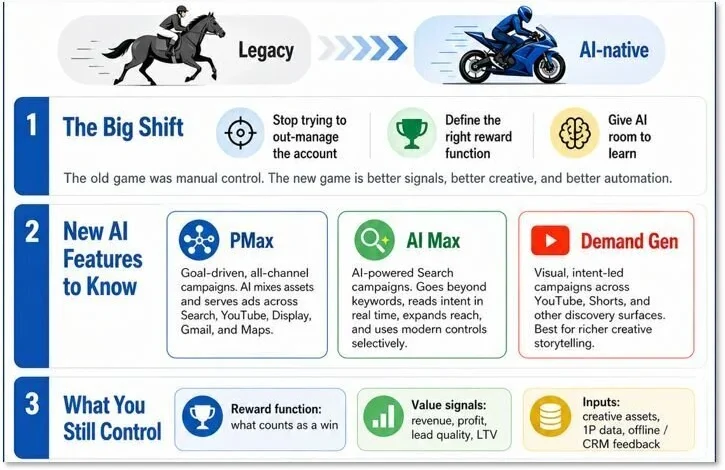
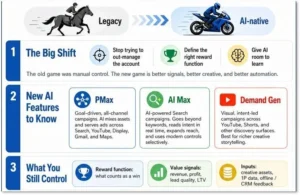
The global digital advertising landscape is currently undergoing a fundamental transformation as legacy manual management techniques are replaced by artificial intelligence and automated machine learning protocols. This transition, often described as the "AIfication" of marketing platforms, is most visible within the Google Ads ecosystem, where the traditional "AdWords" era of manual keyword bidding and granular control is being phased out in favor of intent-based, AI-driven campaign structures. Industry experts and veteran strategists argue that the choice to remain within legacy frameworks is no longer viable for enterprises seeking to maintain competitive profit margins and scalable growth. As Google continues to integrate sophisticated neural networks into its core advertising products, the focus of the modern marketer is shifting from tactical "monkeying" with settings to the strategic architectural design of "reward functions" and data signals.
The Evolution of the Google Ads Ecosystem
The trajectory of search engine marketing has moved through several distinct eras, beginning with the launch of Google AdWords in 2000, which relied heavily on exact-match keywords and manual bid adjustments. For nearly two decades, the primary value proposition of digital agencies was their ability to micromanage account variables such as geographic bid modifiers, time-of-day scheduling, and complex negative keyword lists. However, the rebranding of the platform to Google Ads in 2018 signaled a pivot toward automation that has accelerated significantly in the early 2020s.
The introduction of Performance Max (PMax) in 2021 marked a definitive turning point. PMax serves as an "all-in-one" campaign type that utilizes AI to distribute assets across Search, YouTube, Display, Gmail, and Maps based on a single set of goals and budgets. This was followed by the emergence of "AI Max" concepts—AI-powered search campaigns that disregard traditional silos like brand versus non-brand and match types in favor of real-time intent assessment. More recently, Demand Gen campaigns have replaced the former Discovery Ads, utilizing visual assets and AI to capture consumer interest across Google’s most immersive surfaces.
The Maturity Assessment Framework
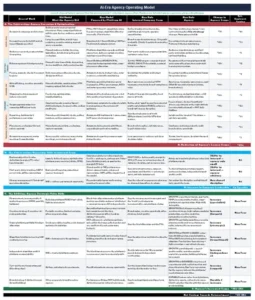
To navigate this shift, a sophisticated maturity model has been developed to help organizations assess their current standing in the transition from legacy "horse-and-buggy" tactics to modern "motorcycle" efficiency. This model evaluates an organization across two primary dimensions: Capability and Depth.
The Scoring Dimension: Capability versus Depth
Capability measures the sophistication of an organization’s technical implementation, ranging from a "Legacy" score of 0 to an "AI-native" score of 4. A legacy organization relies on manual CPC (Cost Per Click) and manual bid modifiers, while an AI-native organization utilizes automated intent-matching and modern matching logic.
Depth, however, is the metric used to prevent organizational self-deception. It measures how widespread the sophisticated capabilities are across the total advertising spend. A company might run a small, successful AI pilot (Capability 4) but only apply it to 5% of their budget (Depth 1). For an organization to be considered truly mature, the "Execution Default" must apply to 75% to 100% of their total campaign volume.
The final Maturity Score is calculated through a weighted formula:
Dimension Score = Weight x (Capability/4) x (Depth/4)
The cumulative goal for a high-performing enterprise is a score of 85 or higher out of 100.
Dimension 1: Measurement and Value Architecture
The most critical component of the AI-native transition, weighted at 30 points, is the Measurement and Value Architecture. In an automated environment, the AI optimizes toward the "reward function"—the specific data signals it is told to value. If an organization feeds the system low-value signals, such as pageviews or basic leads, the AI will efficiently deliver low-value results.
Modern measurement requires a shift toward Value-Based Bidding (VBB). This involves moving beyond binary conversion tracking (did a sale happen?) to sophisticated value modeling (what is the predicted Long-Term Value of this customer?). Key technical requirements include:
- Enhanced Conversions: Utilizing first-party data to improve the accuracy of conversion tracking in a privacy-centric world.
- Offline Conversion Imports: Feeding CRM data back into Google Ads to ensure the AI optimizes for "closed-won" deals rather than just "leads."
- Profit-Based Bidding: Integrating margin data so the system prioritizes high-profit transactions over high-revenue, low-margin sales.
Industry data suggests that companies transitioning from volume-based bidding to value-based bidding see an average increase of 14% in conversion value. Failure to establish a robust value architecture means that all subsequent AI automation is built on a "foundation of sand."
Dimension 2: The Search Operating Model
The second dimension, weighted at 20 points, focuses on the Search Operating Model. This represents a departure from the "Single Keyword Ad Group" (SKAG) era. In the modern model, the system is given broad match keywords and Responsive Search Ads (RSA) to allow for maximum flexibility in matching user intent.
The "AI Max" approach assesses intent in real-time, looking beyond the literal characters typed into a search bar to understand the underlying consumer need. For example, if a user searches for "best way to move cross-country," a legacy system might look for the keyword "move." An AI-native system understands the intent involves logistics, insurance, and vehicle rental, expanding the audience to relevant queries that a human marketer might never have manually researched.
Critics of this model often point to a loss of control. However, Google has responded with "Brand Controls" and "Location-of-Interest" settings, allowing marketers to set governance boundaries while letting the AI handle the auction-by-auction execution.
Strategic Implications and Industry Reactions
The shift toward AI-native advertising has prompted varied reactions from the global marketing community. Many traditional agencies, whose business models were predicated on billable hours for manual account "sculpting," have faced significant pressure to reinvent themselves. The new value proposition for agencies lies in "Creative Excellence" and "Data Engineering."
Sundar Pichai, CEO of Alphabet, has frequently emphasized that AI is the most profound technology Google is working on, noting in recent earnings calls that AI-driven ad formats are delivering higher Return on Ad Spend (ROAS) for small and large businesses alike. Independent studies by major consultancies have corroborated this, showing that while AI may "lose" on three or four auctions by overbidding, it "wins" on thirty or forty more by identifying opportunities that manual bidding would have missed.
The "Human-in-the-Loop" role has not disappeared but has evolved. Marketers are now responsible for:
- Strategic Governance: Setting the guardrails and business objectives.
- Asset Production: Providing high-quality video, image, and text assets that the AI can remix.
- First-Party Data Strategy: Ensuring the organization has a clean stream of customer data to feed the machine.
Broader Impact on Profitability and Career Longevity
The economic impact of this transition is substantial. By automating "soul-sucking" manual tasks—such as adjusting bids for mobile devices in specific zip codes—marketers can focus on high-level business strategy. Organizations that have reached a maturity score above 70 report not only higher revenue but also higher employee satisfaction, as the work shifts from rote data entry to creative problem-solving.
Conversely, "Legacy AdWords Operators" (those scoring between 0 and 29) are increasingly seeing their "profit pulverized." The manual approach is incapable of processing the millions of signals Google’s AI analyzes in the milliseconds before an ad auction. These signals include user location, time of day, previous search history, app usage, and even weather patterns—variables that are impossible for a human to manage across thousands of keywords.
Conclusion: The Path Forward
The "AIfication" of Google Ads is a reflection of a broader trend across the entire technology sector: the move from tools that humans use to systems that humans manage. The maturity model provided serves as a pragmatic roadmap for this transition. To avoid "self-deception," organizations are encouraged to audit the top 80% of their spend and prioritize "Depth" of implementation before claiming "Capability."
The transition from a "control-first" mindset to a "trust-and-verify" mindset is culturally difficult but mathematically necessary. As the platform continues to evolve, the ultimate winners will be those who stop trying to out-manage the machine and instead start feeding the machine better truth, better assets, and more accurate value signals. The era of the manual "AdWords" specialist is closing; the era of the AI-Native Strategic Marketer has arrived.