The landscape of digital marketing is undergoing a fundamental transformation as artificial intelligence shifts from a passive tool for automation to an "agentic" collaborator capable of reasoning, planning, and executing complex tasks. In a recent strategic briefing, Google engineering and product leaders detailed the evolution of their internal AI systems, specifically focusing on the integration of Ads Advisor and Analytics Advisor into the broader marketing ecosystem. This shift represents a move away from traditional dashboard-centric reporting toward a conversational, insight-driven model that empowers marketers to bridge the gap between raw data and decisive action. According to Omer Shakil, Software Engineering Manager for Google Analytics, and Ashutosh Kumar Mishra, Product Manager for Google Ads, the goal is to provide a seamless experience where the AI functions as a high-level consultant rather than a simple search interface.
The rise of agentic AI within Google’s marketing suite comes at a time when the industry is grappling with increasing data complexity and the deprecation of traditional tracking mechanisms. As businesses transition to more privacy-centric measurement frameworks, the volume of data available remains high, but the ability to derive actionable insights manually has become more difficult. To address this, Google has deployed these "agentic advisors" to act as a bridge, utilizing large language models (LLMs) to interpret user intent and navigate the vast repositories of the Google Ads and Google Analytics 4 (GA4) platforms.
The Evolution of Marketing Automation: A Chronological Context
To understand the significance of these new advisors, it is necessary to examine the trajectory of Google’s AI integration over the past decade. The journey began with basic automated bidding strategies in the early 2010s, which used machine learning to predict conversion likelihood at the auction level. By 2018, Google had introduced "Smart Campaigns," designed to simplify the advertising process for small businesses by automating ad creation and targeting.
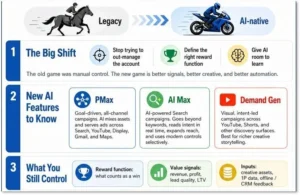
The real pivot occurred in 2023 with the introduction of generative AI into the Google Ads interface. This allowed for the automated generation of assets, such as headlines and descriptions, based on a website’s landing page. However, these earlier iterations were largely transactional—the user provided an input, and the AI provided a single output. The "agentic" phase, which began rolling out in late 2024 and early 2025, introduces a multi-turn conversational capability. Unlike previous tools, Ads Advisor and Analytics Advisor can now recall previous interactions, refine their recommendations based on feedback, and proactively surface anomalies that the user did not explicitly ask for. This evolution marks the transition from "AI as a tool" to "AI as a partner."
Strategic Collaboration: Five Best Practices for Modern Marketers
Google’s leadership has identified five core pillars for maximizing the effectiveness of these AI collaborators. These practices are designed to help marketers move beyond basic queries and unlock the full potential of agentic reasoning.
First, the advisors are built to respond to natural language. The engineering team emphasizes that users no longer need to be proficient in SQL or specialized marketing jargon to extract deep insights. By asking questions as if speaking to a human colleague, users allow the AI to interpret the nuances of business objectives. For instance, instead of navigating through multiple sub-menus to find user acquisition data, a marketer can simply ask, "How did our user growth last month compare to the same period last year?" The AI then performs the data retrieval and comparison automatically.
Second, the system supports iterative refinement. A hallmark of agentic behavior is the ability to handle follow-up questions. If a user receives a summary of performance data, they can immediately ask the advisor to "run an analysis on the causes" or "summarize this for a leadership presentation." This capability to dig deeper into the "why" behind the "what" is a significant leap forward in productivity. The AI’s ability to recall earlier parts of the conversation ensures that the recommendations become more sophisticated and tailored to the specific business context over time.
Third, Analytics Advisor serves as a proactive data analyst. One of the most significant challenges for modern marketers is "analysis paralysis"—having so much data that they don’t know where to look for value. The advisor is designed to identify hidden trends. If a user asks for a simple metric, such as "new users last week," the AI might respond with the data but then proactively flag an atypical spike in traffic from a specific organic search channel. This "proactive discovery" allows marketers to investigate opportunities or threats they might have otherwise missed.
Fourth, the tools are designed to minimize technical downtime. In the past, if a campaign stopped running or an ad was disapproved, a marketer might spend hours auditing policy logs or technical settings. Ads Advisor can now rapidly diagnose these issues. By asking, "Why is my ad disapproved?" or "Why has my spend dropped to zero?", the advisor can cross-reference policy violations with market shifts to provide an immediate technical fix or strategic explanation. This integration of performance data with technical troubleshooting is essential for maintaining campaign momentum.
Fifth, the AI acts as a creative catalyst. While AI cannot replace human brand intuition, it can significantly accelerate the creative process. Marketers can prompt the advisor to generate keyword ideas, headlines, or ad descriptions tailored to specific campaign goals. This serves as a "starting point" for human experts to refine, effectively eliminating the "blank page" problem that often slows down creative departments.
Supporting Data and Technical Architecture
The efficacy of these agentic advisors is rooted in their underlying technical architecture, which combines Google’s Gemini models with Retrieval-Augmented Generation (RAG) techniques. By grounding the AI’s responses in the user’s actual account data and Google’s official documentation, the system minimizes "hallucinations"—the tendency for AI to generate false information.
Internal data from Google suggests that businesses using AI-driven tools in their marketing workflows see a significant reduction in the time spent on manual reporting. Furthermore, by automating the "analysis" phase of the marketing cycle, practitioners can reallocate their time toward high-level strategy and creative development. The "thumbs up" and "thumbs down" feedback loop integrated into the interface provides a continuous stream of reinforcement learning data, allowing the models to adapt to the specific preferences and stylistic requirements of individual users.
Official Responses and Human-Centric Oversight
Despite the advanced capabilities of these advisors, Google’s product teams are clear on one point: human expertise remains the final authority. Ashutosh Kumar Mishra noted that while AI is a powerful collaborator, the judgment of a seasoned marketer is indispensable. The advisors are designed to provide recommendations and data, but the final decision to implement a major change—such as a significant budget shift or a new brand direction—rests with the human user.
This "human-in-the-loop" philosophy is a core component of Google’s responsible AI principles. By providing transparency into how the AI reached a conclusion—often by citing specific data points or policy documents—the system builds trust with the user. The engineering team encourages marketers to review every suggestion and apply their unique business context before execution.
Broader Implications for the Marketing Industry
The introduction of agentic advisors has profound implications for the structure of marketing teams and agencies. As the technical barriers to data analysis and campaign management are lowered, the role of the "technical specialist" may evolve into that of an "AI orchestrator."
For small and medium-sized businesses (SMBs), these tools democratize access to high-level data science. A small business owner who cannot afford a full-time data analyst can now use Analytics Advisor to perform complex funnel analyses, such as identifying where users drop off in the checkout process. For larger enterprises, these tools offer a way to scale operations without a proportional increase in headcount, allowing global teams to maintain consistency and efficiency across thousands of campaigns.
Furthermore, the shift toward agentic AI is likely to influence the competitive landscape of the ad-tech industry. As Google, Microsoft, and Meta all race to integrate similar conversational assistants, the primary differentiator will likely be the depth of the integration and the quality of the underlying data. Google’s advantage lies in its vast ecosystem, where Ads and Analytics data can be synthesized to provide a holistic view of the customer journey.
Analysis of Future Trends
Looking ahead, the "agentic" nature of these advisors is expected to expand. Future updates may allow the AI to take even more autonomous actions, such as automatically pausing underperforming keywords based on a set of pre-defined rules or creating entire cross-platform campaign strategies from a single creative brief.
However, this increased autonomy will require even more robust governance and security frameworks. Google has reiterated its commitment to data privacy, ensuring that the data used to train and ground these advisors remains within the secure confines of the user’s account. As the technology matures, the success of agentic AI in marketing will depend on the balance between automation and human intuition, ensuring that the tools serve to amplify human creativity rather than replace it.
In conclusion, Ads Advisor and Analytics Advisor represent a significant milestone in the journey toward autonomous marketing. By following best practices—engaging in natural language, utilizing iterative questioning, and maintaining human oversight—marketers can transform these tools from simple interfaces into powerful strategic partners. The era of the agentic advisor is not just about doing things faster; it is about uncovering deeper truths within data to drive superior business performance.