The Evolution of Digital Advertising: Navigating the Shift to AI-First Strategies in Google Ads

The landscape of digital marketing is currently undergoing a structural transformation as Google transitions its advertising ecosystem from a manual, keyword-centric model to a fully automated, artificial intelligence-driven platform. This shift represents a fundamental departure from the traditional "AdWords" era, where practitioners manually adjusted match types, bids, and geographic settings, toward a "Google Ads" era defined by machine learning and high-level strategic inputs. Industry veterans and data scientists argue that the era of "micromanaging" search accounts is effectively over, replaced by a paradigm where success is dictated by the quality of data fed into the system rather than the frequency of manual adjustments.
The Historical Context of Search Automation
To understand the current state of Google Ads, it is necessary to examine the trajectory of search engine marketing (SEM) over the last two decades. Launched in 2000, Google AdWords originally functioned as a transparent auction system where advertisers bid on specific keywords to appear in search results. For nearly fifteen years, the primary value proposition of digital agencies was "account hygiene"—the meticulous organization of Single Keyword Ad Groups (SKAGs), manual bid modifiers for devices and hours of the day, and the aggressive pruning of negative keywords.
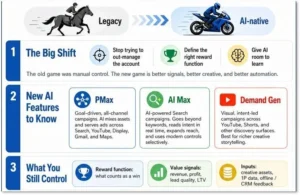
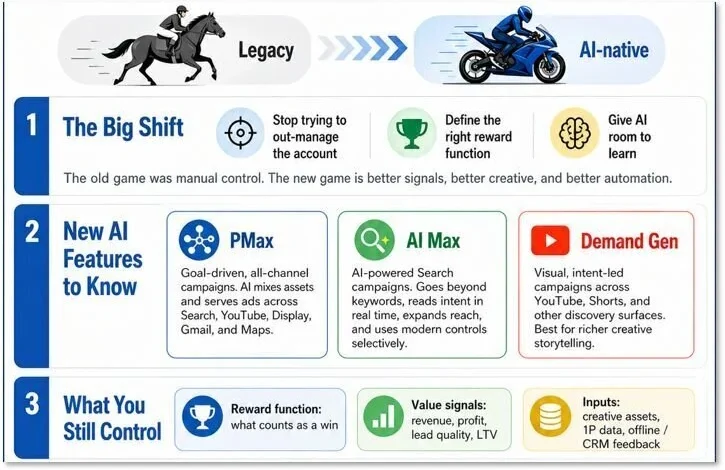
The pivot toward artificial intelligence began in earnest around 2016, following Google’s "AI-first" company-wide mandate. This led to the introduction of "Smart Bidding," which utilized auction-time signals to predict conversion likelihood. By 2021, the launch of Performance Max (PMax) signaled a point of no return. PMax integrated all of Google’s inventory—Search, YouTube, Display, Gmail, and Maps—into a single, AI-managed campaign type. Today, the platform is increasingly "AIfying" its core functions, making it difficult for advertisers to maintain legacy manual controls. The transition is often compared to moving from horse-drawn transportation to fuel-efficient, long-range motor vehicles; while the former offers a sense of traditional control, the latter provides the scale and efficiency required for modern commercial survival.
The Mechanics of Modern AI Campaigns: PMax, AI Max, and Demand Gen
The current Google Ads ecosystem is built upon three primary AI-driven pillars, each designed to remove the burden of manual optimization from the advertiser while maximizing reach through intent-based signals.
-
Performance Max (PMax): This is Google’s comprehensive automation solution. Advertisers provide the system with business goals, a budget, and a library of creative assets (text, imagery, and video). The AI then dynamically mixes and matches these components to deliver ads across the entire Google network. The system optimizes for the "reward function"—the specific outcome defined by the advertiser, such as lead generation or high-value sales.
-
AI Max (Advanced Search): This represents the evolution of search-only campaigns. In this model, traditional concepts like brand vs. non-brand segmentation and specific keyword match types are deprioritized. Instead, AI Max analyzes real-time user intent, looking beyond the literal characters typed into a search bar to understand the underlying need of the consumer. This allows the system to capture relevant traffic that legacy keyword lists would likely miss.
-
Demand Gen: Replacing the former Discovery Ads, Demand Gen focuses on visual and immersive surfaces like YouTube Shorts and Gmail. It utilizes AI to assess consumer intent through visual engagement, helping brands find new customers who may not yet be actively searching for a product but exhibit behaviors suggesting they are in a "buying window."
The Google Ads Maturity Model: A Framework for Assessment
To help organizations navigate this transition, experts have developed a maturity model designed to quantify how effectively a business has embraced AI-native advertising. This model moves away from vanity metrics like click-through rates and focuses on two critical dimensions: Capability and Depth.
The Capability score measures the sophistication of the strategy on a scale from 0 (Legacy) to 4 (AI-native). The Depth score measures how widespread that sophistication is across the total advertising spend. A company might have a sophisticated AI pilot program (High Capability), but if it only accounts for 5% of their budget (Low Depth), their overall maturity remains low.
The maturity model is structured around six core dimensions, with the first two carrying the most significant weight in determining long-term profitability.
Dimension 1: Measurement and Value Architecture (30 Points)
The most critical component of the modern advertising stack is the "Reward Function." Because AI optimizes based on the signals it receives, an account with poor measurement will effectively train the AI to find low-value outcomes.
In a legacy environment (Score 0), teams optimize for "lame proxies" such as page views or basic session counts. In an AI-native environment (Score 4), bidding is driven by true business value, such as predicted Lifetime Value (LTV), profit margins, or CRM-verified "closed-won" sales. This dimension requires the implementation of Enhanced Conversions and the integration of first-party data via Google’s Data Manager to provide the AI with a clear map of what constitutes a "winning" outcome.
Dimension 2: Search Operating Model (20 Points)
The second dimension evaluates how a company manages its search presence. The "Horse Rider" tell in this category is an obsession with manual CPC (Cost Per Click) and exact-match keywords. Conversely, the "Motorcycle Rider" utilizes Smart Bidding combined with Broad Match to allow the AI to find intent-driven opportunities.
The goal for modern advertisers is to reach a state where the search structure is simplified, giving the machine learning algorithms enough "room to learn." This involves moving away from account "sculpting" and toward governance-based controls, where humans set the boundaries (such as brand safety and budget) while the AI manages the auction-by-auction execution.
Supporting Data and Industry Implications
Recent industry data suggests that the move toward automation is not merely a preference but a financial necessity. According to internal Google studies, advertisers who switch to Performance Max campaigns see an average increase of 18% in total conversions at a similar cost per action. Furthermore, the integration of value-based bidding—assigning different weights to different types of conversions—has been shown to increase conversion value by an average of 14%.
The shift is also impacting the labor market within the marketing sector. Digital agencies that once billed clients based on the number of "hours spent in the account" are finding their business models under threat. The new value proposition for agencies is moving toward "Creative Excellence" and "Data Integrity." As the AI handles the tactical execution, the human role shifts toward ensuring the AI has the best possible "fuel"—high-quality video assets and clean, privacy-compliant first-party data.
Official Responses and Market Sentiment
While Google’s official stance is that these tools are designed to "multiply" human creativity, the reception in the marketing community has been mixed. Some veteran marketers have expressed concerns over a "black box" effect, where the lack of granular reporting in PMax makes it difficult to see exactly where ads are appearing.
In response to these criticisms, Google has introduced "Brand Settings" for PMax and "Search Themes," providing advertisers with more ways to guide the AI without reverting to manual keyword management. These updates suggest a middle ground where "embrace and extend" becomes the dominant strategy—trusting the AI’s efficiency while maintaining enough oversight to protect brand equity.
Broader Impact: The Future of Performance Marketing
The broader implication of this "AIfication" is a move toward a more "outcome-based" economy. When the technical barriers to running an ad campaign are lowered by AI, the competitive advantage shifts to those who have the best products and the most accurate customer data.
In the coming years, the "Google Ads Maturity Model" suggests that the gap between "Legacy" operators and "Modern" advertisers will widen into a chasm. Companies scoring below 30 on the maturity scale are essentially "pulverizing profit" by paying for human labor to perform tasks that a machine can do faster and more accurately. Those scoring 85 or higher are positioning themselves to scale their revenue at a rate that manual management cannot match.
The transition from the "AdWords" world of soul-sucking manual adjustments to the "Google Ads" world of strategic AI management is more than a technical upgrade; it is a cultural shift. It requires a move from a "control-first" mindset to a "trust-but-verify" mindset. As the platform continues to evolve, the ultimate winners will be those who stop trying to out-manage the machine and instead focus on feeding the machine a better truth. In the high-stakes environment of global digital commerce, the choice is no longer between the past and the present, but between stagnation and the accelerated growth offered by the AI-driven future.
Related posts: