Measuring the Impact of Sports Marketing: A Strategic Framework for Business Performance in the Live Broadcast Era

In the rapidly evolving landscape of global media consumption, sports broadcasting has emerged as the final stronghold of synchronous, large-scale viewership. Data from the previous calendar year reveals a striking trend in American media: nearly all of the top 50 most-watched telecasts in the United States were live sporting events. While cultural staples such as the 97th Academy Awards, the 50th anniversary of Saturday Night Live, and the 67th Grammy Awards managed to break into the rankings, they remain outliers in a list dominated by the National Football League (NFL), Major League Baseball (MLB), and collegiate athletics. Even an "NFL Weather Delay" outpaced traditional scripted programming, securing the 27th spot in national viewership rankings. This phenomenon has catalyzed a massive migration of marketing capital toward sports sponsorships, though industry experts warn that the ability to measure the return on these multi-million dollar investments remains secondary to the rush for visibility.
The Strategic Migration to Live Sports
The shift toward sports marketing is driven by the fragmentation of traditional media. As streaming platforms and on-demand services erode the efficacy of "appointment television," live sports offer the only guaranteed environment where audiences gather in real-time. This "live-and-together" viewing habit is the primary reason streaming giants such as Amazon, Apple, and Netflix have aggressively pursued sports broadcasting rights, with Amazon’s "Thursday Night Football" and Apple’s "MLS Season Pass" serving as early indicators of a total industry pivot.
For marketers, this has resulted in an unprecedented diversification of advertising inventory. Beyond traditional 30-second spots, brands are now integrated into the fabric of the game through jersey sponsorships, stadium naming rights, "official partner" designations for equipment like balls and bats, and high-visibility placements on sideline back panels during post-game interviews. However, as investment levels reach record highs—often exceeding $38 million for a single multi-year partnership—corporate leadership is increasingly demanding rigorous proof of business impact beyond the prestige of hospitality suites and celebrity associations.
The Evolution of Sports Marketing Measurement
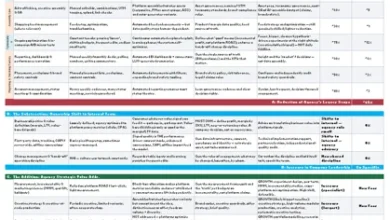
To address the complexities of sports sponsorship, analysts have developed a five-tier playbook ranging from "Vanity Metrics" to the "Gold Standard" of incrementality. This framework, often referred to as the Impact Intelligence Score (IIS), rates a company’s understanding of its business impact on a scale of 1 to 10.
Level 5: The Vanity Metrics (IIS: 1/10)
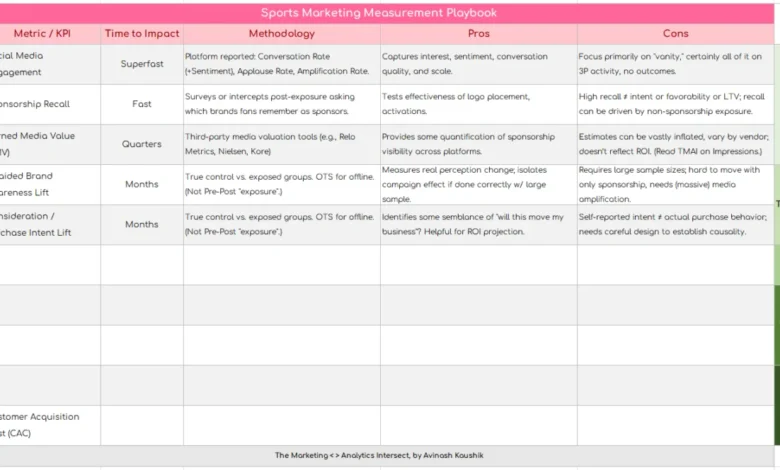
Most brands initiate their sports marketing journey at Level 5, focusing on high-volume data points that measure activity rather than outcomes. These metrics are immediate and easily accessible but offer no proof of causality.
- Social Media Engagement: This includes conversation rates, applause rates (likes), and amplification (shares) across platforms like TikTok, X, and Instagram. While useful for gauging immediate sentiment, these numbers rarely correlate directly with revenue.
- Sponsorship Recall: Often conducted via post-exposure surveys at stadiums or through digital newsletters, recall measures whether a fan remembers seeing a brand logo. Analysts suggest that "unaided recall"—where a consumer mentions the brand without prompting—is a far more valuable, albeit harder-to-achieve, metric than "aided recall."
- Earned Media Value (EMV): Also known as Ad Value Equivalency (AVE), this metric attempts to quantify the value of logo appearances during a broadcast by comparing them to the cost of equivalent paid advertising. Industry critics argue EMV is a "con" because it ignores the quality of the audience and the cluttered environment of a live game.
Level 4: The Quest for Brand Impact (IIS: 4/10)
Level 4 moves toward understanding human perception through test-and-control methodologies. This level seeks to answer whether a sponsorship has fundamentally shifted how a consumer "thinks and feels" about a brand.
- Unaided Brand Awareness (UBA): Moving the needle on UBA is a long-term endeavor. A successful sports partnership should, over a period of 12 to 24 months, ensure that a brand becomes synonymous with the sport it sponsors, much like Rolex’s decades-long association with professional tennis.
- Purchase Intent and Consideration: This is the point where Chief Financial Officers (CFOs) begin to take interest. By comparing a "test" group (fans exposed to the sponsorship) against a "control" group (non-fans or those unexposed), brands can measure the lift in a consumer’s likelihood to choose their product over a competitor’s.
The Fundamental Laws of Sports Marketing
Despite the unique nature of sports, experts emphasize that the universal laws of marketing still apply. The "spike and silence" approach—where a brand spends heavily on a single event like the Super Bowl and then disappears—is often cited as a failure of strategy. For sports marketing to be effective, it requires "spike and sustain." The "halo effect" from an athlete or team takes significantly longer to transfer to a brand than traditional advertising because the sport itself acts as a distraction.
Furthermore, the "frequency of three" rule remains a critical benchmark. Research suggests that a consumer needs to be exposed to a marketing message at least three times per week to trigger a change in behavior. In sports marketing, organic placements (such as a logo on a jersey) are frequently ignored by the subconscious mind. To overcome this, brands must supplement organic presence with paid media that utilizes the sports creative, ensuring the message reaches the necessary frequency to be persuasive.
Creative Efficacy and Storytelling
The most significant "dirty secret" of sports marketing is the reliance on creative storytelling. Research indicates that creative execution is responsible for 60% to 70% of all brand marketing success. Many corporations struggle to develop compelling narratives internally; consequently, they "rent" the values of a sports team or athlete.
By associating with a team known for "resilience" or an athlete known for "precision," a brand inherits those attributes without having to build them from scratch. However, this strategy is only profitable if backed by substantial paid media. Analysts argue that handing over creative storytelling to the sports entity can be highly profitable, provided the company uses Media Mix Modeling (MMM) to prove incremental profitability over time.
Industry Implications and the Road to Incrementality
The transition from Level 4 to the higher echelons of measurement (Levels 3 through 1) represents the current frontier for sophisticated marketing organizations. These upper levels focus on "The First Digital Trace"—tracking how a stadium appearance leads to a website visit or app download—and ultimately, "Incrementality."
Incrementality is the "Gold Standard" of measurement, answering the definitive question: "How many sales did we make that would not have happened without this sports sponsorship?" This requires advanced econometric modeling and a move away from "last-click" attribution, which often overvalues the final touchpoint and ignores the long-term brand building provided by sports.
For B2B companies, such as SaaS providers or consulting firms, these metrics are even more vital due to long sales cycles. A hospitality suite at the Kentucky Derby or a luxury box at a Major League Baseball stadium may satisfy current clients and facilitate contract renewals, but without Level 4 and Level 3 measurement, these activities remain unscalable "boutique" events with limited business impact.
Conclusion: Turning the Lights On
As the cost of sports rights continues to climb—evidenced by the NFL’s recent $110 billion media rights deal—the era of "sponsoring in the dark" is coming to a close. The data suggests that while sports marketing can be transformative, its success is not guaranteed by the mere presence of a logo on a screen.
The most successful brands in the coming decade will be those that treat sports not as a separate vanity project, but as a core component of their analytical framework. By moving beyond Level 5 vanity metrics and embracing the rigors of brand lift and incrementality, companies can ensure that their $38 million investments deliver more than just a handshake with a star quarterback—they deliver a measurable, sustainable competitive advantage in an increasingly distracted world. The "last bastion" of live TV offers unparalleled opportunity, but only for those who have the tools to measure the light it casts on their business.