The Evolution of Marketing Analytics from Activity Tracking to Financial Accountability in the Age of AI Search

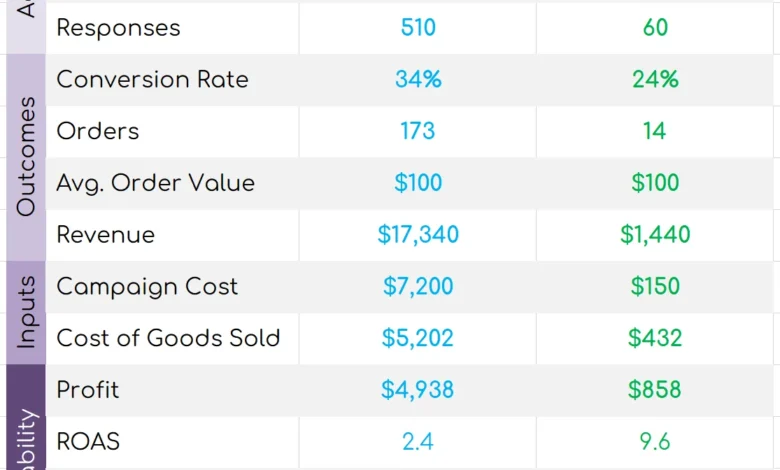
The global landscape of digital marketing is currently undergoing a fundamental paradigm shift as organizations move away from traditional "activity-based" metrics toward a rigorous framework of financial accountability. For decades, marketing departments have relied on high-level indicators such as impressions, clicks, and sessions to justify advertising budgets. However, a growing consensus among strategic consultants and Chief Financial Officers (CFOs) suggests that these metrics often mask underlying inefficiencies and, in some cases, active financial losses. This transition is becoming increasingly critical as search engines integrate generative artificial intelligence, fundamentally altering how users interact with web content and how brands must measure success.
The Discovery of the Cost Per Session Trap
The move toward deeper accountability often begins with the identification of "value-deficient" metrics. During a recent strategic consulting engagement for a global corporation operating in 75 countries, analysts discovered that a primary success metric for a multi-million dollar campaign was "Cost Per Session" (CPS). While Cost Per Sale is a standard industry term, Cost Per Session represents a focus on mere traffic volume rather than the quality or outcome of that traffic.
In a professional marketing context, metrics like impressions and views are increasingly viewed as "activities" rather than "outcomes." While they indicate that a campaign is running, they provide no insight into whether that campaign is contributing to the company’s bottom line. The reliance on CPS suggests a strategy centered on "shoveling traffic" as cheaply as possible, a goal that often conflicts with the ultimate objective of profitability. As marketing budgets face stricter scrutiny from financial departments, the disconnect between traffic-driving activities and incremental business impact has become a focal point for corporate restructuring.
A Chronology of Metric Maturity: From Activity to Accountability
To bridge the gap between the Chief Marketing Officer (CMO) and the CFO, organizations are being urged to adopt a tiered approach to analytics. This evolution typically follows a three-stage chronology that increases in complexity and financial relevance.
Phase 1: The Activity View
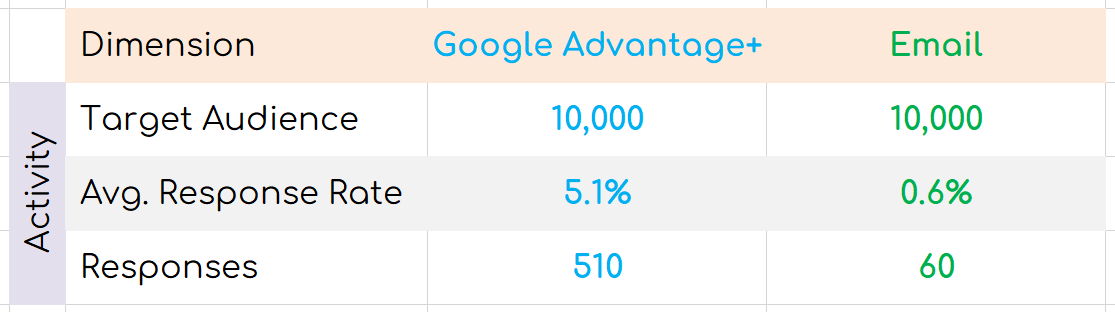
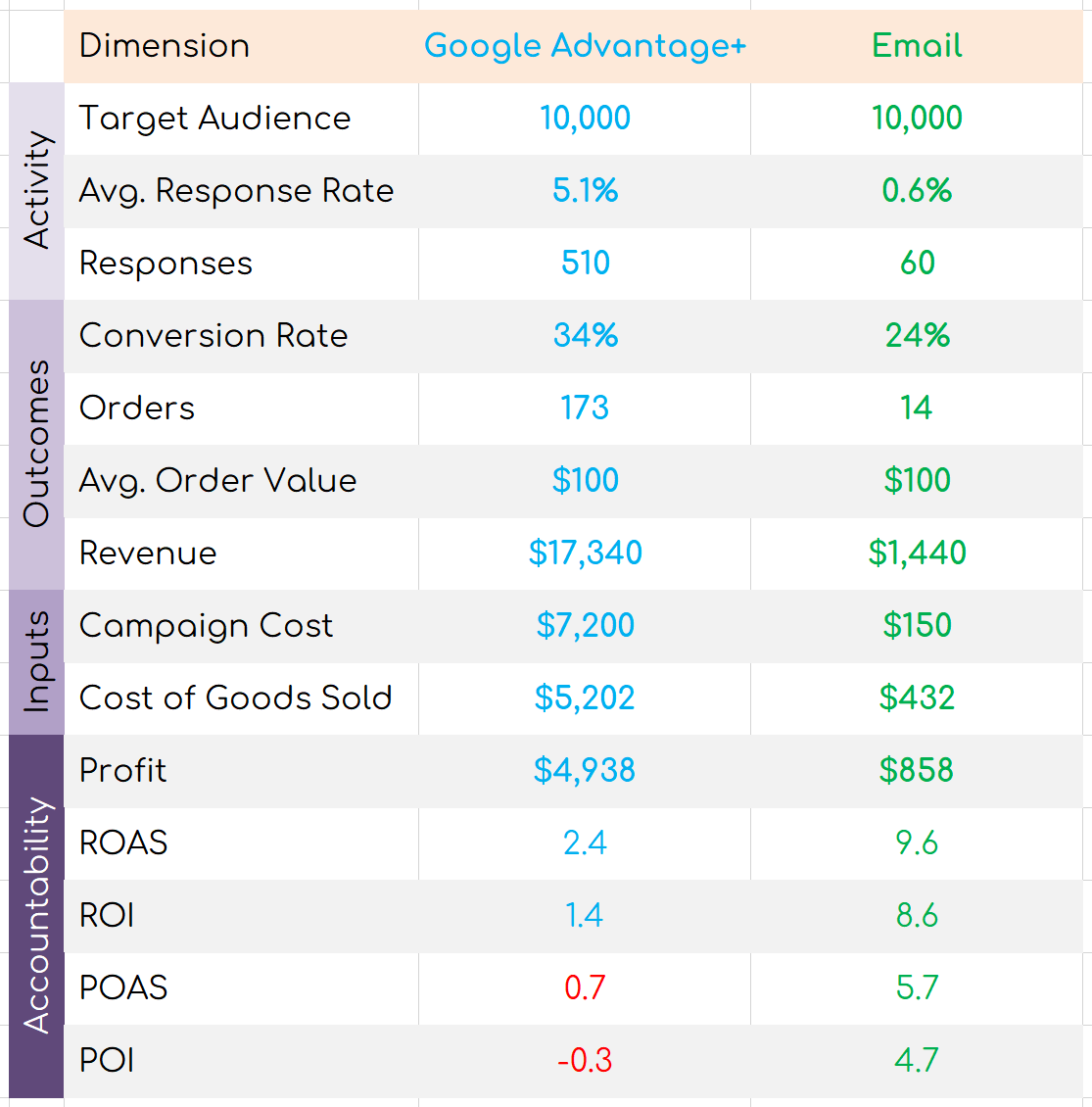
In the initial stage, marketing teams focus on response rates and traffic volume. For example, automated AI-powered tools such as Google Advantage+ often show significantly higher engagement levels compared to traditional channels like email marketing. In this view, a campaign that generates 510 sessions is viewed as a success compared to one that generates 50, regardless of what those visitors do once they arrive.
Phase 2: The Outcome View
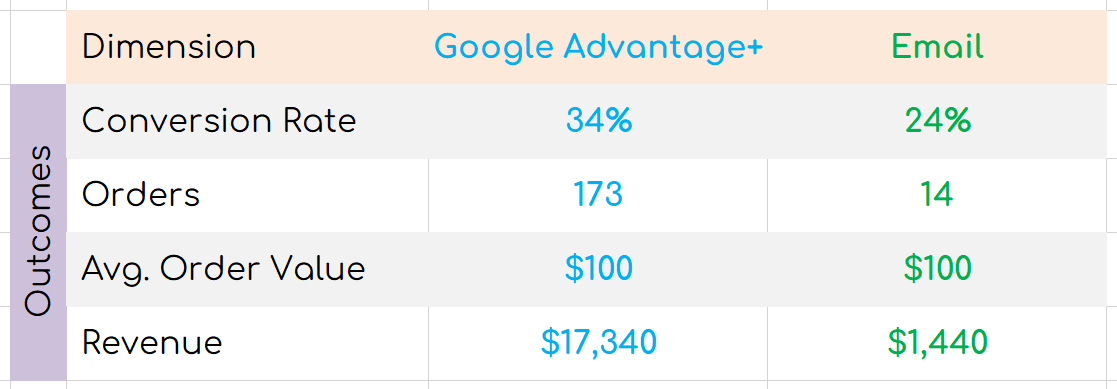
As organizations mature, they begin to track direct outcomes, such as revenue, conversion rates, and total orders. While this provides a clearer picture of performance, it remains incomplete because it does not account for the costs associated with generating that revenue. A campaign might generate $17,000 in revenue, appearing highly successful on the surface, but if the cost to acquire those customers and the cost of the goods sold (COGS) exceeds that amount, the campaign is a net negative for the business.
Phase 3: The Accountability View
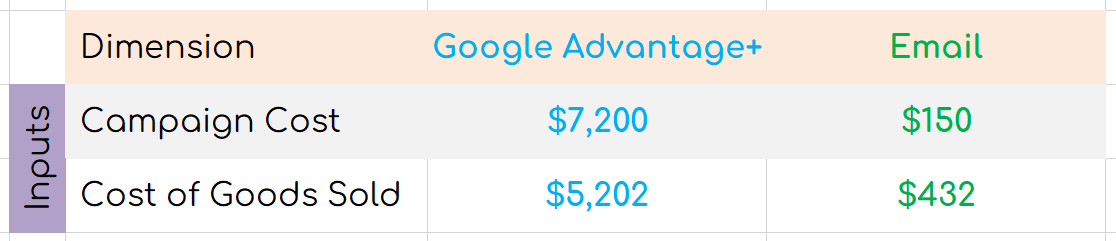
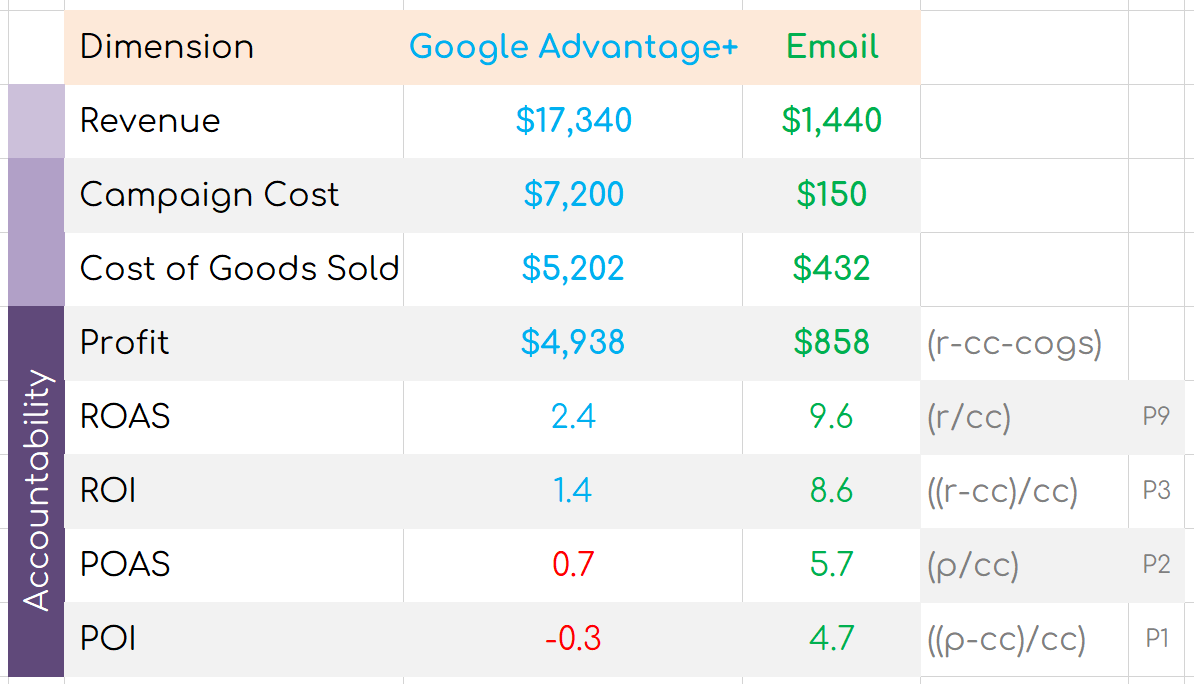
The final stage of maturity involves calculating the true business impact through metrics like Return on Investment (ROI), Profit on Ad Spend (POAS), and Profit on Investment (POI). This stage requires the integration of campaign costs and COGS into the marketing dashboard. It is at this level that the "mirage" of high-volume traffic often disappears. Data suggests that while AI-powered automated campaigns can drive massive revenue, they may result in a negative POI (e.g., losing $0.30 for every $1 spent) if not managed with a focus on profitability rather than just scale.
Supporting Data: Comparing Automated Scale vs. Targeted Profitability
To understand the necessity of this shift, consider a comparative analysis of two common marketing channels: Google Advantage+ (an AI-driven automated ad platform) and traditional Email Marketing.
| Metric | Google Advantage+ | Email Marketing |
|---|---|---|
| Sessions | 510 | 54 |
| Orders | 173 | 14 |
| Revenue | $17,230 | $1,350 |
| Campaign Cost | $7,200 | $140 |
| COGS (Est.) | $10,338 | $540 |
| Profit | -$308 | $670 |
| Return on Ad Spend (ROAS) | 2.4 | 9.6 |
| Profit on Investment (POI) | -0.3 | 4.7 |
In this data set, Google Advantage+ appears to be the superior channel when looking only at activity (sessions) and outcomes (revenue). It delivers 12 times the revenue of email. However, when the "Accountability" lens is applied, the results flip. The email campaign, despite its lower scale, is highly profitable, delivering $4.70 in profit for every $1 spent. Conversely, the Google campaign is actively eroding company capital. This data highlights why the CFO’s involvement is becoming central to marketing strategy; without financial accountability, a company may inadvertently fund its own losses in pursuit of growth.
The Impact of AI Search on Traditional Metrics
The urgency to move away from session-based metrics is further compounded by the rise of AI-powered search experiences. Google recently released guidance on "Succeeding in AI Search," which emphasizes that the nature of web traffic is changing. In an "AI Mode" or "AI Overview" environment—similar to ChatGPT or Perplexity—search engines provide answers directly on the results page.
Google’s official stance indicates that while the total number of clicks may decrease, the quality of those clicks is expected to rise. Because the AI provides context and answers before the user clicks a link, the visitors who do eventually click through to a website are more likely to be highly engaged and further along in the conversion funnel.
The implication for marketers is clear: focusing on "Cost Per Session" is increasingly futile in a world where "sessions" are becoming rarer but more valuable. Organizations that continue to incentivize their teams based on traffic volume will find themselves optimizing for a declining and less relevant metric. Instead, Google advises businesses to focus on "the overall value of visits," such as signups, long-form engagement, and direct sales, rather than the raw number of clicks.
Expert Analysis: "Sucking Less" Through Non-Bounced Sessions
For organizations that find it difficult to immediately transition to a full profit-based model due to technical or cultural hurdles, analysts suggest an intermediate step: measuring "Cost Per Non-Bounced Session."
The standard definition of a bounce—where a user arrives and leaves without any interaction—represents a total loss of investment in a paid advertising context. In the case study of Google Advantage+ cited above, the campaign had a bounce rate of 52%. While the raw Cost Per Session was $14, the "Cost Per Non-Bounced Session" was $27. By filtering out unproductive traffic, marketing teams can gain a more realistic view of what they are paying for actual engagement. This serves as a "reality check" that can prompt a re-evaluation of tactics before a full financial audit is conducted.
Strategic Implications and Future Outlook
The transition to accountability-based marketing requires a fundamental restructuring of how marketing teams, agencies, and platforms interact. Industry experts recommend a five-step recovery plan for companies finding themselves in a "negative POI" cycle:
- Immediate Spend Suspension: If a channel is delivering a negative profit on investment, the most rational financial move is to pause spending. This sends a clear signal to internal teams and external agencies that traffic is not a substitute for profit.
- Intent Re-evaluation: Marketing teams must analyze the "intent" available on different platforms and ensure that creative assets and offers are aligned with that intent.
- AI Feature Optimization: Rather than letting AI platforms run autonomously with "vanity" goals, marketers must learn to use AI-powered features to optimize for specific, high-value outcomes.
- Agency Realignment: Agencies must be incentivized based on the same profitability metrics as the company’s internal financial team.
- Scale Based on Profit: Budgets should only be increased once a "high green POI" (positive profit) is established and stabilized.
The broader implication for the workforce is the emergence of a new "AI-disruption-proof" career path for marketers. Those who can navigate the intersection of creative strategy, data analytics, and financial accountability will become indispensable. As AI continues to automate the technical aspects of ad buying and content creation, the human role will shift toward high-level strategic oversight—ensuring that the massive scale provided by AI platforms is directed toward sustainable, profitable growth.
In conclusion, the era of "marketing for the sake of marketing" is coming to an end. The pressure from CFOs for incremental business impact, combined with the structural changes brought by AI search, is forcing a long-overdue professionalization of marketing analytics. The organizations that thrive in this new environment will be those that treat marketing not as a cost center to be managed, but as a profit-generating investment to be optimized through the lens of total accountability.