Evaluating Ad Lift Studies: The Dangerous Gap Between Platform Metrics and C-Suite Accountability

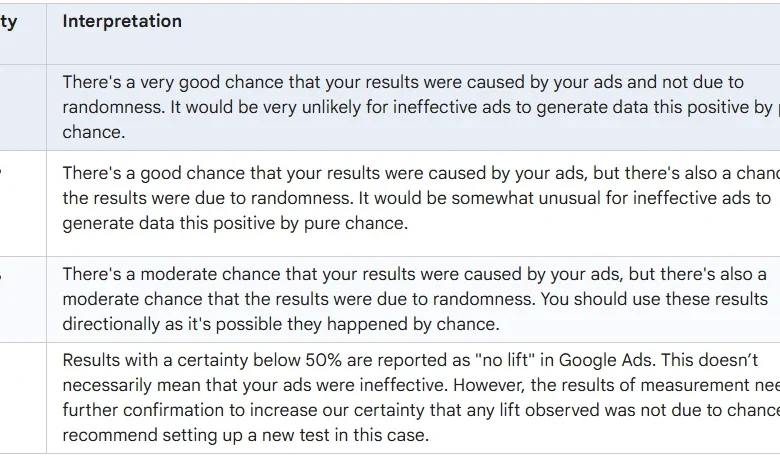
The digital advertising ecosystem has long relied on probabilistic metrics to justify multi-million-dollar corporate expenditures. Recently, increased scrutiny has fallen upon the interpretive guidelines provided by major technology platforms regarding advertising effectiveness. At the center of this debate is how metrics such as "directional results" are defined, categorized, and ultimately utilized by brand media directors reporting to chief financial officers.
A critical examination of official measurement guidelines reveals a fundamental misalignment between the interests of ad-selling platforms and the financial accountability required by enterprise decision-makers. As corporations navigate tightening economic conditions, the reliance on ambiguous statistical thresholds has emerged as a significant risk factor in modern marketing strategy.
The Ambiguity of Platform Metrics and Statistical Certainty
Official guidance published by major digital advertising providers—including documentation for Brand Lift, Search Lift, and Conversion Lift studies—categorizes certainty levels into distinct tiers. Under these frameworks, certainty ratings of 90 percent or higher are classified as a "very good chance" of campaign impact, while ratings between 70 and 90 percent denote a "good chance." Measurements falling within the 50 to 70 percent band are described as representing a "moderate chance," often accompanied by recommendations to utilize the insights "directionally."
For marketing analytics professionals, these linguistic categorizations present a systemic challenge. Terms such as "directional" or "moderate chance" introduce wide margins of interpretation. While a platform vendor may view a 50 to 70 percent certainty threshold as sufficient evidence of potential engagement, corporate budget owners face a vastly different calculus when determining whether to allocate subsequent tranches of capital.
The core friction lies in the asymmetry of consequences. For the advertising platform, a study indicating weak or suggestive evidence of impact still serves an analytical purpose, as it keeps the communication channel open and encourages further experimentation. Conversely, the corporate media director bearing the fiduciary responsibility of budget allocation faces the immediate financial risk of committing capital to a strategy whose efficacy cannot be rigorously defended before an executive board.
Incentives and the Divergence of Risk
To understand the operational impact of these metrics, industry analysts often segment market participants into two distinct parties with opposing risk profiles: the platform vendor and the brand advertiser.
The platform vendor operates as a marketplace for ad inventory. Its statistical frameworks are inherently optimized to encourage continued spending by highlighting positive signals, however weak. Even when documentation includes standard disclaimers advising clients to interpret results according to individual business needs and risk tolerances, the overarching structural design favors optimism.
In contrast, the brand advertiser—represented by roles such as the Senior Director of Brand Media, the Chief Marketing Officer (CMO), and the Chief Financial Officer (CFO)—operates under strict accountability. Their objective is not to extract interesting hypotheses from ambiguous data, but to answer a definitive question: Is the evidence of past performance strong enough to justify risking another substantial allocation of corporate capital?
By accepting lower certainty thresholds as actionable, advertisers effectively outsource their risk tolerance to the entities profiting from the advertising expenditure. Consequently, many enterprise analytics teams have established stricter internal policies, utilizing a 90 percent certainty floor as the minimum threshold before endorsing budget renewals.
Mathematical Realities: Assessing Replication Risk
Moving beyond qualitative terminology requires examining the underlying statistical reliability of ad lift measurements. When a platform reports a specific lift metric—such as a three-point increase in brand consideration at a 70 percent certainty level—decision-makers must evaluate what statisticians term replication risk.
Replication risk measures the probability that repeating an identical campaign under the same market conditions will fail to yield results strong enough to justify continued spending. Utilizing Bayesian replication models—inspired by statistical frameworks developed by biostatisticians like Steven Goodman—analysts can translate abstract certainty percentages into practical business probabilities.
When a campaign yields a 70 percent certainty score, the underlying mathematics reveal a significantly lower probability of replicating positive outcomes in a subsequent round. Specifically, models mapping these parameters often demonstrate that a 70 percent certainty score translates to roughly a 65 percent chance of achieving any positive lift whatsoever upon repetition, and only about a 30 percent chance of reaching a high certainty threshold in a second test.
For a CFO evaluating a multi-million-dollar renewal, these odds introduce a high degree of financial exposure. When replication risk hovers near critical levels, the likelihood of confirming the initial success diminishes substantially, transforming what the platform categorized as a "good chance" into an unfavorable business bet.
Implications for Enterprise Media Planning
The reliance on sub-optimal certainty thresholds carries dual risks for corporate marketing budgets. Beyond the primary risk that an initial positive result will fail to materialize upon repetition, weak evidence often correlates with overestimated effect sizes—a phenomenon well-documented in statistical literature concerning Type S (sign) and Type M (magnitude) errors.
When organizations base strategic decisions on metrics that lack robust statistical backing, they expose themselves to compounded forecasting errors. Marketing departments that fail to independently audit vendor-supplied lift studies risk misallocating resources across campaigns on platforms ranging from search engines to social media networks.
Industry experts emphasize that these methodological concerns are not unique to any single ecosystem. Whether evaluating metrics provided by Google, Meta, TikTok, or third-party measurement agencies, the underlying imperative remains the same: corporate leadership must establish independent, rigorous standards for statistical evidence.
Conclusion and Best Practices for Decision-Makers
The growing complexity of digital attribution requires marketing executives to critically assess the tools and definitions provided by media sellers. By decoupling enterprise standards of proof from vendor definitions of useful information, organizations can protect their capital from the hidden costs of statistical ambiguity.
Moving forward, corporate analytics strategies are increasingly shifting toward stricter verification frameworks. Recommendations for enterprise media teams include:
- Establishing a minimum statistical certainty floor—typically between 90 and 95 percent—for consequential budget allocations.
- Factoring replication risk into media planning models rather than relying solely on single-test outcomes.
- Standardizing reporting templates across internal teams, agencies, and vendors to eliminate interpretive bias.
- Ensuring that financial accountability rests on verifiable business outcomes rather than platform-generated directional indicators.
Ultimately, the responsibility of risk management cannot be delegated to the entities selling the advertising inventory. By aligning marketing analytics with stringent financial standards, organizations can ensure that future media investments are driven by verifiable impact rather than optimistic interpretation.