YouTube’s New Culture and Trends Report Redefines the Modern Mainstream Through Digital Creators and Fandom Participation

The digital media landscape has undergone a profound structural transformation over the past decade, shifting from a centralized ecosystem dominated by traditional institutional gatekeepers to a decentralized, hyper-connected network of niche communities, digital creators, and participatory audiences. A comprehensive new report published by YouTube, titled the Trends and Culture Report on the Evolution of Mainstream Culture, examines this paradigm shift. Based on empirical research, the study explores how expanded internet access and the proliferation of digital platforms have fractured the cultural landscape while paradoxically strengthening the human desire for shared, collective experiences.
Rather than pointing to the death of the mainstream, YouTube’s findings suggest a complete redefinition of the term. Traditional cultural arbiters—such as major Hollywood studios, legacy television networks, and mainstream music labels—no longer hold a monopoly on cultural relevance. Instead, digital creators, internet-native phenomena, and online subcultures now stand shoulder-to-shoulder with institutional mainstays, collectively shaping what enters the global consciousness.
Methodology and Survey Demographics
To understand these shifting cultural dynamics, YouTube commissioned NRG, a leading global insights and strategy firm, to conduct a comprehensive quantitative and qualitative study. The research framework centered on a survey of 939 respondents ranging in age from 14 to 44 years old. This demographic span encompasses Generation Z and Millennials, cohorts that are widely recognized as digital natives and early adopters of emerging media formats, making them the primary drivers of modern cultural trends.
The survey was designed to measure audience perceptions of popularity, the influence of digital creators versus traditional celebrities, and the changing ways consumers engage with fandoms. By analyzing the data gathered from this cross-section of internet users, YouTube sought to identify the core signals that propel an idea from a localized digital niche into a globally recognized mainstream phenomenon.
The Paradox of Fragmentation and Shared Experiences
At the heart of YouTube’s report lies a fascinating psychological paradox: while the media landscape is more fragmented than ever, the human appetite for shared cultural moments remains as robust as it has always been. In the past, mass media functioned as a universal megaphone, broadcasting a limited number of cultural touchstones to a passive audience. Today, the democratization of content creation tools and high-speed internet access has allowed thousands of micro-communities to flourish around highly specific interests.
Yet, despite this vast array of niche choices, consumers continue to seek out common ground. According to the survey data, 63% of respondents indicated that compared to five years ago, it feels truer today that they actively watch content or follow creators that everyone they know is also watching or following.
This suggests that while people appreciate the freedom to explore personalized, niche content, they simultaneously crave the social cohesion that comes from participating in widely shared cultural conversations. The mainstream has not vanished; rather, its underlying mechanics have evolved. Finding the mainstream has become more complex because ideas and concepts can now originate from an infinite variety of decentralized sources rather than a top-down corporate hierarchy.
The Democratization of Cultural Authority
One of the most striking revelations in the survey data is the parity between traditional institutional giants and digital-native entities in the minds of modern consumers. When participants were surveyed about what people seem to be into nowadays, digital entities scored remarkably high alongside conventional cultural touchstones.
Specifically, 77% of respondents perceived YouTube creators as widely known, and 78% pointed to internet memes as universally recognized cultural phenomena. These figures place digital creators and memes on nearly equal footing with traditional heavyweights, such as Hollywood celebrities, who were recognized by 79% of respondents, and the Super Bowl, which scored 83%.
This high level of perceived popularity among digital entities demonstrates that online culture has officially achieved mainstream status. It no longer exists as an alternative subculture operating on the fringes of society; instead, it occupies a central pillar of the modern entertainment ecosystem. Digital platforms have effectively dismantled the traditional barriers to entry, allowing independent creators armed with cameras and internet connections to command audiences that rival or exceed those of multinational media conglomerates.
Three Key Signals of Modern Mainstream Culture
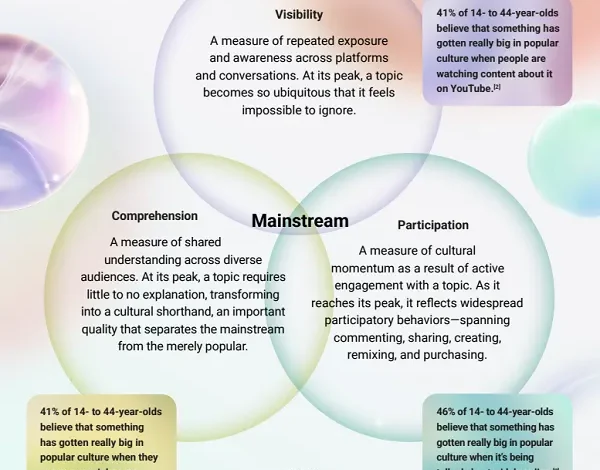
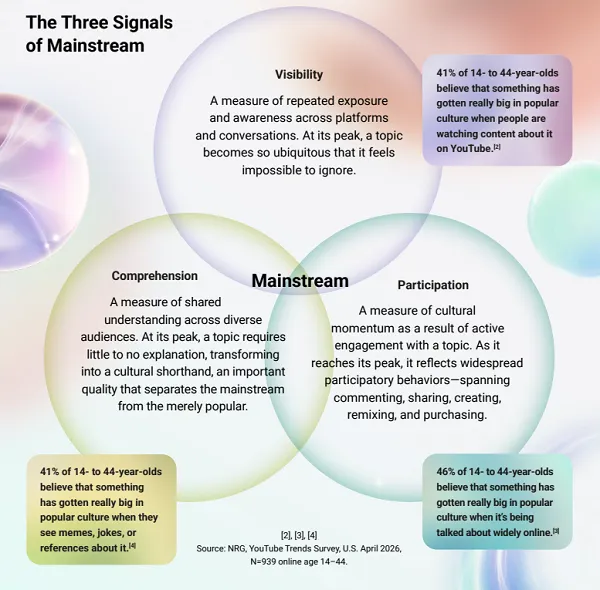
To provide a concrete framework for understanding how ideas successfully transition into the mainstream, YouTube’s report identifies three foundational signals that define cultural relevance in the digital era: visibility, comprehension, and participation.
While visibility and comprehension have historically been the primary requirements for mass-market success—requiring significant capital investment in advertising and widespread distribution—the modern era elevates participation to a critical third pillar. The key dynamic shift in contemporary culture is the audience’s ability to actively engage, remix, and co-create rather than merely consume.
As YouTube notes in the report, digital culture has forged entirely new pathways to mainstream success. The ideas and concepts that successfully break through the noise are those that actively inspire participation, foster vibrant communities, and sustain ongoing conversations. Without this active engagement from the audience, even heavily funded projects struggle to achieve true cultural resonance. Conversely, a concept that originates in a hyper-niche online community can rapidly scale to global prominence if it provides sufficient avenues for participatory fan creation.
Case Studies: From Digital Incubators to Global Blockbusters
To illustrate these theoretical concepts in practice, the YouTube report highlights several high-profile examples of modern cultural phenomena that trace their origins directly back to digital creator ecosystems rather than traditional Hollywood development pipelines.
A prime example cited in the research is the viral phenomenon known as the "Backrooms." What began as a simple, unsettling piece of digital art and a short YouTube video spawned an explosive wave of user-generated expansions, lore building, and online discussions. The participatory nature of the trend allowed thousands of creators to add their own interpretations to the concept. This massive groundswell of community engagement ultimately caught the attention of traditional entertainment executives, leading to the development of a Hollywood feature film adaptation.
Similarly, the massive multimedia success of the horror franchise Five Nights at Freddy’s serves as a testament to the power of digital ecosystems. The franchise built its foundational audience through online gaming communities, YouTube Let’s Play videos, and viral theorycrafting discussions long before it was transformed into a major motion picture.
Independent digital creators have also achieved unprecedented levels of cultural penetration. Internet personality MrBeast (Jimmy Donaldson), who boasts hundreds of millions of subscribers on YouTube, commands an audience footprint that surpasses many traditional movie stars and professional athletes. His high-production-value videos and philanthropic stunts generate global cultural conversations that rival traditional media events, proving that individual creators can build institutional-scale media enterprises from the ground up.
Generational Shifts in Content Consumption and Fandom
The report underscores the vital role that platform ecosystems play in nurturing these modern cultural shifts. Among online young adults aged 14 to 24, platform reliance is remarkably high. According to the data, 82% of individuals in this demographic turn to YouTube specifically for content, conversation, or information regarding subjects they are passionate about.
Furthermore, the depth of this engagement is profound. Among those who use the platform for fandom-related content, an overwhelming 95% consume media related to their specific interests on at least a weekly basis. This high-frequency engagement creates a continuous feedback loop between creators and fans, sustaining the conversation and building the community visibility required to push niche interests into the broader mainstream consciousness.
Industry Implications and Future Outlook
The findings of YouTube’s Trends and Culture Report carry significant implications for marketers, media executives, content creators, and cultural analysts alike. As the lines between digital subcultures and mass entertainment continue to blur, traditional strategies for audience acquisition and brand building must adapt to the realities of a participatory media ecosystem.
For media companies, the traditional gatekeeper model is no longer a reliable predictor of success. Consumers, particularly younger demographics, place high trust in peer recommendations and independent digital creators whom they perceive as authentic and accessible. Consequently, modern entertainment strategies increasingly involve monitoring emerging digital trends, identifying grassroots fandoms early in their lifecycle, and providing platforms for audience participation rather than attempting to dictate cultural tastes from the top down.
For creators and independent artists, the report offers validation of the creator economy’s growing maturity. It highlights that building a sustainable audience is no longer solely about chasing algorithmic optimization, but about fostering deep, interactive communities that are inspired to participate in the creative process.
As digital connectivity continues to expand globally, the mechanisms governing mainstream culture will undoubtedly continue to evolve. YouTube’s research makes it clear that while the definition of the mainstream has expanded to encompass the digital frontier, the fundamental human desire to connect, share, and create together remains the ultimate engine of cultural evolution.