Google Expands Data Manager and Meridian with Advanced AI and Integration Capabilities to Supercharge Ad Targeting

Google has announced a significant expansion of its digital advertising ecosystem, introducing a robust suite of new data integration tools for its centralized Data Manager platform alongside advanced artificial intelligence capabilities for its Meridian marketing mix modeling tool. Designed to help advertisers navigate an increasingly complex digital landscape defined by stringent privacy standards and rising consumer expectations, these updates aim to streamline first-party data utilization, enhance campaign targeting precision, and automate critical data quality audits.
The announcement comes at a pivotal time for the digital advertising industry. As third-party cookies face a phased deprecation across major browsers and global data privacy regulations continue to evolve, brands are increasingly shifting their focus toward first-party data strategies. Google’s latest enhancements are strategically positioned to assist marketers in maximizing the value of their owned customer data, bridging the gap between offline consumer interactions, mobile application behaviors, and digital ad performance.
Background Context: The Evolution of Google Data Manager and First-Party Strategies
For years, digital advertisers struggled with fragmented data ecosystems. Customer information was frequently siloed across disparate platforms—Customer Relationship Management (CRM) databases, point-of-sale systems, mobile apps, and web analytics tools. This fragmentation made it difficult for brands to construct a unified view of their audience, leading to inefficient ad spending and missed targeting opportunities.
Recognizing this industry-wide pain point, Google introduced Data Manager as a centralized hub allowing advertisers to upload, manage, and activate their owned customer and sales data directly within Google Ads. The core philosophy behind the platform is straightforward: by feeding high-quality, privacy-compliant first-party data back into Google’s machine learning and AI-powered bidding models, advertisers can significantly improve the relevancy and efficacy of their campaigns.
However, the initial iterations of data onboarding tools often required complex technical implementations, leading to friction for mid-sized and enterprise businesses alike. Over the past several years, Google has systematically rolled out API connections, simplified diagnostics, and expanded cross-platform sharing capabilities to make data activation more accessible. The latest update represents a massive leap forward in this ongoing strategy, weaving advanced artificial intelligence directly into the fabric of data governance, validation, and activation.
Key Integrations: Connecting Data Manager Across Google Analytics and Display & Video 360
At the heart of the recent announcements is a major expansion in how Data Manager information can be distributed and utilized across Google’s enterprise marketing stack. Historically, data uploaded to Data Manager was primarily restricted to specific campaign types within Google Ads. Under the new framework, Google has launched a seamless integration that feeds Data Manager insights directly into both Google Analytics and Display & Video 360 (DV360).
This cross-platform data sourcing allows marketers to leverage comprehensive audience insights across multiple touchpoints, driving more accurate ad display options and precise bidding decisions. By connecting offline sales data and mobile application activity directly into these broader environments, brands can train Google’s machine learning algorithms on actual business outcomes rather than superficial engagement metrics like clicks and impressions.
According to internal Google performance metrics, the impact of these integrations can be substantial. Advertisers who successfully connect their offline and app data repositories to Data Manager experience an average 26% increase in incremental Return on Ad Spend (ROAS). This statistic underscores the commercial viability of first-party data activation, demonstrating that brands willing to invest in robust data plumbing can unlock tangible financial returns.
In tandem with these multi-platform integrations, Google is rolling out enhanced conversions within Google Analytics and Display & Video 360. Enhanced conversions serve as a privacy-safe mechanism to match customer data—such as hashed email addresses collected during checkouts or sign-ups—with signed-in Google accounts. This improves measurement accuracy without violating modern privacy frameworks, ensuring that conversions driven by digital ads are correctly attributed even when user journeys span multiple devices and browsers.
Standardization and API Enhancements
To accommodate diverse enterprise tech stacks, Google has also expanded the connective options available through the Data Manager API. Built upon the Interactive Advertising Bureau (IAB) Tech Lab’s Event and Conversions API (ECAPI) standard, the upgraded Data Manager API provides a unified, secure technical infrastructure.
This standardization enables businesses to connect, manage, and activate their audiences and measurement frameworks across major ad platforms with minimal friction. Furthermore, Google has integrated automated diagnostics directly into the Data Manager interface. These diagnostic tools proactively identify, flag, and address data ingestion or quality issues before they have a chance to negatively impact live campaign performance.
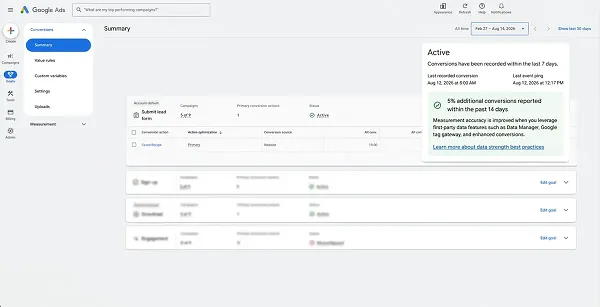
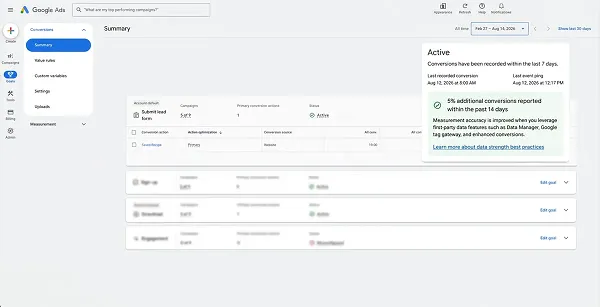
To help quantify the financial impact of these efforts, Google has introduced a new Data Strength Uplift Metric within Google Ads. This metric is designed to calculate and display the additional conversions directly attributable to first-party data sources, giving media buyers a transparent, data-backed view of how their proprietary customer insights are influencing campaign outcomes.
Revolutionizing Marketing Mix Modeling with Meridian and Agentic AI
While Data Manager addresses real-time campaign targeting and first-party data activation, Google’s second major announcement focuses on long-term strategic measurement through its Meridian marketing mix modeling (MMM) portal.
Marketing mix modeling has experienced a significant renaissance in recent years. As probabilistic attribution models struggle with cookie-less tracking limitations and privacy-centric operating systems, brands are returning to macroeconomic, statistical modeling to evaluate the true impact of their advertising investments across all channels—both digital and traditional. Meridian, Google’s open-source and enterprise-ready marketing mix model, was built to provide transparent, highly accurate measurement capabilities.
With the latest update, Google is integrating artificial intelligence agentic capabilities directly into the Meridian portal. These AI agents are designed to act as intelligent assistants for data scientists and analysts, automating tedious data quality audits, diagnosing and resolving data errors in real time, and guiding model building processes.
By incorporating AI agents into Meridian, Google aims to democratize advanced econometric modeling. Historically, building and maintaining a reliable marketing mix model required specialized data science teams capable of spending weeks cleaning datasets and troubleshooting model convergence issues. Automated agentic capabilities significantly reduce this technical barrier to entry, allowing marketing teams to iterate faster, test hypotheses continuously, and adjust media strategies based on real-time insights.
In addition to AI agent integration, Google is incorporating richer brand signals directly into Meridian models. This ensures that long-term brand equity metrics—such as aided and unaided awareness—are properly factored into overall performance equations alongside immediate conversion data. Furthermore, Google has expanded access to its GeoX library, an advanced toolkit designed for running causal geography-based experiments. GeoX enables brands to isolate the exact impact of specific marketing campaigns by comparing test and control geographic regions over defined periods, providing a gold standard for incrementality testing.

Broader Impact and Industry Implications
The simultaneous updates to Data Manager and Meridian highlight a broader strategic shift within the digital advertising industry: the convergence of machine learning automation and strict data governance.
For nearly two decades, digital advertising relied heavily on rented audiences—third-party cookies and device identifiers provided by ad tech intermediaries. This model created a commoditized ecosystem where creative differentiation and algorithmic bidding strategies often overshadowed the quality of a brand’s underlying data foundation. The rapid dismantling of third-party tracking has forced a structural correction, returning the competitive advantage to brands that possess deep, direct relationships with their customers.
However, owning first-party data is only half the battle; the operational challenge lies in activating that data cleanly, securely, and at scale. By embedding AI capabilities directly into data ingestion pipelines and attribution models, Google is attempting to solve the technical complexity that often paralyzes marketing organizations.
Industry analysts note that these tools will likely widen the performance gap between mature digital advertisers and lagging competitors. Brands that have invested heavily in clean-room technology, robust CRM databases, and structured offline data collection are uniquely positioned to exploit Google’s new Data Manager features. Conversely, organizations with fragmented data practices may find themselves struggling to feed the AI models effectively, highlighting an urgent need for enterprise-wide data modernization.
Moreover, the integration of agentic AI into Meridian signals a broader trend toward autonomous enterprise software. Rather than merely presenting dashboards and data visualizations, modern marketing tools are evolving into proactive assistants capable of identifying anomalies, suggesting optimizations, and executing complex diagnostic tasks autonomously. This shift promises to free up valuable human capital, shifting marketing teams away from manual data cleaning and toward higher-level strategic planning and creative development.
Conclusion and Future Outlook
Google’s latest updates to Data Manager and Meridian represent a comprehensive effort to equip advertisers with the tools necessary for a privacy-first, AI-driven future. By streamlining data integration across Google Analytics and Display & Video 360, standardizing APIs through the IAB Tech Lab framework, introducing transparent attribution metrics like the Data Strength Uplift Metric, and infusing Meridian with agentic AI, Google is reshaping how brands measure and optimize their advertising investments.
As these features roll out globally, advertisers across sectors will be evaluating how to restructure their data pipelines to capture the reported 26% increase in incremental ROAS. Ultimately, the success of these tools will depend not only on Google’s underlying technology but on the commitment of brands to maintain pristine, high-integrity first-party data practices in an increasingly automated world.