LinkedIn Releases New 18-Page B2B Ads Attribution Guide to Help Marketers Navigate Complex Buyer Journeys and Prove ROI

In an effort to help business-to-business (B2B) marketers untangle the increasingly complex web of modern buyer journeys, LinkedIn has published a comprehensive, 18-page guide focused on ads attribution and directional signals. The resource is designed to bridge the persistent gap between early buyer engagement and concrete advertising approaches, ultimately empowering marketing professionals to make smarter, more defensible investment decisions. As sales cycles grow longer and involve a myriad of digital touchpoints, the professional networking platform’s new publication arrives at a crucial time for an industry grappling with transparency and performance measurement.
The Challenge of Modern B2B Attribution
For decades, digital marketing measurement relied heavily on linear attribution models—tracking a user’s direct click from an advertisement straight to a conversion page. However, the contemporary B2B landscape bears little resemblance to these traditional models. According to LinkedIn’s newly released overview, B2B purchasing decisions are inherently lengthy, nonlinear, and involve multiple stakeholders interacting across dozens of digital and physical touchpoints.
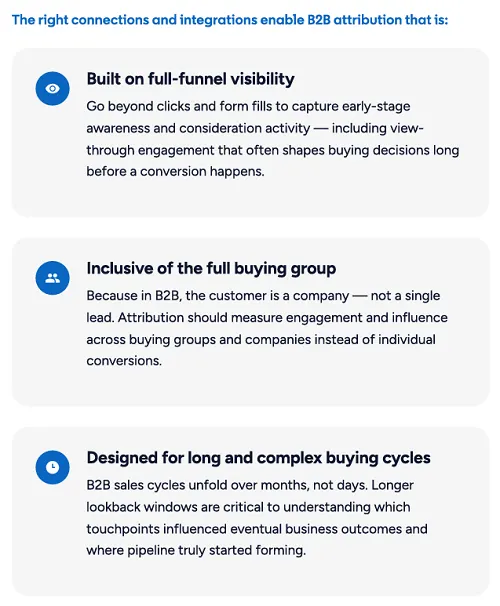
Modern buyers frequently move fluidly between channels, engage anonymously, consume valuable content without ever clicking a link, and increasingly rely on artificial intelligence-powered tools to inform their purchasing decisions. Consequently, by the time a formal opportunity or lead appears in a company’s sales pipeline, many of the critical interactions that shaped the final purchase decision have already occurred entirely beyond the reach of conventional measurement systems.
This visibility gap creates profound difficulties for tracking and accountability. When brands fail to capture the holistic journey of a prospective client, they frequently misattribute conversions to the final touchpoint rather than the top-of-funnel brand awareness campaigns that actually built trust over months. As a direct result, organizations often fail to capitalize on the most relevant, high-value opportunities, leading to sub-optimal budget allocations and wasted ad spend.
The Crisis of Confidence Among B2B Marketers
The struggle to accurately measure and attribute marketing impact is not merely an operational annoyance; it represents a major crisis of confidence at the executive level. Industry data highlighted alongside LinkedIn’s guide reveals a staggering disconnect between marketing teams and the corporate C-suite.
According to LinkedIn’s research, a mere 33% of B2B marketers strongly agree that they are currently able to conclusively prove the impact of their marketing campaigns to their executive leadership teams. More damningly, roughly 75% of surveyed professionals admitted that their existing measurement systems are falling short of operational needs. This pervasive inadequacy leaves marketing departments vulnerable during budget review cycles, where they are repeatedly pressed to justify expenditures without the empirical backing required to demonstrate true return on investment (ROI).
To combat this widespread frustration, LinkedIn’s guide introduces a structured framework designed to help B2B marketers upgrade their performance tracking methodologies and account for the invisible, unclicked touchpoints that drive enterprise revenue.
A Detailed Breakdown of LinkedIn’s Five-Part Attribution Framework
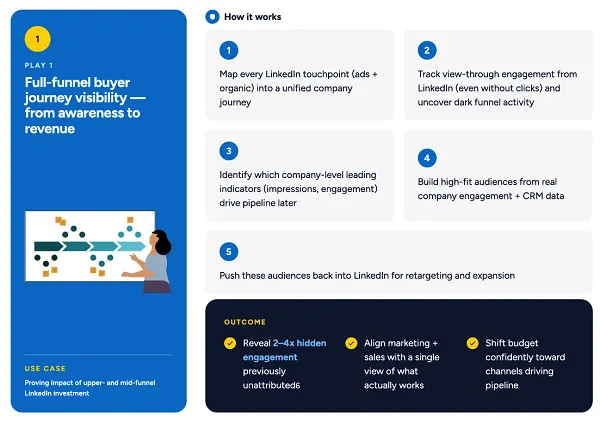
At the core of the 18-page document is a strategic blueprint outlining five distinct frameworks that marketers can deploy to better track promotional performance. Each section features a practical, step-by-step breakdown intended to guide teams away from flawed last-touch models and toward a more nuanced understanding of pipeline generation.
-
Shifting from Tracking to Directional Signals
The guide emphasizes that in a world dominated by privacy regulations, cookie deprecation, and anonymous browsing, exact attribution is often a mathematical impossibility. Instead, marketers must learn to rely on "directional signals"—aggregated data points that indicate macro-level interest and engagement trends rather than individual user tracking. -
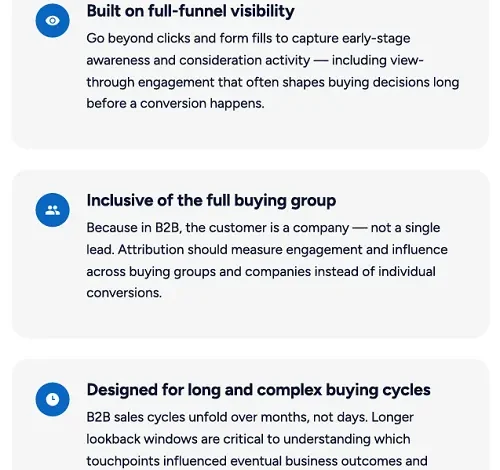
Establishing Full-Funnel Visibility
Marketers are encouraged to map out every phase of the buyer’s journey, explicitly acknowledging the dormant periods where prospective clients consume content without interacting. By broadening measurement parameters to include brand lift, share of voice, and early-stage engagement, teams can capture the true breadth of their market impact.
-
Integrating Multi-Touch Attribution (MTA) with Marketing Mix Modeling (MMM)
The guide outlines how combining granular digital tracking (MTA) with macro-economic and cross-channel evaluations (MMM) provides a more resilient defense against data blind spots caused by privacy changes and ad blockers. -
Aligning Marketing Metrics with Sales Outcomes
A recurring theme in the documentation is the necessity of speaking the language of the C-suite. The framework details methods for connecting top-of-funnel marketing metrics directly to revenue velocity, customer lifetime value (LTV), and pipeline acceleration. -
Leveraging Third-Party Validation and Partnerships
The overview concludes with a curated list of LinkedIn-approved attribution and analytics partners. These integration partners are positioned as essential tools for adding vital context to a brand’s internal data ecosystem, helping verify the efficacy of campaigns running across the platform.
Industry Context and Strategic Implications
The release of this attribution guide reflects a broader, industry-wide reckoning regarding digital privacy and data collection. With major technology providers phasing out third-party cookies and privacy regulations such as the General Data Protection Regulation (GDPR) and the California Consumer Privacy Act (CCPA) strictly limiting user tracking, marketers have had to fundamentally rethink how they evaluate success.
Platforms like LinkedIn occupy a unique position in this evolving ecosystem. Because professional networks rely on first-party data—users voluntarily logging in with professional credentials, job titles, and industry affiliations—they possess visibility into B2B buyer intent that open-web programmatic advertising simply cannot replicate.
By releasing a framework that champions its own ecosystem while addressing a universal industry pain point, LinkedIn is positioning itself as an indispensable strategic advisor for enterprise marketing departments. However, industry analysts note a distinct commercial undertone within the publication. Much of the guidance naturally steers users toward LinkedIn’s proprietary analytics tools and measurement suites, some of which remain locked behind paywalls or require enterprise-tier investments.
Despite this inherent promotional vehicle, independent marketing consultants have welcomed the guide as a step in the right direction. Even if the frameworks encourage platform retention, the conceptual shift from rigid conversion tracking to holistic directional signals is viewed as a necessary evolution for modern B2B advertising strategies.
Looking Ahead: What B2B Marketers Must Do Next
As organizations finalize their digital advertising budgets for the upcoming fiscal quarters, the pressure to demonstrate clear, undeniable business impact will only intensify. Economic headwinds mean that corporate leadership teams will scrutinize every line item, demanding proof that marketing expenditures translate directly into closed deals.
For B2B marketing leaders, the immediate takeaway from LinkedIn’s initiative is the urgent need to audit current measurement infrastructure. Relying solely on platform-reported metrics or legacy attribution models is no longer tenable in an environment shaped by anonymous buyers and AI-driven research.
Marketers are encouraged to review the five-step framework outlined in the guide, evaluate whether their current tech stack supports full-funnel visibility, and begin conversations with sales leadership to better align definitions of pipeline health. By acknowledging the nonlinear reality of modern buying behavior and adopting a more sophisticated approach to directional attribution, B2B brands can finally bridge the credibility gap with their C-suites and secure the resources needed for sustained growth.