X Enhances Transparency Dashboard to Display Government-Mandated Content Restrictions and Local Law Compliance Penalties

X, the social media platform formerly known as Twitter, is further refining its user analytics and moderation transparency reporting by introducing detailed disclosures regarding content visibility restrictions driven by local law compliance. This latest expansion builds upon the foundation laid by the platform’s recent transparency initiatives, offering creators, businesses, and everyday users unprecedented visibility into how sovereign legal demands affect their global reach. By shedding light on geographical content filtering and account-level penalties, X aims to demystify the mechanics behind content distribution while reinforcing its stated commitment to open communication.
The move comes at a critical juncture for digital platforms navigating an increasingly fragmented and stringent global regulatory environment. As governments worldwide intensify their scrutiny of online discourse—ranging from hate speech laws in the European Union to strict defamation and national security statutes in various Asian and Latin American jurisdictions—social media companies face mounting pressure to balance freedom of expression with local legal mandates. X’s latest feature update provides a technological bridge between compliance and user accountability, ensuring that account holders understand precisely why and where their digital footprint experiences friction.
Evolution of the Under the Hood Initiative and Recent Transparency Milestones
To understand the significance of this latest update, it is necessary to examine the chronology of X’s recent transparency push. Following the corporate restructuring that accompanied Elon Musk’s acquisition of the platform in late 2022, leadership repeatedly emphasized a desire to make the platform’s algorithmic mechanics more accessible. For years, users frequently complained of "shadowbanning"—a colloquial term describing the covert suppression of content or profile visibility without the user’s explicit knowledge.
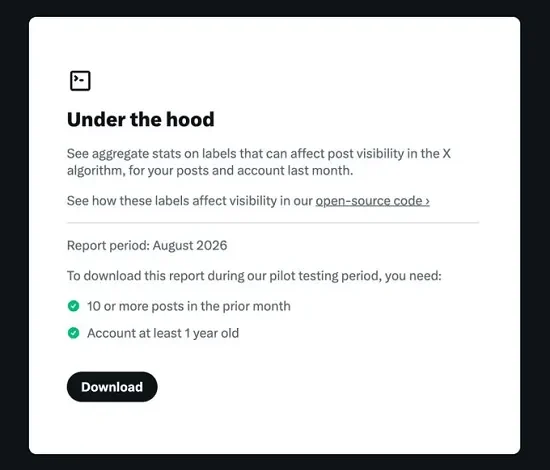
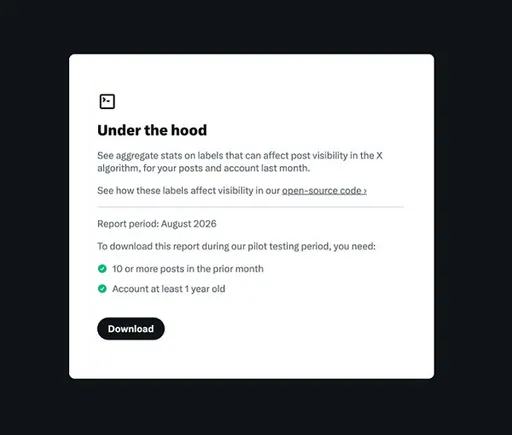
In response to these persistent concerns, X launched the "Under the Hood" update. This initial rollout provided deeper technical visibility into how the platform’s source code functions, paired with a simplified reporting interface. For the first time, users could log into their accounts and immediately view any active penalties, algorithmic downranking, or distribution restrictions applied to their profiles or individual posts over a preceding 30-day window.
The initial reception from the creator community was largely positive. Content creators, digital marketers, and influencers who rely on predictable platform reach welcomed the diagnostic clarity. However, while the first iteration of Under the Hood successfully highlighted algorithmic and trust-and-safety penalties, it left a significant blind spot: international content restrictions resulting from government-issued legal demands. When a post was withheld in a specific country due to local censorship laws or court orders, the notification mechanism was often opaque, leading to confusion and misplaced accusations of arbitrary algorithmic manipulation.
Expanding Visibility into Legal Compliance and Geographic Filtering
With the newly deployed system expansion, X is directly addressing this opacity. The platform now explicitly indicates whether an account or its individual posts have experienced limited visibility specifically because of mandatory compliance with local laws.
According to official documentation and platform announcements, users can now access granular insights specifying if a particular post was withheld in a given country following a formal legal demand. Crucially, the interface names the specific country or jurisdictions involved. This distinction is vital for distinguishing between internal platform moderation—such as automated spam filters or trust-and-safety policy enforcements—and external, government-mandated censorship.
"We’ve expanded Under The Hood after seeing people’s appreciation of more transparency into government-required content filtering," X stated in a briefing detailing the update. "In addition to showing labels applied to your account and posts in the prior month, Under The Hood now shows if your account or posts had their visibility limited because of required compliance with local law(s). For example, you can see if any of your posts were withheld in a country following a legal demand — and which country."
Eligibility Criteria and Platform Accessibility
Access to these advanced transparency insights is not entirely universal across all account tiers, as X has implemented specific guardrails to manage server load and prevent automated scraping or abuse of the reporting dashboard.
Under the current implementation guidelines, the expanded transparency metrics are available exclusively to accounts that meet two primary operational thresholds:
- Account Age: The profile must be at least one year old.
- Activity Level: The account must have published a minimum of 10 posts within the preceding 30-day calendar month.
By tying access to established accounts with a baseline level of activity, X ensures that the reporting infrastructure primarily serves active community members, verified creators, and professional publishers who possess a genuine stake in audience analytics and international reach metrics.
Implications for the Creator Monetization Program and Digital Marketing
The financial stakes of content distribution have risen dramatically in recent years. Platforms like X have transitioned from simple microblogging networks into complex ecosystems featuring robust monetization models, creator revenue-sharing programs, and subscription tiers. For professional creators and media organizations, unexpected drops in post-impressions can translate directly into lost advertising revenue and diminished audience engagement.
The integration of geographic compliance insights into the Under the Hood dashboard provides several distinct advantages for monetization participants:
- Diagnostic Precision: Creators can now definitively separate domestic algorithmic underperformance from international legal restrictions, allowing them to adjust their content strategies accordingly.
- Accountability and Trust: By clearly identifying government-ordered withholdings, X deflects criticism regarding arbitrary censorship, framing such limitations as external legal realities rather than internal platform bias.
- Strategic Market Planning: Understanding which regions block specific content enables global brands and creators to tailor their messaging to comply with local legal frameworks proactively without accidentally triggering widespread distribution penalties.
Broader Industry Context: Transparency Reports vs. Individualized User Insights
Historically, major technology companies—including Meta, Google, Apple, and X’s predecessor, Twitter—have published semi-annual or annual transparency reports detailing government requests for content removal and user data. While these macro-level reports provided valuable statistical overviews for researchers, journalists, and legal scholars, they offered virtually no actionable utility for the average user whose content was directly affected.
By shifting from macro-level transparency reports to individualized, account-level diagnostic dashboards, X is pioneering a more granular approach to platform governance. This methodology mirrors movements in other digital sectors, such as search engine optimization and digital advertising, where granular reporting tools have long been standard practice.
Industry analysts note that this approach aligns with mounting regulatory expectations worldwide. Legislation such as the European Union’s Digital Services Act (DSA) places heavy emphasis on transparency, requiring platforms to provide clear, specific statements of reasons whenever content is restricted, demonetized, or removed. While X operates globally outside the direct jurisdiction of single regulatory blocks, aligning its interface with these transparency expectations helps mitigate regulatory friction and shields the company from sustained criticism regarding arbitrary content moderation.
Expert Analysis and Potential Industry Reactions
Legal scholars and digital rights advocates have offered cautious praise for the update, noting that while transparency does not solve the underlying problem of government censorship, it significantly improves procedural fairness.
"When a government forces a platform to suppress speech, the chilling effect is often compounded by the ambiguity of the enforcement," explains a digital policy researcher tracking platform governance models. "Users are left guessing whether their post was removed due to a technical glitch, a secret algorithmic penalty, or a state-level legal demand. By itemizing these actions down to the specific post and the specific country, X is providing a degree of evidentiary clarity that has been largely missing from the social media landscape."
However, civil liberties organizations also point out the inherent tension platforms face when complying with authoritarian or restrictive legal regimes. While displaying a notification that content was withheld due to local laws informs the creator, it simultaneously highlights X’s compliance with local censorship demands. Critics argue that transparency regarding censorship is a necessary step, but it does not substitute for robust resistance against overreaching government demands—a balance that modern social media executives must constantly negotiate to maintain market access in key international territories.
Future Outlook for X’s Transparency Roadmap
As the digital regulatory landscape continues to evolve, social media platforms are under continuous pressure to refine their moderation toolkits. X’s ongoing development of the Under the Hood initiative suggests that user-facing transparency diagnostics will become a standard competitive differentiator in the social media industry.
Looking ahead, industry watchers anticipate that X may further expand its reporting capabilities to include predictive analytics—warning creators before publication if a proposed post is likely to trigger regulatory flags in specific jurisdictions. Additionally, as artificial intelligence plays a larger role in both content generation and automated moderation, integrating AI-driven compliance assistants into user dashboards could become the next frontier in platform transparency.
For now, the immediate rollout of geo-specific compliance reporting marks a mature step forward for X’s governance model. By demystifying the intersection of international law and digital reach, the platform empowers its user base with the data necessary to navigate an increasingly complex global communications ecosystem.
Related posts: