The Great Airbnb Chore War: How a New Policy on Guest Cleaning Duties Sparked a Revolt Among Property Hosts

Airbnb is facing a major internal backlash following the implementation of a sweeping policy update designed to curb excessive checkout chores for travelers. The platform, which has grown into a titan of the global lodging industry, instituted rules prohibiting hosts from forcing guests to handle time-consuming cleaning tasks prior to departure. While the directive was welcomed by consumers weary of paying steep cleaning fees only to face a lengthy list of domestic duties, it has ignited a fierce rebellion among property owners. Across online forums, social media networks, and advocacy platforms, hosts are protesting, threatening strikes, and questioning their long-term futures on the platform, turning a routine corporate policy shift into a profound ideological debate over the nature of modern hospitality.
Background and Context of the Policy Shift
To understand the current friction between Airbnb management and its host community, one must look at the evolution of the platform’s fee and chore structures over the past decade. Originally marketed as a peer-to-peer alternative to traditional hotels—where individuals could rent out spare rooms or secondary properties—Airbnb gradually attracted professional real estate investors, property management companies, and individual hosts seeking substantial secondary income.
As the platform scaled, a common consumer grievance emerged: travelers reported paying increasingly exorbitant cleaning fees, sometimes amounting to hundreds of dollars per stay, only to receive a detailed list of checkout chores upon arrival. These instructions frequently included stripping beds, washing and putting away dishes, taking out the trash, sweeping floors, gathering used towels, and turning off specific appliances. Public dissatisfaction peaked on social media platforms like X (formerly Twitter) and TikTok, where viral posts mocked listings that charged high cleaning fees while treating guests like unpaid domestic staff.
In response to sustained consumer pressure and declining brand perception, Airbnb leadership moved to overhaul the user experience. The updated guidelines, which apply to all reservations booked on or after November 20, explicitly bar hosts from demanding that guests complete strenuous tasks or labor typically performed by professional cleaning crews. Under the new standards, rules and requests must be transparently disclosed in a designated listing section prior to booking, preventing hosts from springing unexpected chores on travelers after payment has been processed.
The Host Rebellion: Petitions, Strikes, and Platform Threats
The regulatory crackdown has not gone over quietly within the host community. A significant faction of property owners argues that the policy strips them of operational autonomy, undermines property preservation, and misunderstands the fundamental mechanics of self-catering accommodations.
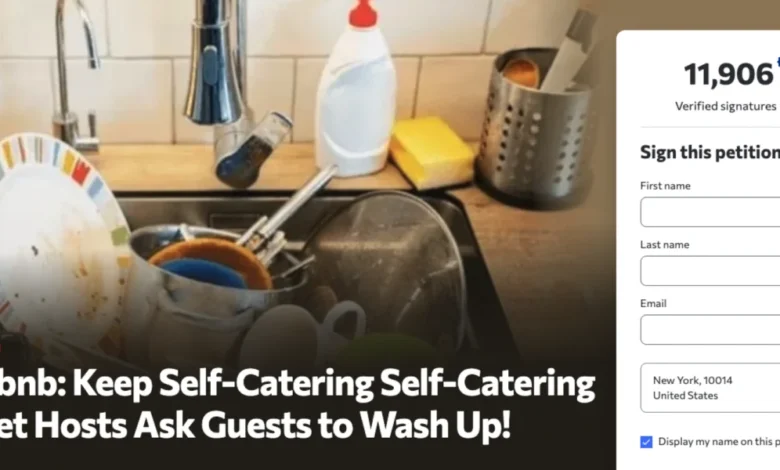
A prominent Change.org petition, which has amassed more than 11,000 verified signatures, calls on Airbnb to reverse its restrictions on asking guests to wash dishes. Organizers of the petition argue that renting a property equipped with a kitchen carries an inherent responsibility for basic cleanliness. The petition text asserts that washing a plate or a pan does not constitute a professional cleaning duty, but rather represents a standard aspect of living responsibly in another person’s private space. Organizers warn that forcing hosts to absorb these added labor costs or hire external cleaners will inevitably drive up nightly rental rates for consumers.
Economic and operational anxiety has also spurred radical forms of protest. According to industry reports from outlets like WIRED, discussions within closed Facebook groups for hosts have yielded proposals for coordinated boycotts, including plans to collectively unlist properties for several days to remind the corporation of its reliance on independent property owners.
Individual hosts have voiced similar disillusionment. Ryan Robbins, a property owner in Searsport, Maine, told regional media that while he cleans his own rental and typically only asks guests to wash their dishes, the blanket policy prevents him from managing his investment according to local needs. On Airbnb’s official community forums, frustrated hosts have echoed these sentiments, arguing that the company is attempting to force a rigid, hotel-style model onto diverse peer-to-peer properties. Some Reddit users in specialized host subreddits have even begun floating the idea of organizing a rival platform to challenge Airbnb’s market dominance, characterizing the company as increasingly hostile to the very people who supply its inventory.
The Counter-Movement: Progressive Hosts Embrace the Change

Despite the vocal opposition, the host community is far from unified. A substantial cohort of property owners has taken to online forums to defend the new policy, arguing that excessive chore lists damage the reputation of the platform and alienate travelers.
In discussions on Reddit’s r/airbnb_hosts community, several Superhosts expressed frustration with the practices of their peers. One user recounted a recent personal travel experience where a steep cleaning fee was paired with a demand to strip beds, start laundry loads, and navigate a complex parking garage simply to dispose of trash. Several hosts pointed out practical operational reasons for avoiding guest-led chores, noting that leaving beds unstripped allows owners or cleaners to inspect linens for stains or damage immediately upon arrival, rather than finding out about ruined mattresses or upholstery long after the guest has departed.
Furthermore, proponents of the policy argue that treating short-term rentals like traditional hotels is essential for remaining competitive in the broader lodging market. In a widely discussed thread, a host managing multiple "no chores" properties urged colleagues to reframe their business model. They emphasized that professional hospitality enterprises do not charge customers for cleaning and simultaneously demand manual labor. Other contributors noted that considerate travelers naturally tidy up out of basic courtesy, and that rigid chore mandates risk antagonizing the very guests who would have left the property in pristine condition anyway.
Navigating the Line Between Chores and Basic Rules
A central point of confusion during the rollout of the new policy has been distinguishing between prohibited chore lists and necessary property rules. Many hosts utilize house rules to ensure compliance with local government ordinances, homeowners association (HOA) bylaws, fire safety regulations, and neighborhood noise restrictions.
Airbnb’s updated framework accommodates these realities by providing a dedicated, separate section for local rules and legal disclosures, ensuring that property owners can still enforce safety and regulatory guidelines without imposing domestic chores. Simultaneously, the company’s foundational ground rules for guests remain fully active. The platform explicitly maintains that travelers do not have permission to leave a rental in a catastrophic state requiring excessive or deep cleaning—explicitly citing scenarios such as moldy dishes, biohazards, or heavily soiled carpets as violations. Hosts retain the right to submit documentation, leave honest cleanliness reviews, and seek financial compensation through Airbnb’s AirCover protection program if a guest abuses the property.
As one experienced host summarized in an online discussion: "Most guests just clean up because it’s normal human behavior, not because you told them to. The ones who don’t won’t change regardless of what the rules say."
Fact-Based Analysis of Broader Implications and Market Impact
The ongoing dispute over Airbnb checkout chores highlights a critical transitional phase for the short-term rental industry. As the sector matures, it faces mounting pressure to professionalize its standards to match consumer expectations set by the traditional hotel and resort industry.
Economically, the policy shift is expected to trigger a period of structural adjustment. Hosts who previously relied on guests to perform heavy lifting during turnarounds may now need to adjust their pricing models to absorb the cost of professional cleaning services or allocate more personal time to property maintenance. While some fear this will compress profit margins, consumer advocates suggest it will lead to greater price transparency, as upfront listing costs will more accurately reflect the true price of the stay rather than hiding labor requirements in the fine print.
From a brand perspective, Airbnb’s willingness to alienate a portion of its host base underscores the company’s strategic pivot toward protecting the consumer experience. In a competitive travel landscape where alternatives like Vrbo, Booking.com, and boutique hotels are readily available, eliminating friction at checkout is seen as vital for retaining customer loyalty.
Whether the disgruntled host faction will follow through on threats of strikes or platform migration remains to be seen. Historically, the immense liquidity and massive consumer traffic offered by Airbnb make it difficult for independent hosts to abandon the platform entirely. Nevertheless, the Great Chore War of recent weeks demonstrates that the uneasy alliance between a tech intermediary, entrepreneurial property owners, and everyday travelers remains perpetually vulnerable to friction over who cleans up when the vacation ends.