The Great SEO Pivot: Why Chasing AI Citations Is a Strategic Misstep in the Age of Agentic Search


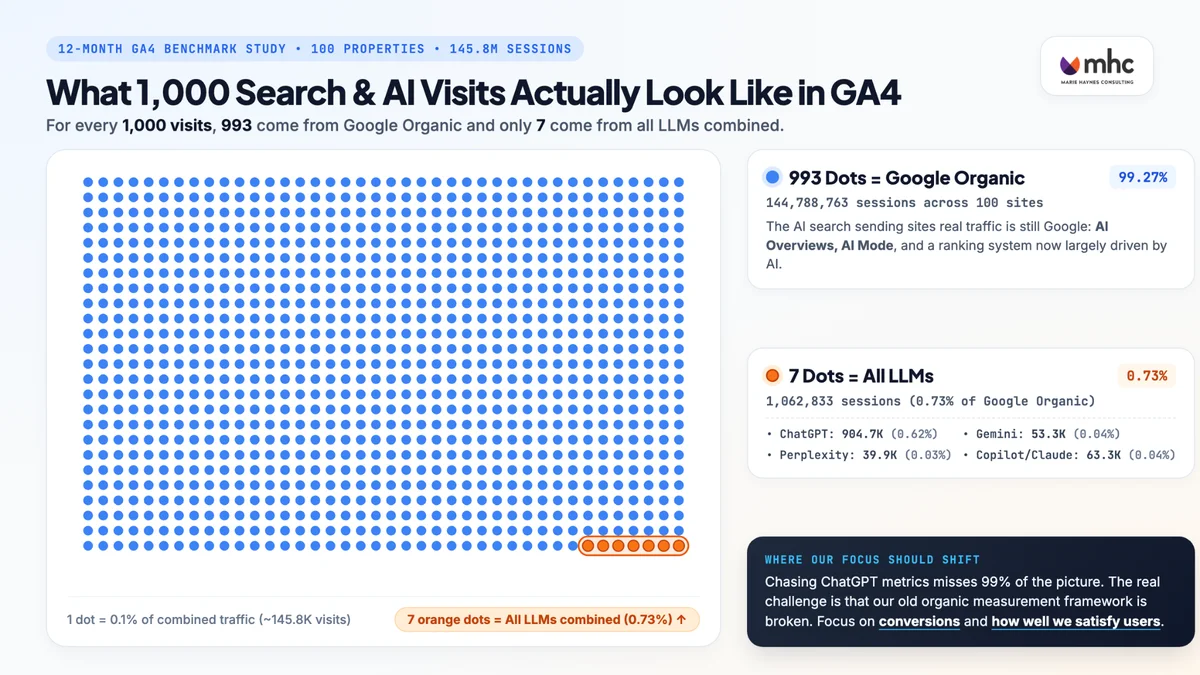
The digital marketing landscape is undergoing a profound transformation as artificial intelligence redefines the mechanics of discovery. For years, search engine optimization (SEO) practitioners have been fixated on "Generative Engine Optimization" (GEO), obsessing over whether large language models (LLMs) like ChatGPT cite their brand content. However, new data indicates that this preoccupation may be a significant strategic distraction. A comprehensive analysis of 100 diverse websites, encompassing over 145 million sessions, reveals that traffic driven by LLMs remains a statistically negligible fraction of total web volume, while the traditional search giant, Google, maintains an overwhelming dominance in both traffic acquisition and conversion generation.
The Reality of Traffic Distribution
Current industry sentiment has been heavily skewed by the meteoric rise of generative AI. Since the widespread adoption of LLMs in late 2022, marketers have feared—and hoped for—a total disruption of the traditional organic search model. Data collected over a 12-month period suggests, however, that the shift has not materialized as predicted.

In the analyzed dataset, sessions originating from ChatGPT accounted for a mere 0.62% of the traffic driven by Google Organic. When the scope was expanded to include all other prominent LLMs, the total AI-driven referral volume reached only 0.73%. These figures provide a sobering reality check for businesses pouring significant resources into AI-specific optimization at the expense of core search performance. While ChatGPT users may demonstrate higher conversion rates—often exceeding 4.5 times the rate of Google organic visitors—the absolute volume of these conversions is dwarfed by the massive scale of Google’s ecosystem. Google organic search continues to drive approximately 96.5% of total conversions across the monitored sites, with a conversion volume 27 times higher than that of all LLMs combined.
Chronology of the AI Traffic Plateau
The trajectory of AI-driven traffic has not followed the exponential growth curve many analysts anticipated. Following the initial excitement surrounding the launch of ChatGPT and subsequent iterations of LLM technology, traffic growth saw a sharp, upward trend throughout 2023 and 2024. However, this growth hit a structural ceiling.
By August 2025, concurrent with the release of GPT-5, the exponential increase in ChatGPT referral sessions abruptly stalled. Recent trends indicate that, rather than continuing to climb, ChatGPT is now contributing fewer visitors to external websites than it did at its peak. This plateau suggests that LLMs are increasingly functioning as "closed-loop" environments—providing answers within the chat interface rather than acting as gateways to external content. This architectural choice by AI developers reinforces the necessity for brands to stop optimizing for "mentions" and instead focus on how their content interacts with the evolving, agent-led search infrastructure.
Google as the Primary AI Search Engine
It is a common misconception that the shift to AI search is occurring solely through third-party platforms. In reality, Google remains the most critical AI search engine in existence. Through the integration of AI Overviews, "AI Mode," and core ranking algorithms now heavily reliant on deep learning, Google is delivering AI-driven experiences to millions of users daily without forcing them to abandon the search engine’s interface.
Industry leaders argue that the obsession with "GEO" misses the fundamental evolution of Google itself. The search engine is no longer just a list of blue links; it is a complex, predictive AI system that prioritizes user satisfaction and intent. Consequently, the most effective SEO strategy in the current climate is not to "game" the LLM, but to ensure that a brand provides the most helpful, high-quality, and satisfying experience for a user—and by extension, the algorithms that represent them.
The Emergence of the Agentic Web
The future of search lies in the concept of the "Agentic Web," where search engines evolve into active work coordinators or "agent managers." As articulated by Google CEO Sundar Pichai, the role of search is shifting from passive information retrieval to active task completion. This transition is marked by several key technological developments that represent the next frontier for businesses:

- Universal Cart and Merchant Center: The "Universal Cart" allows users to aggregate products from multiple retailers and complete transactions directly within Google Wallet. For businesses, the opportunity lies in meticulous management of the Google Merchant Center. Mastery of this data—ensuring accurate stock status, competitive pricing, and rich product information—is now essential for being included in these native checkout experiences.
- Universal Commerce Protocol (UCP): A collaborative effort between Google, Shopify, and Stripe, UCP creates an open discovery layer that allows AI agents to compare inventory and execute purchases without the user ever visiting a retailer’s website. Businesses must now consider "agentic discovery" as a pillar of their technical SEO, ensuring their product endpoints are optimized for these automated systems.
- WebMCP (Model Context Protocol): This standard enables websites to expose interactive functions, such as booking schedulers, calculators, and complex forms, directly to AI agents. By integrating WebMCP, a business allows an AI agent to perform tasks on behalf of the user, effectively turning a website into an interactive application for machine users.
- Intelligent Eyewear and Multimodal Search: The rollout of "Intelligent Eyewear" running on Android XR platforms marks a shift from screen-based search to ambient, real-time assistance. This technology will allow users to interact with the world around them through AI, creating new opportunities for service-oriented businesses to provide "just-in-time" guidance, from home repairs to retail shopping, via voice and visual interfaces.
Strategic Implications for Business
The data indicates that the "AI revolution" is not a singular event but a series of incremental changes that require a fundamental shift in how businesses view their digital presence. For organizations, the path forward involves three core actions:
- Prioritize Conversions Over Clicks: Given that many businesses still lack robust tracking for key events, the first priority is to define and measure success beyond simple traffic volume. Understanding what a "conversion" looks like in an agentic world is critical.
- Invest in Structured Data and Feeds: As the web moves toward machine-readable, agent-driven interactions, technical hygiene—specifically in product feeds and API-accessible toolsets—will become the new competitive advantage.
- Adopt an Experimental Mindset: Technologies like WebMCP and Android XR are in their infancy. Rather than waiting for widespread adoption, businesses should begin low-lift experiments to understand how their specific services can be "consumed" by AI agents.
The professional consensus is that the era of chasing LLM citations is drawing to a close. The future of search will be defined by the businesses that can effectively interface with the agentic systems that now govern discovery, commerce, and daily life. While the "blue link" era of search is not over, its dominance is being superseded by a more integrated, proactive, and machine-first ecosystem. By shifting focus from vanity metrics to the foundational architecture of the agentic web, businesses can position themselves to thrive in an environment where search is no longer a destination, but a utility.