Inside the Engine of OpenAI’s ChatGPT Advertising Ecosystem: A Technical and Strategic Breakdown

OpenAI has officially unveiled the underlying architecture of its ChatGPT advertising system, providing a detailed look at how the company integrates commercial content into conversational AI while maintaining a strict firewall between ad selection and organic response generation. This technical disclosure arrives as OpenAI marks a significant milestone in its monetization strategy, reporting that its advertising platform has reached an annualized revenue run rate of $1 billion in fewer than 200 days since its inception. With over 100,000 advertisers having participated in the program, the company is attempting to demystify the "orchestrator" model that powers its ad delivery, addressing industry concerns regarding user experience, data privacy, and the influence of commerce on generative intelligence.
The Chronology of ChatGPT’s Monetization
The path to this billion-dollar run rate began with intense internal development following the explosive growth of ChatGPT. While the platform was initially a pure utility, the high computational costs associated with large language models necessitated a sustainable revenue model. OpenAI began testing ad integrations quietly, focusing on non-intrusive placements that complemented the user’s informational journey. By mid-2024, the company began rolling out these features to a broader pool of advertisers, emphasizing "conversational relevance" over traditional keyword-based targeting. The rapid adoption—reaching six figures in advertiser participation in less than seven months—suggests that brands are eager to tap into the high-intent traffic generated by AI chat sessions.
Architectural Separation: The Firewall Between Content and Ads
A central pillar of OpenAI’s disclosure is the separation of concerns within its technical stack. According to the company, the system responsible for selecting and rendering advertisements operates on an entirely different set of models and codebases than the system tasked with generating answers for the user. This separation is intended to ensure that the integrity of the information provided by ChatGPT remains uncompromised by commercial interests.
The mechanics are designed to be asynchronous. As the language model constructs a response, the "ads orchestrator" simultaneously monitors the conversation in real-time. Crucially, the ad selection process does not feed back into the language model’s reasoning engine. If the advertising system fails to return a result or experiences latency, the generative AI continues to function uninterrupted, ensuring that the user experience is never degraded by the ad-serving infrastructure. If an ad is selected but arrives after the response has already been rendered, it is discarded rather than forced into the interface. This design choice serves as a technical safeguard to uphold the perception of neutrality, though critics note that the lack of third-party, independent auditing leaves some degree of "black box" uncertainty regarding the absolute influence of commercial algorithms on AI outputs.
The Role of the Orchestrator and Contextual Awareness
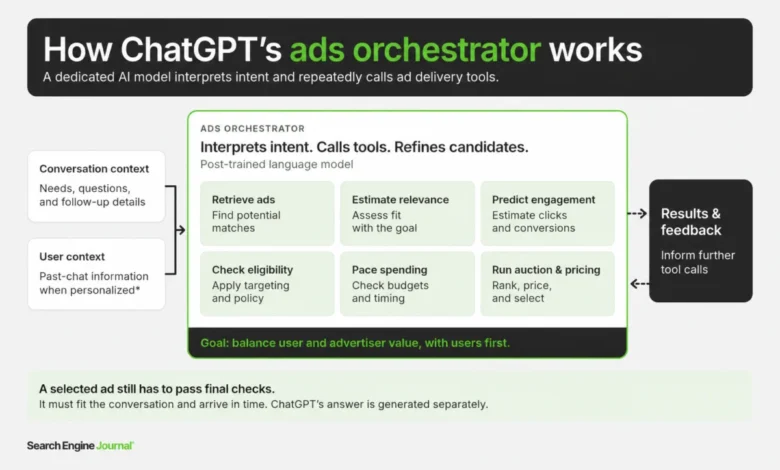
At the heart of the system is the "orchestrator," a specialized language model that acts as an intelligent intermediary. Unlike traditional search engines that rely on static keyword matching, the orchestrator utilizes "stateful" sessions. This allows the system to retain context throughout a dialogue, identifying the user’s intent even if that intent evolves over several turns of conversation.
When a user engages with ChatGPT, the orchestrator transforms fragments of the dialogue into "embeddings"—mathematical representations of meaning. These embeddings allow the system to identify relevant advertisements even when the user’s phrasing does not align perfectly with an advertiser’s set keywords. For example, if a user begins a session with broad questions about business efficiency and later asks specifically about project management software pricing, the orchestrator maintains the context of the user’s previously mentioned needs—such as the requirement for "free guest accounts"—to filter and rank potential ads. This ability to synthesize intent across multiple messages is what differentiates the ChatGPT ad experience from traditional display advertising.
The Lifecycle of an Ad: From Query to Impression
The journey of an advertisement within this ecosystem is a multi-stage process involving rigorous validation. Once the orchestrator identifies potential candidates, it performs a series of eligibility checks, evaluating criteria such as geographical targeting, budgetary constraints, and brand-safety policy compliance.
Following these initial checks, the selected ads are funneled into an auction. It is important to note that the language model itself does not determine the auction winner; it merely acts as the filter that selects the candidates for the auction tool. The auction process handles the final ranking, pricing, and ultimate selection based on a combination of relevance, past performance data, and the probability of user engagement.
However, winning an auction is not a guarantee of an impression. OpenAI implements a final post-auction "appropriateness" check. If the system determines that the ad, while technically relevant and policy-compliant, is contextually discordant or potentially intrusive given the tone of the ongoing conversation, it will suppress the ad entirely. This "gatekeeper" function is intended to preserve the quality of the user experience, yet it creates a complex reporting environment for advertisers who may see their bids fail without clear diagnostic feedback.
Implications for Advertisers and Market Transparency
While the technical transparency provided by OpenAI is a step forward, it highlights significant gaps for marketing professionals. Advertisers currently lack a granular view of why their campaigns may be underperforming. Because the system tracks multiple failure points—including auction losses, relevance rejections, and timing issues—advertisers are often left to guess which stage of the funnel requires optimization.
Furthermore, while the $1 billion revenue figure is an impressive metric of adoption, it does not disclose the return on investment (ROI) for those 100,000 advertisers. Industry analysts point out that without benchmarks regarding Customer Acquisition Cost (CAC) or Return on Ad Spend (ROAS), the long-term sustainability of the platform remains speculative. The lack of controlled studies regarding "incremental lift"—or the number of sales that would have occurred regardless of the ad—also presents a challenge for brands attempting to justify their spend in an era of tightening digital marketing budgets.
The Need for Advanced Reporting and Future Outlook
As OpenAI continues to scale its advertising business, the demand for more robust performance analytics will likely intensify. Advertisers are increasingly calling for transparency regarding how their ads are being contextually integrated and why certain segments of their audience are being reached while others are ignored.
The current state of ChatGPT advertising represents a shift toward "intent-based" marketing, where the AI’s ability to understand human nuance is the primary product. For the 100,000+ businesses already utilizing the platform, the key to success will be moving beyond simple search-term targeting and toward a more sophisticated understanding of how their value propositions fit into the conversational flow.
In the coming quarters, the industry will be watching for two things: first, whether OpenAI provides clearer diagnostic reporting to help advertisers understand their impression volume; and second, whether the company releases case studies that demonstrate tangible conversion data. Until then, ChatGPT’s advertising ecosystem remains a high-potential but high-opacity environment, where technical brilliance meets the unresolved challenges of digital marketing accountability. The rapid growth of this revenue stream is a testament to the platform’s influence, but its ultimate success will depend on its ability to prove that it can drive real-world results for the businesses that fuel its expansion.