The Paradigm Shift: How Artificial Intelligence and Agentic Automation Are Redefining Marketing Agency Contracts and Operating Models

The rapid evolution of artificial intelligence and machine learning architectures has catalyzed a fundamental restructuring of marketing agencies across all disciplines, including media, creative, performance, brand, measurement, and lifecycle advocacy. For decades, the foundational economic model governing the relationship between brands and their marketing agencies relied heavily on manual labor, billable hours, and media-spend percentages. However, the maturation of platform intelligence, autonomous bidding systems, and agentic workflows has rendered traditional agency operating models obsolete. Industry analysts and enterprise marketing leaders are now confronting a structural reality: automation has absorbed the vast majority of tactical execution, necessitating a comprehensive renegotiation of agency compensation, contracts, and operational scope.
Background Context and Industry Evolution
To understand the current friction in agency-client relationships, one must examine the historical mechanics of digital marketing operations. Over the past twenty-five years, as advertising migrated from traditional print and broadcast mediums to programmatic digital environments, marketing agencies scaled their workforces primarily as execution armies. Contracts were structured around the volume of human labor required to manage complex multi-channel campaigns. Tasks such as keyword research, match-type sculpting, audience segmentation, daily bid adjustments, budget pacing, creative assembly, and manual reporting formed the bedrock of agency Statements of Work (SOWs).
Crucially, the predominant compensation mechanism—the percent-of-media-spend model—created a perverse commercial incentive. Because agencies were compensated proportionally to the sheer volume of capital deployed, they were structurally disincentivized from adopting efficiencies that reduced manual intervention or optimized media spend downward. Furthermore, the necessity for clients to justify agency expenditures led to a proliferation of administrative overhead, including bi-weekly status meetings, extensive multi-tab manual reporting spreadsheets, and continuous micro-optimization rituals that often disrupted the machine learning cycles of modern advertising platforms.
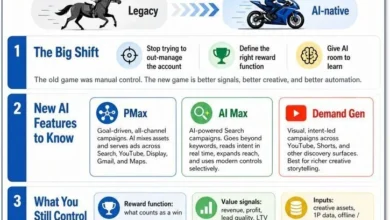
By late 2024 and into 2025, the commercial deployment of platform-native artificial intelligence tools—such as Google’s Performance Max, Meta’s Advantage+, and various autonomous agentic systems—reached a critical threshold. These algorithms demonstrated an unprecedented capacity to process millions of contextual signals in real time, outperforming human operators in narrow execution tasks. Consequently, the ongoing manual intervention by agencies in routine campaign management has increasingly been recognized as counterproductive, frequently resetting algorithmic learning phases and degrading overall performance.
Timeline of Contractual Transformation
As enterprises prepare for budgetary cycles extending into 2026 and 2027, the timeline for structural agency transformation has accelerated. Industry benchmarks indicate a phased realization of cost efficiencies and scope reallocations across three distinct operational horizons:
- Immediate Term (Mid-2026): Enterprises are projected to achieve a 25% to 75% reduction in baseline agency fees as legacy administrative, reporting, and execution tasks are fully absorbed by platform intelligence. This phase involves the aggressive pruning of old-world SOW deliverables.
- Medium Term (Late 2026 to 2027): Concurrently, contracts are expected to expand by 15% to 25% to accommodate newly elevated strategic imperatives, such as cross-platform consumer behavior analysis, advanced data engineering, brand safety governance, and creative concept pre-testing.
- Long-Term Integration (2028 and Beyond): Analysts predict the complete eradication of hourly billing and percent-of-media compensation models, replaced entirely by lean base retainers, project-based fees, and verifiable incremental outcome incentives.
Structural Breakdown of SOW Subtractions
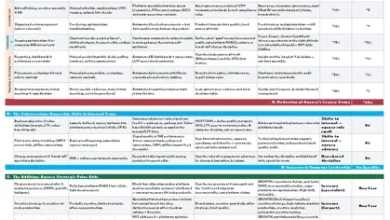
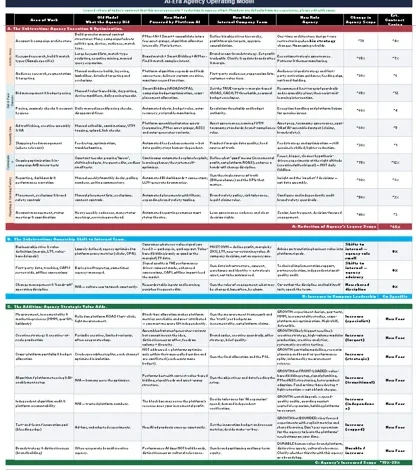
A rigorous examination of traditional agency contracts reveals twelve distinct operational dimensions that are rapidly migrating to automated systems. These dimensions can be consolidated into five primary operational clusters, each demonstrating substantial reductions in human effort and corresponding contract cost weight:
- The Agency Activity Army: Spanning account and campaign architecture, keyword research, and audience segmentation, this cluster historically accounted for approximately 22% of contract cost weight. With automated asset grouping and intent-based algorithms, this workload can be reduced by roughly 78%.
- The Bid and Pace Dancers: Encompassing manual bidding, budget pacing, dayparting, and anomaly checks, this category represents roughly 14% of contract cost weight. Continuous autonomous bidding models allow for a 73% reduction in human labor, eliminating the counterproductive "rescue" interventions that previously sabotaged machine learning.
- The Assembly Line: Covering ad builds, creative variations, tagging, and feed management, this segment constitutes about 12% of contract cost weight. Generative AI tools and platform-native asset synthesis enable a 45% reduction in manual trafficking and assembly.
- The Optimization Theater: Consisting of daily pause/scale rituals, minor A/B testing, and fragmented learning agendas, this is often the most destructive cost center at 16% of contract weight. Modern explore-exploit algorithms execute continuous testing at scale, allowing for a 75% reduction in manual agency optimization.
- The Reporting and Servicing Factory: Comprising manually compiled slide decks, status meetings, and multi-tab spreadsheets, this cluster represents the largest cost weight at approximately 30%. Front-end automated data lakes and streamlined communication protocols reduce this administrative burden by roughly 60%.
When synthesized across all operational clusters, organizations that successfully restructure their agency agreements stand to eliminate significant redundancy, yielding net baseline contract savings while redirecting capital toward high-value strategic initiatives.
The New Agency Operating Model
To align agency incentives with the realities of an artificial intelligence-driven ecosystem, industry experts emphasize the necessity of migrating away from antiquated remuneration frameworks. The percent-of-media-spend model must be replaced by a modern tri-part contract structure designed to reward strategic judgment rather than operational friction:
- Lean Base Retainer (40% to 50% of Total Fees): Designed to cover essential governance, executive steering, and data engineering infrastructure.
- Project Fees (30% to 40% of Total Fees): Allocated for specialized, high-impact initiatives including creative concept ideation, pre-testing, portfolio strategy, and complex strategic analytics.
- Outcome Incentives (15% to 25% of Total Fees): Tied directly to verifiable incremental profit or revenue lift, explicitly excluding platform-reported Return on Ad Spend (ROAS) metrics that fail to measure true business incrementality.
Fact-Based Analysis of Implications
The transition toward an agentic operating model carries profound implications for both brands and agency holding companies. For enterprises, the primary challenge lies in internal change management. Procurement and marketing departments must transition from buying hours to purchasing advanced operational models, ensuring internal marketing managers do not penalize agencies for reducing manual interventions. Furthermore, brands must secure absolute, independent ownership of their advertising accounts, pixels, and data pipelines to prevent vendor lock-in.
For marketing agencies, the shift represents both an existential threat and a historic professional liberation. Traditional agencies that rely on billable-hour models and junior-staff arbitrage face severe attrition. However, forward-thinking agencies that embrace the transformation can shed low-margin execution tasks, elevate employee compensation, and position themselves as indispensable strategic partners. By focusing on cross-client pattern recognition, governance, and creative audacity, modern agencies are evolving from tactical task-takers into vital architects of long-term commercial growth.