The Dawn of Predictive Media Intelligence: Anticipating Tomorrow’s Headlines Today

In the hyper-connected landscape of the 21st century, the velocity at which brand narratives evolve is unprecedented. A seemingly innocuous customer post, initially garnering minimal attention, can rapidly escalate into a mainstream concern, shaping public perception before a brand even has an opportunity to formulate a response. This seismic shift in information dissemination underscores the growing imperative for organizations to adopt forward-thinking strategies, moving beyond reactive monitoring to embrace predictive media intelligence.
The Shifting Sands of News Discovery
The traditional gatekeepers of news dissemination are increasingly being supplanted by the very platforms where everyday conversations unfold. According to the Q1 2026 Sprout Social Pulse Survey, social media has emerged as the paramount channel for discovering breaking news, cited by 49% of consumers. This figure eclipses traditional television (45%) and digital news apps (32%), signaling a profound transformation in how individuals engage with and consume information. For businesses, this dynamic creates a critical gap between external events and the internal validation of data. Historical reports, while valuable for understanding past occurrences, often fall short in providing the timely insights needed to navigate rapidly evolving situations.
This is precisely where predictive media intelligence, a sophisticated branch of social intelligence, offers a transformative solution. By leveraging Artificial Intelligence (AI) to analyze live social and media data, these technologies can identify emerging patterns and forecast the trajectory of public narratives before they reach their peak. This proactive approach allows organizations to anticipate, rather than merely react to, the unfolding media landscape.
Defining Predictive Media Intelligence and Monitoring
Predictive media intelligence encompasses a suite of advanced technologies designed to empower PR professionals, reporters, and marketing teams. Its core function is to forecast the potential impact of news stories, emerging consumer trends, and to inform the creation of optimized content and earned media strategies. This is achieved through the meticulous analysis of patterns across social, digital, and traditional news media. Key indicators include the speed at which a story is disseminating, the demographics and influence of engaging audiences, shifts in sentiment, and the historical prevalence of similar issues. These data points allow predictive systems to estimate which conversations are likely to gain traction, which might fade, and which demand immediate attention.

The increasing availability of public data, coupled with advancements in processing power and AI algorithms, underpins the efficacy of these predictive models. This trend aligns with a broader societal embrace of predictive analytics, which is revolutionizing fields ranging from cybersecurity threat detection to food safety protocols. For communications and marketing departments, predictive media intelligence injects a crucial element of confidence into an often chaotic media environment. Reputation threats, potential crises, and significant news events can emerge simultaneously across numerous channels. Predictive analysis enables communicators to discern underlying patterns amidst the noise, facilitating more informed decisions regarding what to monitor, when to engage, and when to escalate.
Predictive media monitoring, a direct application of this intelligence, focuses on detecting newly published news stories and forecasting their likely impact in the immediate hours and days ahead. This capability is invaluable for reporters and communications professionals who require advance knowledge of a story’s potential reach to inform critical decisions, whether in managing a crisis or capitalizing on a time-sensitive opportunity. For instance, organizations like the World Health Organization (WHO) have utilized predictive monitoring to identify burgeoning commentary around vaccine-related topics, enabling their communications teams to prepare informed briefings. On a more routine level, brands can employ these tools to gauge the escalating visibility of a critical news story or assess the relevance of a cultural trend for potential engagement.
The Mechanics of Predictive Media Monitoring
While traditional media monitoring tools meticulously track mentions, coverage, and engagement after an event has occurred, predictive media monitoring introduces a crucial forward-looking dimension. It shifts the focus from retrospective analysis to anticipating future developments.
| Traditional Media Monitoring | Predictive Media Monitoring |
|---|---|
| Tracks mentions, coverage, and engagement post-event | Detects emerging stories and forecasts future reach |
| Helps understand what happened | Helps anticipate what may happen next |
| Relies heavily on historical data and reporting | Combines historical patterns with real-time engagement activity |
| Supports retrospective analysis and reporting | Supports faster decision-making during active moments |
| Shows where attention has been | Shows where attention may be headed |
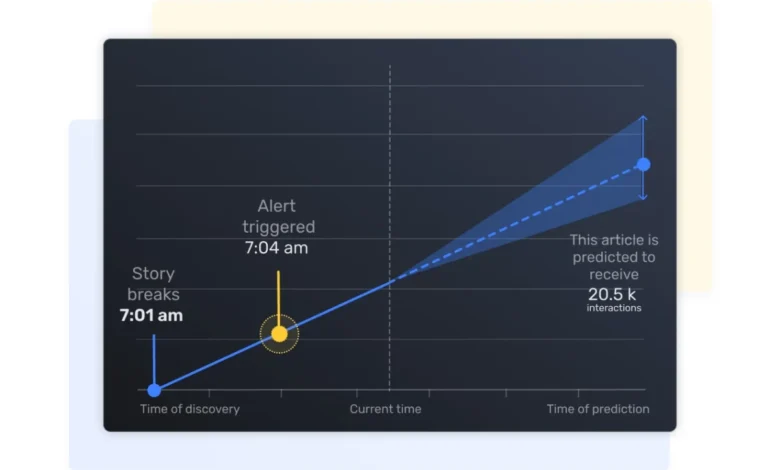
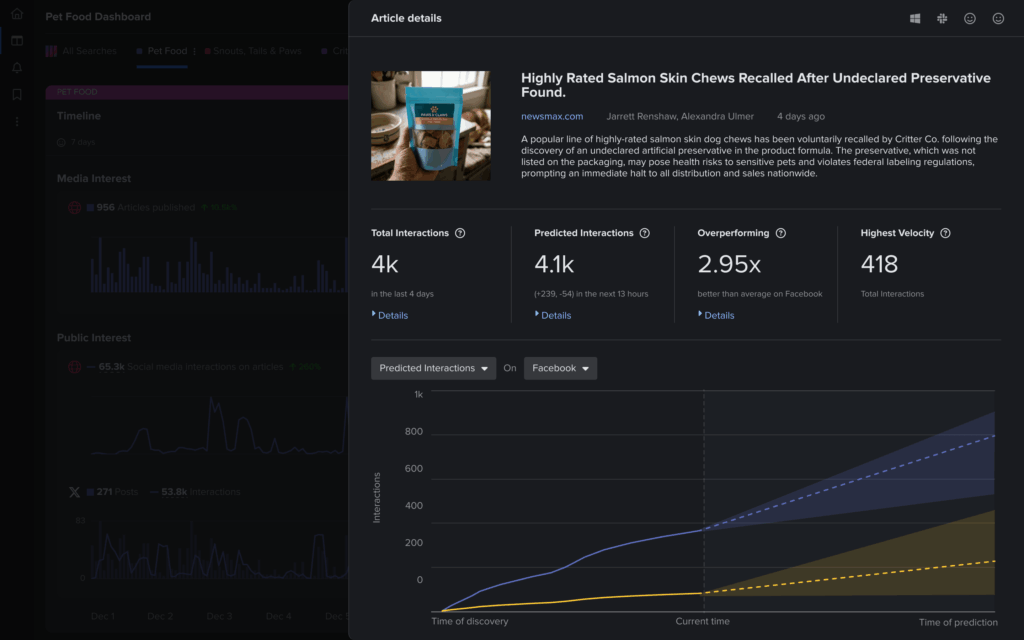
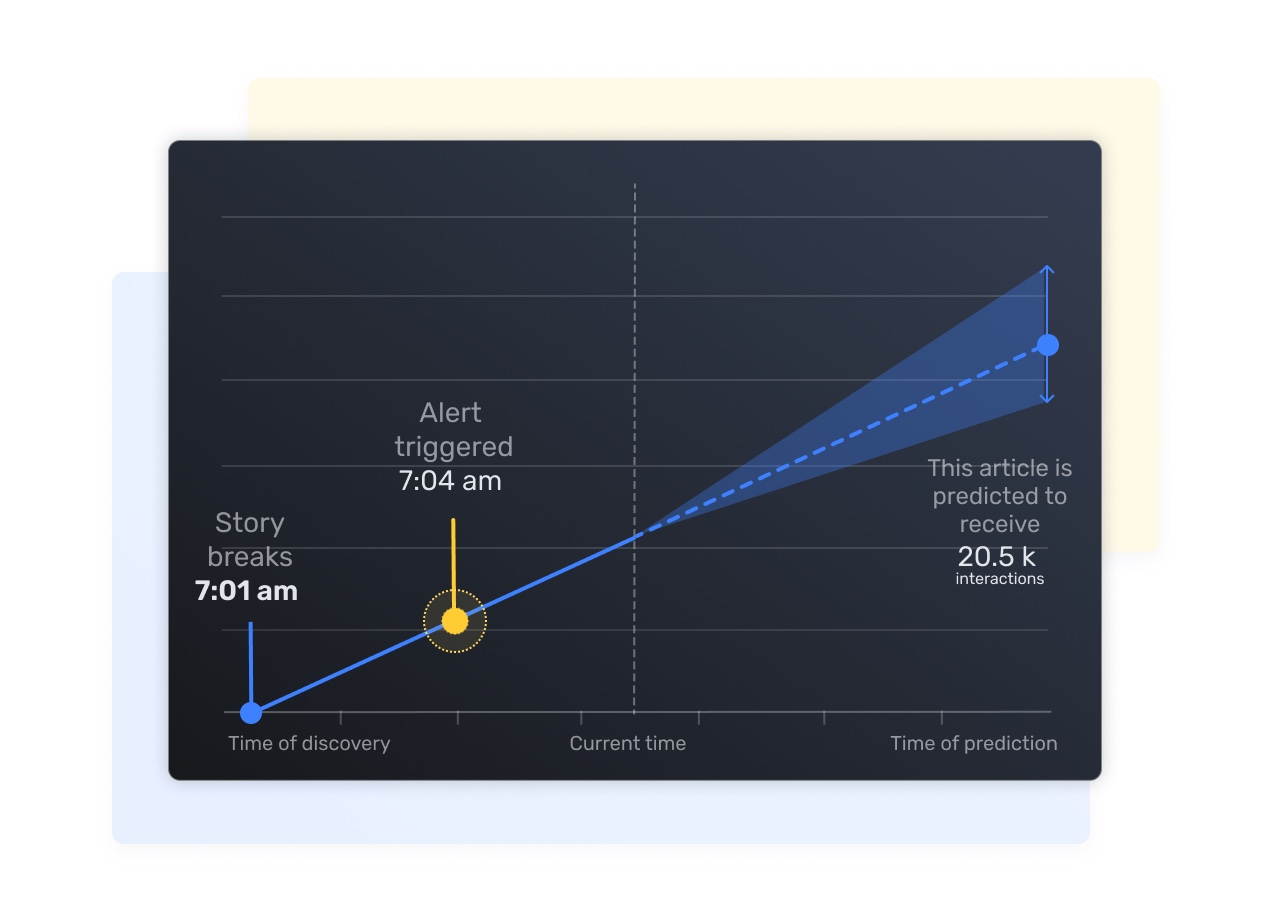
Platforms like NewsWhip by Sprout Social initiate the predictive process from the moment a news story or social post is published. They capture granular details such as the source, category, author, and topic, alongside real-time engagement data. By calculating the rate of engagement change, these systems can project the expected level of future interaction. When a story is predicted to grow in influence, users can identify the specific reports or content likely to drive engagement, the potential speed of dissemination, and the demographics of engaged audiences. This comprehensive insight empowers communicators to understand audience attention and discern whether a narrative is likely to dissipate or persist.
Jaclyn Ruelle, formerly of The Martin Agency, articulated the value proposition, stating, "We rely on NewsWhip predicted interactions to see if this story is going to die out by this time tomorrow morning… Or if our brand joined the story is it on the brink of being something that could have some staying power and push beyond the 24-hour window?" The predictive capabilities are dynamic, adapting to new inputs. A brand statement, a creator’s response, or a celebrity endorsement can significantly alter a story’s trajectory, and platforms like NewsWhip continuously update predictions based on this fresh engagement data.
The Expanding Horizon of Platform Coverage
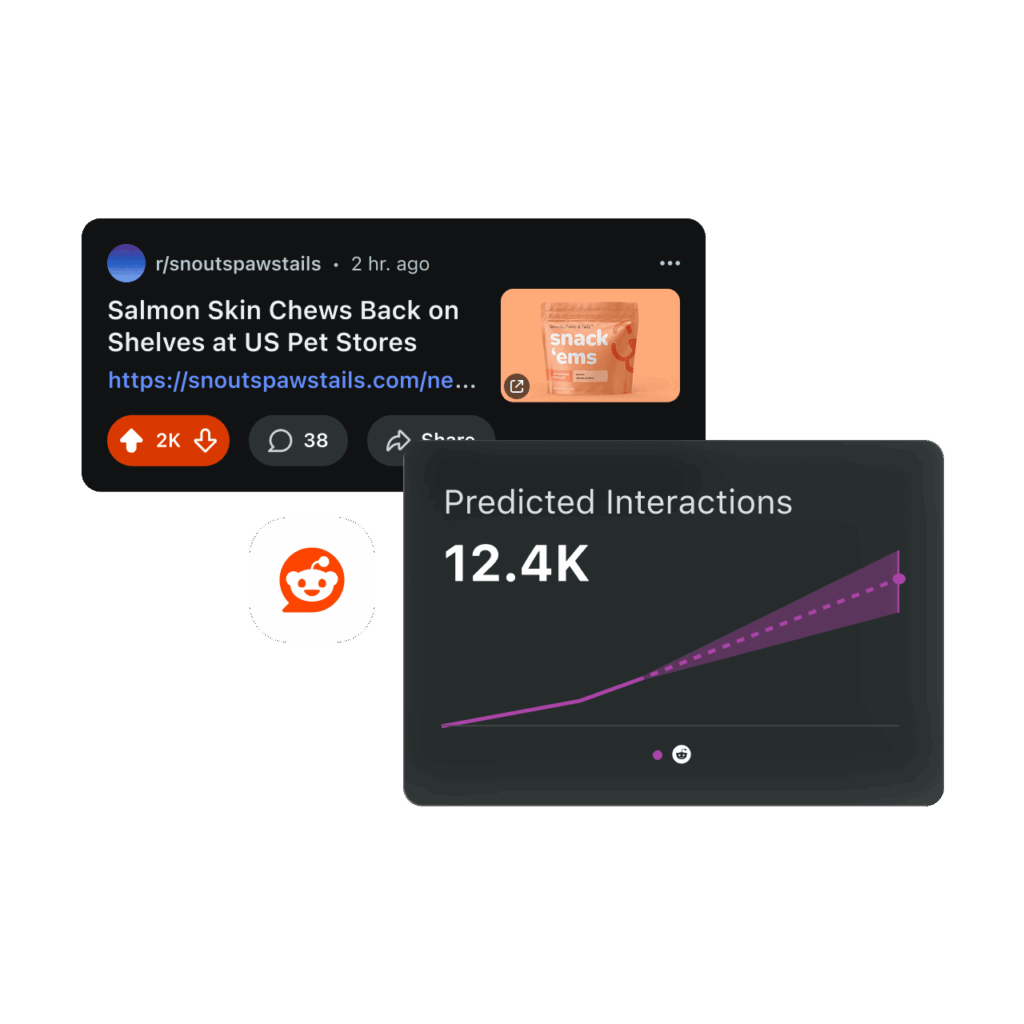
The accuracy and efficacy of predictive media monitoring are intrinsically linked to the breadth of data accessible. As news discovery increasingly fragments across social, community-driven, and decentralized platforms, prediction engines necessitate a panoramic view of where attention is coalescing. While major social networks like Facebook, Instagram, and YouTube continue to be significant news sources – with consumers planning increased usage in 2026, according to Sprout’s Q4 2025 Pulse Survey – emerging signals are appearing beyond these dominant platforms.
The Q2 2025 Sprout Social Pulse Survey revealed a notable trend: 51% of global social media users intend to dedicate more time to community-driven platforms such as Reddit, while 48% plan to increase their engagement on newer platforms like Bluesky, Mastodon, and Threads. This diversification necessitates that predictive monitoring tools encompass these evolving spaces. NewsWhip, for instance, integrates discussions from across these varied platforms, allowing for a holistic view of a story’s arc alongside contemporaneous Reddit discussions, cutting-edge Bluesky commentary, and highly engaged X (formerly Twitter) interactions. Predictive signals for platforms like Facebook, Reddit, X, and Bluesky are now embedded within article rankings and workflows, including predictive alerts and the Trellis Monitoring Agent, enabling teams to detect early narrative shifts without introducing additional manual steps.
Deconstructing Predictive Media Intelligence Models
At the heart of predictive media intelligence lie sophisticated AI and machine learning models, each contributing a unique layer of insight into the complex ecosystem of public discourse.
Sentiment Analysis
A story’s virality is only one facet of its impact; the underlying emotional tone is equally critical. Sentiment analysis delves into the emotional tenor of social posts, reviews, and online conversations, classifying language as positive, negative, or neutral. Advanced models can further discern specific emotions like anger, frustration, excitement, or trust. For a brand monitoring a product launch, a rise in mentions is informative, but sentiment analysis reveals whether this attention stems from excitement or customer complaints. This distinction dictates whether to amplify the moment, clarify messaging, or address emergent concerns.
Time Series Forecasting
This model leverages both historical and real-time data to predict the future evolution of metrics such as engagement growth, story volume, and shifts in audience attention. In media intelligence, time series forecasting estimates whether a conversation is likely to diminish, remain stable, or continue to spread over the ensuing hours and days. A communications team, for example, might use this to gauge if a critical news story will fade by morning or persist, thereby informing decisions on issuing statements, escalating internally, or maintaining close observation.
Topic Modeling
Topic modeling distills vast quantities of text into discernible themes, illuminating which narratives are capturing engagement. During industry events, it can reveal whether discussions are coalescing around pricing, sustainability, product features, or executive pronouncements. Understanding these distinct thematic clusters is crucial, as each may necessitate a tailored response. This context allows teams to adjust planned content, refine messaging, and prepare leadership talking points based on the dominant conversation drivers.
Anomaly Detection
This model identifies unusual deviations in data, such as sudden spikes or drops in brand mentions, unexpected sentiment shifts, or stories spreading at an atypical pace for their subject matter. For instance, a sudden surge in brand mentions overnight could be flagged by anomaly detection, prompting an investigation into its origin – be it a creator post, breaking news, a customer complaint, or coordinated activity – before the conversation escalates.
The Power of Predictive Alerts and Intelligent Agents
Traditional media alerts often rely on fixed thresholds, notifying users only after a story has reached a predetermined level of mentions or interactions. By then, the narrative may have already gained significant momentum. Predictive alerts, conversely, intercept these developments earlier. They utilize nascent patterns to flag stories poised to reach user-defined thresholds before they do. This proactive notification allows teams monitoring brands, executives, competitors, or sensitive issues to gain awareness while a story is still in its formative stages.
However, the challenge lies in avoiding alert fatigue. An excessive number of notifications, even if predictive, can obscure critical developments. This is where intelligent agents, such as NewsWhip’s Trellis Monitoring Agent, come into play. Operating as an autonomous, always-on analyst, Trellis identifies emerging stories and significant shifts with remarkable early detection capabilities, delivering concise, context-rich briefs.
Trellis evaluates coverage based on factors such as the velocity of engagement, the diversity of sources, the influence of engaging accounts, and the similarity to past high-impact stories. Its AI judgment allows it to prioritize meaningful shifts over mere noise. When combined with NewsWhip’s predictive signals, which offer earlier visibility into discussions on community-driven and decentralized platforms, Trellis becomes even more potent. Early engagement cues from platforms like Facebook, Reddit, X, or Bluesky can inform article rankings and trigger alerts before a narrative achieves widespread mainstream coverage. Ultimately, predictive alerts and intelligent agents transform media monitoring from a passive record of "what happened" to an active anticipation of "what is changing."
Six Strategic Applications of Predictive Media Intelligence
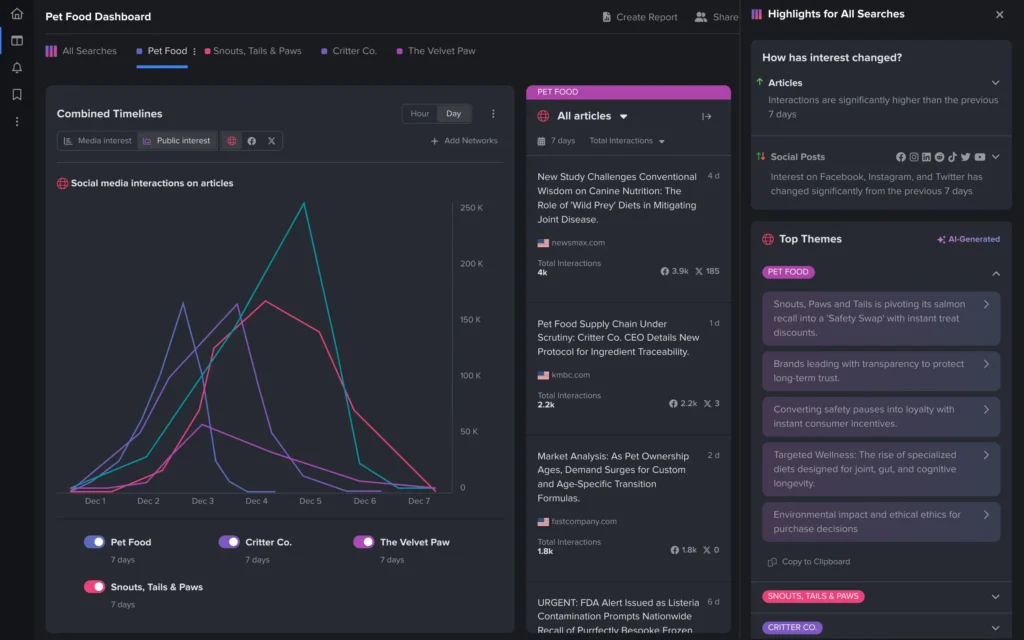
Predictive media intelligence does not replace existing business performance tracking tools; rather, it augments them with invaluable external context. It reveals how public conversations are evolving before these shifts manifest in sales figures, customer feedback, or quarterly reports.
| Existing System | What it Typically Shows | What Predictive Media Intelligence Adds |
|---|---|---|
| Business Intelligence | Validates past operational history (sales, campaign results, customer behavior) | Forward-looking foresight into market direction and public narratives influencing future outcomes. |
| Customer Intelligence | Tracks past transactions, profiles, and direct customer interactions | Real-time human sentiment and emotional context from conversations outside owned or direct channels. |
| Market Intelligence | Competitor actions, often through delayed reports and periodic research | A live view of competitor developments, category shifts, and emerging risks. |
This enhanced contextual understanding empowers communications and analyst teams to integrate media intelligence into strategic decisions across brand strategy, product positioning, customer experience, competitive response, and risk management.
-
Predictive Crisis Management: Not every negative mention constitutes a crisis, but discerning which ones might escalate is a critical challenge. Predictive crisis management leverages real-time data to assess developing issues, estimate their scale, forecast their trajectory, and inform response strategies. A product complaint, legal issue, or environmental concern might be a fleeting story or the genesis of a significant reputational risk. Predictive intelligence allows communicators to compare current conversations against historical crises, enabling more informed decisions on monitoring, responding, or escalating.
-
Proactive Campaign Optimizations: A campaign’s success can falter due to misaligned messaging across different markets or cultural nuances. Predictive media intelligence helps identify these potential gaps before launch. Analyzing how diverse audiences, publishers, and communities discuss a topic can inform where a campaign is likely to resonate, where it might fall flat, and where strategic adjustments are necessary. Todd Ringler, Head of US Media at Edelman, shared an experience where NewsWhip data revealed significant regional differences in how a topic was being discussed, necessitating a localized campaign recalibration across 12 US cities. This data-driven approach moves beyond gut feeling, offering concrete evidence for strategic pivots.
-
Predictive Media Relations: An impressive media list does not guarantee story reach. Predictive media intelligence enables PR and communications professionals to identify individuals and outlets that not only cover a specific topic but do so with high engagement, thereby maximizing the potential reach of a pitch. Zach Silber, former Chief Innovation Officer at PR agency Kivvit, emphasizes that relying solely on traditional media databases is insufficient. Social engagement data on specific topics, as provided by tools like NewsWhip, is crucial for identifying outreach targets most likely to generate widespread engagement. The Q1 2026 pulse survey indicates that 39% of consumers desire more active engagement from news organizations and reporters on social media, highlighting the growing importance of this social dimension in media relations.
-
Predictive Trendspotting: This intelligence is instrumental in identifying emergent cultural trends, whether it’s a recurring question on a subreddit, a highly active comment section on a creator’s post, or a cluster of niche articles gaining traction. By comparing current activity against historical patterns related to key conversations, teams can discern when interest in a topic surpasses its baseline and approaches a tipping point. For instance, a brand monitoring consumer trust in AI-generated content can observe when public discourse begins to surge, providing an opportune moment to engage, adjust messaging, or brief leadership while the conversation is still nascent.
-
Real-time Business Strategizing: While quarterly reports document past customer actions, they may not always articulate future desires. Predictive media intelligence offers insights into emerging customer demands, complaints, and expectations within a category before these patterns are reflected in sales data or support tickets. If buyers begin discussing affordability, transparency, or ease of use more frequently, this context can inform roadmap adjustments, refine positioning, or shape launch messaging, providing teams with a real-time market perspective.
-
Improving Brand Awareness: Brand awareness flourishes when a brand is visible within relevant conversations before individuals actively seek it out. Predictive media intelligence illuminates these opportunities. By analyzing questions, interests, frustrations, and comparisons emerging across news, social media, forums, and online communities within a brand’s category, teams can identify underserved audiences or unmet needs. If discussions revolve around a problem a brand’s product solves, questions a team can answer, or comparisons that current messaging doesn’t address, these represent potent awareness opportunities to shape content, media outreach, and campaigns.
The Future Trajectory of Predictive Media Intelligence
Predictive media intelligence is poised to become an integral component of a broader movement towards comprehensive social media intelligence. The influence of public online conversations extends far beyond communications and marketing departments, impacting product development, customer trust, sales strategies, competitive positioning, and executive decision-making. The critical next step involves ensuring these insights are disseminated effectively to the appropriate teams, enabling timely action.
Platforms like NewsWhip are advancing this future with agentic AI capabilities, such as Trellis. The objective is to make predictive media intelligence more automated, allowing it to learn a business’s specific concerns, monitor relevant topics and narratives, and surface critical changes with minimal manual intervention. The ultimate goal for organizations is to reduce blind spots, minimize time spent sifting through extraneous data, and gain a more accurate understanding of external shifts impacting their business.