The Evolution of Content Strategy: Why AI Demands Accountability and Personalization in a Zero-Click World

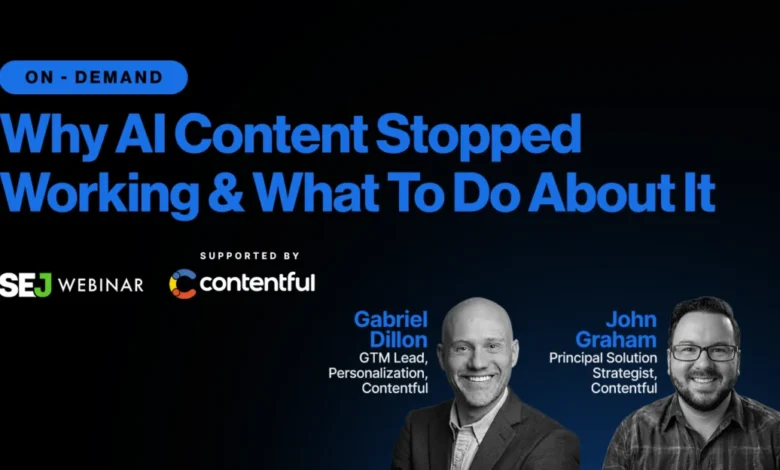
The landscape of digital content and search engine optimization is undergoing a profound transformation, driven by the pervasive influence of artificial intelligence and the changing nature of user interaction with search results. A recent webinar hosted by Search Engine Journal, featuring insights from Gabriel Dillon, Go-to-Market Lead for Personalization, and John Graham, Principal Solution Strategist at Contentful, illuminated the critical shifts marketers must embrace to remain effective. At the heart of their argument lies a stark reality: approximately 60% of Google searches now conclude without a click to any external content. This "zero-click" phenomenon, coupled with the increasing ease and volume of AI-generated content, necessitates a radical rethinking of traditional content strategies, shifting focus from mere production volume to demonstrable business outcomes, hyper-targeted personalization, and rigorous data-driven accountability.
The Shifting Landscape: Zero-Click Searches and AI Proliferation
The statistic that 60% of Google searches end without a click serves as a potent indicator of how search engine results pages (SERPs) have evolved. Over the past decade, Google has steadily enriched its SERPs with features like featured snippets, knowledge panels, local packs, and direct answer boxes. More recently, the integration of generative AI directly into search results (e.g., Google’s Search Generative Experience, or SGE) has further exacerbated this trend, providing users with synthesized answers directly on the results page, thereby reducing the need to visit external websites.
This evolution signifies a fundamental change in user behavior. For many informational queries, users are satisfied with the concise, AI-summarized answers presented upfront. This immediate gratification means that content creators can no longer rely solely on ranking highly in traditional organic search results; they must also compete for visibility within these AI answer layers. Data from analytics firms like SparkToro and Similarweb have consistently tracked this upward trajectory of zero-click searches, demonstrating a clear erosion of traditional organic traffic for many publishers and businesses.
Simultaneously, the advent of sophisticated AI writing assistants has democratized content creation, making it faster and cheaper to produce vast quantities of text. While this offers undeniable efficiencies, Dillon cautioned that "when AI makes content nearly free to produce, volume stops being a strategy." The ease of generation often leads to a deluge of generic, undifferentiated content that struggles to capture attention in an already saturated digital environment. This paradox—the ability to produce more content faster, yet seeing less of it achieve impact—underscores the urgency of the new approach advocated by Contentful.
Content Accountability: The New Imperative
In this evolving ecosystem, the core challenge for marketers is to ensure their content delivers tangible value. Dillon emphasized that the only content that truly earns attention is "content held accountable to a business outcome, built for a specific human, and measured against real data." This principle moves content marketing beyond vanity metrics like page views or impressions, pushing it towards measurable contributions to sales, lead generation, customer retention, or brand loyalty.
One of the primary pitfalls of relying heavily on AI for content creation, as highlighted by Dillon, is the tendency for AI-assisted copy to "drift toward generic output." He explained that "our biases as we write content using the robots ends up eating the content that we produce. We end up in this cycle of creating content that we think is good but doesn’t actually do what we think it does." AI models, trained on vast datasets of existing internet content, naturally gravitate towards consensus and common themes. This can lead to content that confirms existing beliefs or merely mirrors competitors, failing to offer unique insights or differentiate a brand.
To counteract this, Dillon champions the concept of "taste," which he defines as more than just a cliché. It encompasses "discernment and intuition, plus the risk-taking to make a claim no AI tool would volunteer, based on what you actually know about your market." This human element—the ability to identify unique angles, challenge assumptions, and infuse content with genuine market understanding and strategic intent—is where human expertise remains irreplaceable in an AI-assisted workflow. AI should serve as a powerful research and context layer, but the final strategic shaping and distinctive voice must come from human marketers.
Dillon’s Four Questions for Outcome-Driven Content
To ensure content is truly accountable for business outcomes, Dillon outlined four critical questions that B2B marketing copy must answer before it ships:
- Does the copy produce the outcomes you expect? This foundational question demands a clear definition of success for each piece of content. Is it meant to drive a demo request, an ebook download, an email signup, or a product inquiry? Without a defined outcome, measuring success and optimizing becomes impossible.
- Who is the content for? Beyond broad audience segments, this question pushes for a granular understanding of the specific human persona the content aims to serve. What are their pain points, their aspirations, their role in the decision-making process?
- How do you identify those people? This delves into the practical aspects of audience segmentation and targeting. How can data—from CRM systems, website analytics, ad platforms, or survey responses—help pinpoint the specific individuals who would benefit most from this content?
- How does the insight scale? Even highly personalized content needs a pathway to broader impact. This question considers how successful content strategies or insights can be replicated, adapted, and extended to other segments or content types, transforming one-off successes into scalable frameworks.
Dillon stressed the importance of data in this process: "If we don’t have data that proves that our content is good, then we can’t really think about the way to scale it out or make it more effective." This highlights the symbiotic relationship between content creation, data analysis, experimentation, and personalization, forming an "accountability loop" for continuous improvement.
Practical Personalization Strategies: Beyond Over-Complication
Personalization is a powerful tool for driving content effectiveness, but its implementation often stumbles due to complexity. Dillon observed that B2B personalization has "underdelivered for years" because "teams tackle programs that are too ambitious, then stall on complexity." His solution is a pragmatic, tiered approach that leverages existing data signals without requiring an entirely new technology stack.
He outlined three signal tiers, starting with the most straightforward:
- New vs. Returning Visitors: This fundamental distinction offers immediate personalization opportunities. A first-time visitor likely needs introductory information, brand context, and a clear value proposition, whereas a returning visitor might be seeking deeper product details, case studies, or pricing information. Serving the same hero copy to both is a missed opportunity to cater to distinct intents.
- Signals from Ad Campaigns: Data generated by advertising efforts—such as the specific ad clicked, the campaign parameters, or the user’s interaction history with ads—can provide rich context for on-site personalization. If a user clicked an ad for a specific product feature, their landing page experience should immediately reflect that interest.
- Signals from Loyalty Programs/CRM: For existing customers or known leads, loyalty program data, purchase history, or CRM interactions offer the most granular insights. This allows for highly tailored content that anticipates needs, offers relevant upgrades, or provides support resources based on their relationship with the brand. Dillon referred to the current underutilization of such data as "such a missed opportunity."
The key takeaway is to start simple, experiment, and gradually build out personalization capabilities using data that is already being collected. This iterative approach allows teams to demonstrate value quickly and build confidence before tackling more complex personalization initiatives. The Contentful platform, as demonstrated in the webinar, is designed to facilitate the creation and delivery of these differentiated experiences, enabling marketers to build personalized journeys without extensive custom coding or overhauling their entire tech stack.
Navigating Google’s AI Content Policy and the AI Answer Layer
A recurring concern among content creators is whether Google "penalizes" AI-generated content. Dillon argued that focusing on "detection is the wrong problem to solve." He asserted that "whether Google can identify AI content matters less than what happens to clicks." Google’s official stance, reiterated across various updates (e.g., the Helpful Content System, core updates, and spam updates), is not to penalize AI content per se, but rather to evaluate content based on its helpfulness, quality, and originality, regardless of its generation method. However, the prevalence of generic AI content often falls short of these quality benchmarks.
The more pressing issue, according to Dillon, is the "zero-click shift" and its impact on organic traffic. Contentful’s clients are already reporting a noticeable decrease in organic traffic as AI summaries and rich results absorb clicks. This means the battleground for visibility has moved.
The "practical response is to compete for the AI answer layer." This involves optimizing for Generative Experience Optimization (GEO) and Answer Engine Optimization (AEO).
- Generative Experience Optimization (GEO): Refers to optimizing content so that generative AI models (like those powering Google’s SGE or other AI chatbots) accurately and favorably represent a brand’s information when synthesizing answers. This goes beyond traditional SEO keywords; it requires structuring content for clarity, conciseness, and authority, making it easy for AI to extract and present as a definitive answer.
- Answer Engine Optimization (AEO): Focuses on optimizing for direct answers presented within search engines or AI interfaces. This involves targeting queries that are likely to trigger featured snippets, rich results, or direct AI summaries, and structuring content to directly answer those questions comprehensively and authoritatively.
Effective GEO and AEO ensure that even if a user doesn’t click through to a website, the AI summary at the top of the results page still reflects the brand’s expertise and messaging. This strategy requires content that is not only high-quality and helpful for human readers but also easily digestible and authoritative for AI systems. Dillon emphasized that "one kind of content performs in AI summaries and on-page conversion simultaneously," and the webinar detailed the specific requirements for such content and the tooling Contentful offers to support it, ensuring a unified content strategy rather than a bifurcated approach.
Key Industry Questions from the Webinar
The Q&A segment of the webinar addressed several critical questions facing content marketers today, further solidifying the principles discussed:
-
Q: After the Google spam update, is Google removing AI-written content?
Dillon’s response reiterated that identification of AI content will only become more challenging, calling it a fight "Google won’t win." He advised redirecting energy away from evading detection and towards a more impactful target: optimizing for the zero-click search environment. The focus should be on creating genuinely helpful and authoritative content, regardless of whether AI assisted in its creation, to compete effectively for the AI answer layer. -
Q: How do you think critically about the inherent bias in AI content?
Bias can enter AI content in two primary ways: through user prompting and context, and through the training data itself. Users can inadvertently inject their own biases through the prompts they provide, leading to "a result that you want, but maybe not the result that would be most effective." The vast datasets AI models are trained on also contain societal biases, which can be reflected in the generated output. Dillon’s mitigation strategy begins before content generation, involving critical evaluation of prompts, diversification of data sources, and a human editorial layer to scrutinize and refine AI outputs for fairness and accuracy. -
Q: What do you do when leadership wants mass AI content without understanding quality control?
This common challenge requires a data-driven approach. Dillon advised holding leadership accountable to their expected performance metrics. By demonstrating through data that "you can create better content that drives the business outcomes that you want by creating fewer but better pieces of content," marketers can make a compelling case for quality over sheer volume. He also conceded that there might be a place for high-volume, lower-stakes AI content for specific, less critical tasks, but stressed that core marketing assets require strategic human oversight and quality control. -
Q: Do SEO service pages need a unique voice, or can AI write them?
Dillon distinguished between voice and effectiveness. While "service pages or pricing pages don’t need to be very characterful to be effective," they still serve visitors with different goals. AI can certainly generate functional, informative content for these pages. However, even these "rote" pages can benefit from strategic human input to ensure they address specific customer pain points, differentiate offerings, and guide users effectively through the conversion funnel. The decision on how much human intervention is needed depends on the page’s strategic importance and the specific visitor goals it aims to achieve.
The Contentful Solution and Future Outlook
The webinar concluded with a demonstration of how Contentful’s platform empowers marketers to implement these advanced content strategies. The platform is designed to facilitate the creation of rich, modular content that can be easily personalized and deployed across various channels, including those optimized for AI answer layers. Its capabilities support the entire "accountability loop," from defining outcomes and targeting specific audiences to measuring performance and iterating based on data.
The insights from Gabriel Dillon and John Graham underscore a pivotal moment in content marketing. The era of simply churning out high volumes of content and hoping for organic traffic is rapidly fading. Success in the AI-driven, zero-click future demands a strategic, human-led approach where every piece of content is purposefully crafted, deeply personalized, and rigorously measured against specific business outcomes. The future of content is not about avoiding AI, but about leveraging it intelligently, complementing its capabilities with human "taste," discernment, and accountability, ensuring that content truly earns attention and drives tangible value. The full webinar, including the detailed walkthroughs and live demos, remains an invaluable resource for marketers navigating this complex and exciting new frontier.