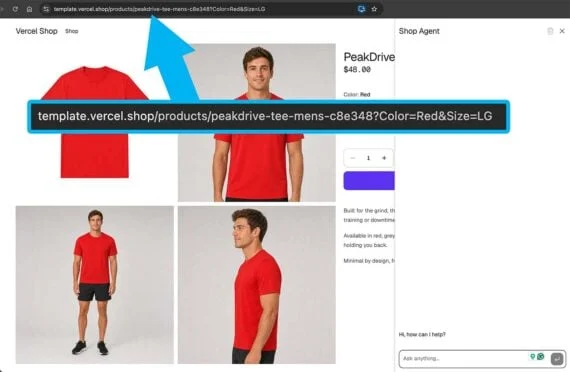
The centerpieces of this collaboration are the recently overhauled Shopify Hydrogen software development kit (SDK) and the introduction of Vercel Shop, an open-source, AI-ready storefront template. These tools represent a departure from traditional, siloed ecommerce development, offering a framework that treats AI agents as first-class citizens in the digital shopping journey.
A Chronology of Cooperation
The October announcement is the latest milestone in a sustained effort to harmonize the developer experience between the two platforms. The partnership gained momentum on June 30, when the companies announced a comprehensive rebuild of the Hydrogen SDK. This initiative was designed to liberate developers from platform-specific constraints, allowing them to leverage Shopify’s commerce primitives across a diverse array of JavaScript frameworks and runtime environments.
For years, building a bespoke, high-performance storefront required immense technical overhead. Developers had to manually bridge the gap between frontend user interfaces and the complex backend systems governing inventory, pricing, and checkout. The June update to Hydrogen, followed by the October unveiling of the Vercel Shop template, effectively abstracts much of this complexity. By modularizing ecommerce functions, the companies have enabled developers to spend less time on plumbing and more time on the unique value proposition of the merchant’s brand.
The Technical Architecture of Agentic Commerce
The integration of Vercel Shop into the ecommerce ecosystem is designed to solve a fundamental problem: most websites are built exclusively for human eyes. AI agents—automated bots capable of browsing the web and making purchasing decisions—often struggle to navigate traditional HTML-heavy storefronts. They are frequently blocked by complex DOM structures, dynamic content, and inaccessible data.
Vercel Shop addresses this through structured, agent-readable data. By utilizing the Hydrogen SDK, the template ensures that product information, stock availability, and pricing are exposed in a machine-readable format. This allows an external AI agent to perform complex tasks, such as finding a specific item, checking its current inventory, and updating a shopping cart, without ever needing to “see” the visual storefront.
For instance, if a user tasks an AI personal assistant with buying a black jacket, the agent can query the Vercel Shop API directly. It can parse the requirements—size, color, and fit—and execute the necessary calls to add the item to the cart. This interaction happens in the background, bypassing the friction of loading images, navigating menus, or manually inputting data into standard web forms.
Official Perspectives and Strategic Rationale
During the Ship 26 keynote, Shopify CEO Tobi Lütke emphasized the importance of stability and modularity in the checkout experience. “Checkouts are ridiculously hard to get right,” Lütke stated. “It’s one of those pieces of software that actually does need 20 years of tinkering with. And Shopify has always been very open, and so we invite people to remix pieces from our checkout just as much as you want. Basically taking all the infrastructure that Shopify built, and you can build whatever you want with it.”
This philosophy underscores the "headless" commerce movement, where the checkout process remains a secure, stable, and highly optimized black box, while the storefront experience is completely flexible. By allowing developers to "remix" the frontend while relying on Shopify’s battle-tested backend, the collaboration ensures that security and compliance are never sacrificed for the sake of design innovation.

Guillermo Rauch, CEO of Vercel, has consistently championed the concept of the “AI-native” web. The Vercel Shop template is a direct manifestation of this vision. By providing an optional, built-in AI assistant, merchants can offer human shoppers a conversational interface that functions much like Amazon’s Alexa or Walmart’s Sparky. This assistant is not merely a chatbot; it is deeply integrated into the state of the shopping cart. A shopper can interact with the assistant to ask about store policies, filter products by technical specifications, or even change the size of an item already in the cart.
Impact on Retail and User Experience
The implications for the retail sector are profound. By shifting the focus from static page views to conversational and agentic interactions, merchants can reduce the abandonment rates often caused by complex navigation menus.
Data from the broader ecommerce industry suggests that friction is the primary driver of cart abandonment. According to industry benchmarks, the average global cart abandonment rate hovers around 70%. Many of these exits occur during the search and discovery phase. By implementing an AI assistant that can instantly guide a user to the right product variant—or by enabling an AI agent to handle the procurement process entirely—merchants can significantly shorten the path to purchase.
Furthermore, the Vercel Shop template ensures consistency. Because the AI assistant and the visual storefront share the same backend logic, there is no risk of the “data drift” that often plagues third-party integrations. When a user asks an assistant to add a product to their cart, that action is reflected in the main browser window in real-time. Shopify’s infrastructure validates every step, ensuring that pricing and availability are always accurate, while the actual payment processing remains handled through the standard, secure Shopify checkout flow.
Implementation and Customization
The Vercel Shop assistant is designed to be highly configurable. It is disabled by default, requiring developers to explicitly enable it and configure access to Vercel’s AI Gateway. This design choice highlights a commitment to developer control. Merchants can determine the “personality” of the AI, the depth of its guidance, and the specific store data it is authorized to access.
This level of granularity is essential for brand consistency. A luxury fashion brand might configure its AI assistant to provide concise, elegant responses, while a hardware retailer might prefer a more technical, data-driven approach. Because the template is open-source, the barrier to entry for small and medium-sized businesses is significantly lowered, allowing them to compete with enterprise-level retailers who have previously had the resources to build custom AI experiences from scratch.
The Broader Implications for the Web
The collaboration between Shopify and Vercel signals a broader transition in how the internet is constructed. We are moving away from an era where the web was viewed as a collection of static documents and toward an era where the web is a collection of programmable, AI-accessible services.
As AI agents become more prevalent, the ability to serve both humans and machines will become a competitive necessity. Websites that are difficult for agents to interpret may find themselves invisible to the next generation of AI-powered search engines and shopping assistants. By proactively adopting frameworks like Hydrogen and Vercel Shop, merchants are future-proofing their businesses.
In conclusion, the partnership between Shopify and Vercel is more than just a software update; it is a fundamental shift in the architecture of commerce. By merging the reliability of a mature, global commerce platform with the speed and agility of modern frontend development, they are creating a scalable, intelligent, and highly accessible ecosystem. As this technology matures, it is likely that the "agentic" capabilities demonstrated at the Ship 26 conference will become the standard for all digital storefronts, fundamentally changing how consumers find, interact with, and purchase products in the digital age. Through this initiative, Shopify and Vercel are not just building shops; they are defining the infrastructure for the next twenty years of commerce.