Fine Art America: A Deep Dive into the Premier Print-on-Demand Platform for Artists and Photographers


Fine Art America stands as a prominent print-on-demand platform meticulously designed for artists, photographers, and illustrators. Its core offering revolves around high-quality wall art, home decor, and lifestyle merchandise. What distinguishes Fine Art America from many competitors is its unique model where artists retain complete control over their profit margins, setting their own markups on every product offered. This review delves into the platform’s pricing, product selection, fulfillment capabilities, and competitive standing, providing a comprehensive analysis for creators considering its integration into their art businesses.
This in-depth review is built upon extensive hands-on testing of the platform, supplemented by feedback gathered from artist communities on platforms like Reddit and Facebook, verified buyer reviews, and current market data from third-party analytics services. To ensure accuracy and relevance, these print-on-demand reviews are updated annually, reflecting any changes in pricing, new feature introductions, and shifts in platform performance. Recent updates to this review include verified pricing for 2026, refreshed traffic and revenue data, and documented concerns regarding customer support based on recent artist reports.
Fine Art America: A Balanced Perspective on Pros and Cons
Fine Art America garners a commendable rating of 4.2 out of 5, positioning it as a "Very Good" option within the print-on-demand landscape. The platform is particularly well-suited for serious photographers, artists who focus on building a collector base, and those seeking a low-overhead method to test the waters of print-on-demand sales. While a free account is available, offering essential functionalities, a Premium subscription is priced at $30 per year for enhanced features.
Key Advantages (Pros):
- Artist-Controlled Markups: The ability for artists to set their own profit margins is a significant draw, offering unparalleled control over potential earnings.
- High-Quality Production: The platform is renowned for its commitment to producing high-quality prints and merchandise, appealing to a discerning clientele.
- Extensive Product Catalog: A vast array of products, from traditional prints to home decor and apparel, provides diverse selling opportunities.
- In-House Manufacturing: Control over its own manufacturing facilities contributes to consistent quality and potentially faster turnaround times.
- Free Entry Point: The Standard account allows artists to test the platform without upfront financial commitment.
- Sale of Original Artwork: A unique feature allowing artists to sell original pieces alongside reproductions.
Key Disadvantages (Cons):
- Dated User Interface: The backend interface can feel cluttered and less intuitive compared to more modern platforms.
- Limited Storefront Customization: The ability to create a highly branded and visually unique artist storefront is restricted.
- Discoverability Challenges: With a vast number of artists, breaking through the marketplace noise requires significant external marketing effort.
- Delayed Payouts: A 30-day delay on payments, to accommodate returns, can impact cash flow for rapidly scaling artists.
- Customer Support Concerns: Artist-facing customer support has been a recurring point of contention in user feedback.
- Data Ownership: Customer data and email lists remain with Fine Art America, limiting direct customer relationship building for artists.
At a Glance: What Works and What Needs Improvement
What I Like:
- Unmatched Pricing Autonomy: The ability to set markups is a game-changer for profit maximization.
- Exceptional Print Quality: Consistently praised for producing gallery-worthy prints.
- Vast Product Variety: Offers a comprehensive range of items for diverse artistic expression.
- Low Barrier to Entry: The free tier makes it accessible for artists at any stage.
- Global Fulfillment: Worldwide shipping capabilities expand market reach.
What I Dislike:
- Outdated Backend: The user experience for managing an account could be significantly modernized.
- Branding Limitations: Artists seeking a bespoke online presence may find the storefront options insufficient.
- Marketing Dependence: Reliance on external traffic sources for significant sales.
- Payment Schedule: The 30-day payment cycle can be a hurdle for cash flow management.
- Artist Support Issues: Reported inconsistencies and challenges with artist-specific customer service.
Navigating the Fine Art America Experience: A Hands-On Account
The initial onboarding process for Fine Art America is remarkably straightforward. Creating a free Standard account requires only an email address and basic profile information, with no credit card details mandated. Upon logging in, artists are greeted with a personalized dashboard that clearly outlines the key steps: uploading images, configuring products, setting markups, and publishing to their storefront.
The platform inquires about the artist’s primary focus—whether they are a photographer, illustrator, or fine artist—and their preferred product categories, such as prints or merchandise. Unlike the AI-driven setup wizards found on platforms like Shopify or Wix, Fine Art America offers a more traditional templated approach. Artists receive a standardized profile page with a unique URL (yourname.fineartamerica.com), with customization options limited to adding a biography, headshot, social media links, and arranging featured images.
From a user experience perspective, particularly for those accustomed to the slick interfaces of platforms like Shopify or Squarespace, the Fine Art America backend can feel somewhat dated. While functional, the navigation can be cluttered, and certain settings might be tucked away in less obvious menus, often labeled under "Behind the Scenes." However, it’s crucial to recognize that Fine Art America operates fundamentally as a marketplace and a production partner, rather than a comprehensive website builder. The trade-off is understandable: artists are here to list their artwork and have production handled seamlessly, rather than to construct a unique brand experience from scratch.
The Product Upload and Configuration Process
The process of adding products to Fine Art America is where the platform’s design truly shines and feels purpose-built for artists. Artists upload high-resolution JPEG images, provide a title, description, and relevant keywords. The system then automatically generates product mockups across its extensive catalog. This includes various print sizes, framed options, canvas, metal prints, mugs, tote bags, and numerous other merchandise items.
Artists have the flexibility to set markups on a per-image basis or apply a default markup across their entire portfolio for each product type. It is highly recommended to establish default markups first to save significant time, followed by customizing pricing for particularly strong or high-demand pieces. The free Standard account imposes a limit of 25 image uploads, a constraint that most serious artists will likely encounter relatively quickly. The Premium account, priced at $30 per year, removes this limitation, offering unlimited uploads.
Storefront Configuration: A Realm of Simplicity
Storefront customization is arguably the weakest aspect of the Fine Art America experience. The platform does not offer themes, drag-and-drop editing, or extensive layout control. Instead, artists are provided with a standardized profile page where they can rearrange image collections, add a banner image, and write biographical content.
For artists prioritizing a fully branded website, an upgrade to the Premium plan is necessary. This unlocks a white-label site powered by Fine Art America’s technology, along with an embeddable shopping cart widget. This widget is invaluable for artists who already possess an external website (built on platforms like WordPress or Squarespace) and wish to leverage Fine Art America solely for fulfillment. Crucially, all uploaded artwork synchronizes bidirectionally, a feature that is genuinely beneficial for artists who already have an established online presence and simply need a robust fulfillment solution.
For those who prioritize branding and storefront design, Fine Art America may not be the primary solution. It excels as a marketplace and fulfillment engine. Artists who desire a highly customized storefront typically pair Fine Art America with their existing websites, utilizing the embed widget, or compare it with platforms like Printful or Gelato, which integrate with e-commerce giants like Shopify and empower users to build their own brand front-ends.
Fine Art America’s Cost Structure: Accessible Entry, Strategic Investment
Fine Art America distinguishes itself with one of the simplest pricing structures in the print-on-demand sector. The platform offers only two tiers, with no monthly subscription fees or per-product listing charges.
| Plan | Price | Best For |
|---|---|---|
| Standard | Free | Testing the platform with up to 25 images |
| Premium | $30 / year | Serious artists needing unlimited uploads and marketing tools |
The Standard plan provides all the essential tools for an artist to get started, including a profile page with a custom URL, access to the complete product catalog, the ability to set markups, and a presence within the Fine Art America marketplace. The primary limitation of this free tier is the 25-image cap, which is quite restrictive, considering that highly successful Fine Art America sellers often maintain portfolios exceeding 1,500 images.
The Premium plan, at an annual cost of $30, unlocks unlimited image uploads, a white-label artist website, the embeddable shopping cart widget, email marketing capabilities, and access to a licensing program that places artwork with partner retailers and national chains. For comparative context, platforms like SmugMug, which offer comparable creator-focused services, often charge upwards of $250 per year.
Value Proposition: Is Fine Art America Worth the Investment?
From an entry-level perspective, Fine Art America offers exceptional value. There is arguably no more cost-effective way to access a comprehensive print-on-demand catalog—encompassing canvas, metal prints, framed art, apparel, and home decor—with in-house production capabilities. The free plan alone serves as an invaluable tool for validating whether an artist’s work resonates with buyers before any financial commitment is made.

However, the true cost of utilizing Fine Art America extends beyond the platform’s direct fees. Significant investment in marketing efforts is often required to drive sales. Furthermore, the profit margins, after accounting for Fine Art America’s base manufacturing costs, can be relatively thin. An often-overlooked opportunity cost is building a presence on a platform where artists do not own the customer relationship; customer data and email lists remain with Fine Art America, not the individual seller.
For the majority of artists, initiating with the free Standard account is the recommended approach. Uploading 25 of your most compelling pieces and observing sales performance over a 60-90 day period is a prudent strategy. Should sales materialize, the $30 annual upgrade to Premium becomes a trivial investment to unlock unlimited uploads. If sales are negligible, however, the Premium account is unlikely to rectify the underlying issue of market demand or marketing effectiveness.
Product Range and Print Quality: A Focus on Excellence
Fine Art America boasts one of the most extensive product catalogs within the print-on-demand sector. The quality of these offerings consistently aligns with the platform’s positioning, which targets serious art buyers rather than those seeking casual merchandise.
Depth of the Product Catalog
The platform’s catalog is broadly segmented into five primary categories:
- Wall Art: This includes a vast array of prints such as canvas, metal, acrylic, wood, and traditional paper prints. Framed and matted options are also available, offering diverse presentation choices.
- Home Decor: The selection extends to tapestries, throw pillows, blankets, towels, and other decorative items designed to enhance living spaces.
- Apparel: Artists can offer a range of clothing items, including t-shirts and hoodies, allowing for wearable art.
- Tech Accessories: This category encompasses items like phone cases and tote bags, catering to modern consumer needs.
- Stationery & Gifts: Greeting cards and coffee mugs are also part of the comprehensive product mix.
A particularly noteworthy feature of Fine Art America is its capacity for artists to sell original artwork directly alongside their print reproductions. This is a rare offering in the print-on-demand space, where most competitors focus exclusively on reproductions.
Print Quality: A Hallmark of Fine Art America
Fine Art America operates a network of 14 to 16 manufacturing facilities strategically located across the globe. This in-house production model, as opposed to outsourcing to third-party manufacturers, is a significant factor in ensuring consistency across orders. When a single entity controls the entire production chain, the likelihood of uniform quality is generally enhanced.
Verified reviews on platforms like Trustpilot, which aggregate thousands of customer experiences, lean heavily positive regarding print quality. Canvas and framed prints, in particular, receive consistent praise. Photographers, a demographic known for its exacting standards regarding color accuracy, frequently rate Fine Art America’s reproduction quality as being on par with that of dedicated photo labs. This is a significant endorsement, reflecting the platform’s commitment to fidelity.
On the other hand, some artists have observed that the final consumer pricing for premium products, such as large framed pieces and metal prints, can be on the higher side. This can compress the potential profit margin that artists can add before the product becomes uncompetitive in the market.
Pricing Control and Artist Earnings: The Power of the Markup
Fine Art America’s most significant differentiator lies in its pricing structure and its direct impact on artist earnings. Unlike platforms such as Society6 or Redbubble, which typically pay artists a fixed royalty rate (often in the 10-20% range), Fine Art America empowers artists to set their own markups on every product. The company’s revenue is derived solely from the base manufacturing cost of each item, with artists retaining 100% of their designated markup.
The Mechanics of Markup Application
Every product available on the Fine Art America catalog has a base price established by the platform. This base price covers the costs associated with manufacturing, materials, and fulfillment. Artists then add their desired markup on top of this base price, determining the final consumer price (Base Price + Markup). When a sale is made, Fine Art America retains the base price, and the artist receives the full amount of their markup.
Artists can implement markups through three primary methods:
- Individual Image Pricing: Setting specific markups for each uploaded image, allowing for granular control.
- Default Markup per Product Type: Applying a consistent markup across all instances of a particular product (e.g., all canvas prints).
- Global Default Markup: Establishing a single markup percentage that applies to all products across the artist’s entire portfolio.
Payment Structure and Cash Flow Considerations
Payments to artists are disbursed on the 15th of each month, covering sales generated in the preceding month. This 30-day payment cycle is primarily in place to accommodate Fine Art America’s 30-day return policy. While this policy is reasonable from a business perspective, it can present challenges for artists experiencing rapid growth and requiring more immediate access to their earnings. Payouts are typically issued via PayPal or check.
Pricing Tip: Successful Fine Art America sellers often establish markups ranging from $15 to $50 for standard prints, and $50 to $150 or more for premium items like canvas, metal prints, and large framed pieces. Pricing too aggressively high can hinder conversion rates within the marketplace, while pricing too low can diminish the perceived value of high-quality artwork. Thorough testing of various price points across an artist’s portfolio is crucial before committing to a default strategy.
Marketing and Discoverability: Navigating the Marketplace Landscape
Fine Art America offers a modest suite of built-in marketing tools. However, given the platform’s competitive density, most successful artists find it necessary to drive traffic from external sources rather than solely relying on internal marketplace discovery mechanisms.
Integrated Marketing Features
Premium members gain access to several valuable marketing tools, including email marketing capabilities, promotional discount codes, and participation in the licensing program. This program facilitates the placement of artwork with partner retailers and national retail chains. The platform also fosters an active artist community through topic-based groups and contests, which can provide incremental exposure.
Historically, Fine Art America has performed well in Google search results for image-based queries. This means that individual artwork pages can attract organic traffic from buyers actively searching for specific subjects or styles (e.g., "abstract ocean canvas print"). Consequently, optimizing artwork titles, descriptions, and keywords is of paramount importance for capturing this organic traffic.
The Discoverability Conundrum
With an estimated 700,000 artists on the platform, achieving significant visibility through internal marketplace discovery can be a considerable challenge for new sellers. The marketplace algorithm surfaces a mix of trending artwork, recently uploaded pieces, and curated collections. However, to break through this crowded space, artists typically need either a substantial portfolio (upwards of 1,500 images) or a consistent stream of external traffic generated from their own social media channels and personal websites.
Artists who treat Fine Art America as a primary income source universally report driving their own traffic through platforms like Instagram and Pinterest, and directing potential buyers to their Fine Art America shop. Conversely, artists who primarily upload work and await marketplace-driven sales often experience only a handful of orders per year, if any. While the platform excels at fulfillment, the responsibility for marketing and driving sales rests squarely on the artist’s shoulders.
Marketplace Performance and Competitive Positioning: A Shifting Landscape
Fine Art America remains the largest dedicated marketplace for fine art prints. However, recent data suggests a potential shift in its market share. Third-party analytics sources present a mixed picture of its recent performance.
Recent Performance Data Analysis
| Metric | Value |
|---|---|
| Annual Revenue (2025) | ~$144.8M |
| Year-over-Year Decline | 10-20% |
| Online Sales (March 2026) | $10.5M |
| Sessions (March 2026) | 3.3 million |
| Conversion Rate | 2.50-3.00% |
| Average Order Value (AOV) | $100-125 |
| US Site Rank | #5,884 |
| Projected 2026 Revenue Trend | 5-10% decline |
While traffic saw a notable increase of 27.1% month-over-month in December 2025, the overall decline appears to be linked more to a reduction in average order value and conversion rates rather than a significant drop in visitor volume. The platform continues to attract substantial traffic, with an average session duration exceeding 9 minutes, indicating engaged browsing behavior.
Fine Art America’s Position Among Competitors
| Platform | Monthly Revenue (Mar 2026) | Avg Order Value | Best For |
|---|---|---|---|
| Fine Art America | $10.5M | $100-125 | Fine art and photography prints |
| Redbubble | $14.2M | $50-75 | Casual merchandise and apparel |
| Art.com | $5.5M | N/A | Mainstream wall art |
| Saatchi Art | $3.9M | $275-300 | Original art and high-end collectors |
| Society6 | $2.9M | $75-100 | Lifestyle products and home decor |
Fine Art America occupies a strategic middle ground. Its average order values are higher than those of Redbubble and Society6, which cater more to casual merchandise and lifestyle products. However, its AOV is lower than Saatchi Art, a platform focused on original art sales to serious collectors. The platform’s sweet spot is the segment of buyers seeking quality wall art and home decor at price points that do not approach the cost of original artwork.
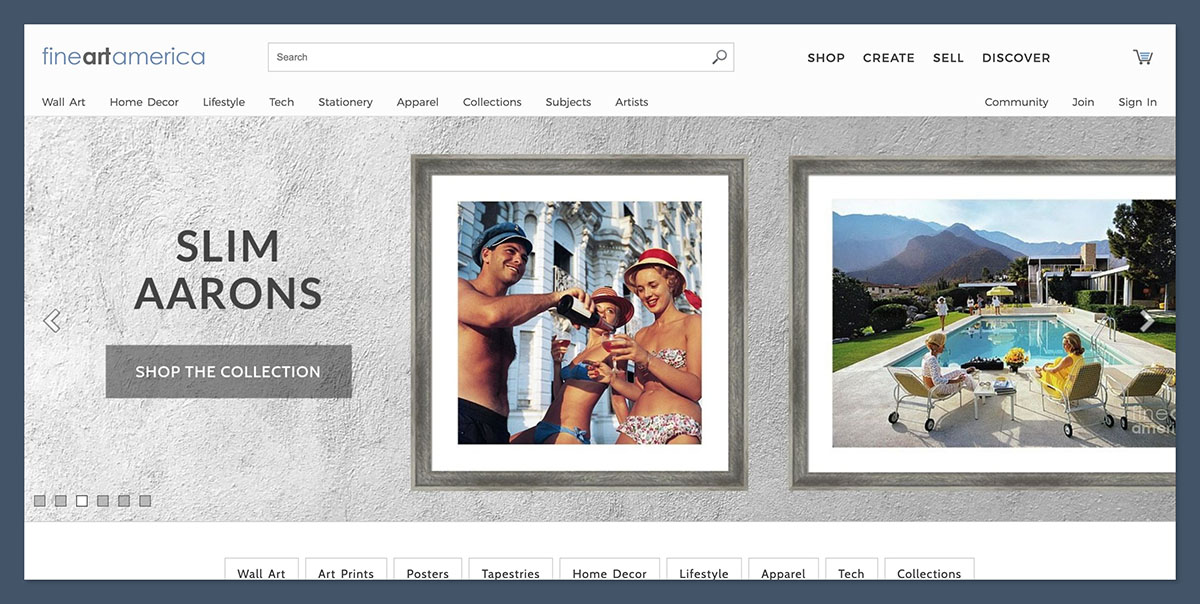
In comparison to other platforms:
- Redbubble & Society6: These platforms focus on a broader range of merchandise, often with lower base costs and fixed artist royalties, making them more accessible for mass-market designs but potentially less lucrative for fine art.
- Art.com: Primarily a mainstream art retailer, it offers less control to individual artists.
- Saatchi Art: Caters to a high-end collector market with a focus on original art, often commanding significantly higher prices.
Customer Support and Account Stability: Areas of Concern
The reputation of Fine Art America regarding customer support is notably mixed. While buyer-facing service, encompassing order fulfillment and the 30-day return policy, generally receives positive feedback for responsiveness, artist-facing support presents a different narrative.
Reported Artist Issues
A recurring pattern of problems has been documented by artists across various online forums and review sites. These reported issues include:
- Account Suspension/Termination: Instances of artists experiencing unexpected account suspensions or terminations without clear justification or adequate recourse.
- Disputes over Image Rights: Conflicts arising from perceived intellectual property infringements or disputes related to the rights of uploaded artwork.
- Lack of Transparency in Algorithm Changes: Artists often express frustration over a lack of transparency regarding how the marketplace algorithm functions and how their visibility might be affected by platform updates.
- Slow or Unresponsive Artist Support: Delays in responses or inadequate resolutions from artist support teams have been frequently cited.
- Concerns Over Platform Stability: A general sentiment among some artists regarding the long-term stability and future direction of the platform, exacerbated by reported revenue declines.
It is important to note that these reports represent a minority of artist experiences. Many sellers have enjoyed years of positive and uneventful engagement with Fine Art America. However, the consistent nature of these complaints across independent sources suggests that these issues warrant careful consideration, particularly for artists intending to rely on Fine Art America as their primary source of income.
Comparative Analysis: Fine Art America Versus the Competition
Fine Art America stands as the largest dedicated marketplace for fine art prints. However, it is not universally the ideal platform for every artist. Understanding its competitive positioning is key to making an informed decision.
- Printful/Gelato (with Shopify/Etsy): These platforms offer robust print-on-demand fulfillment services that integrate seamlessly with custom storefronts on e-commerce platforms like Shopify or marketplaces like Etsy. This approach grants artists complete control over branding, customer relationships, and website design, but requires a more active role in website management and marketing.
- Redbubble/Society6: As mentioned, these platforms are more geared towards a casual merchandise market. While they offer a wide product range and handle fulfillment, their royalty structures and average order values are typically lower than Fine Art America, making them better suited for trend-driven designs or artists seeking broader product exposure.
- Etsy: A vast marketplace that allows artists to sell handmade, vintage, and craft supplies, including their own print-on-demand products through integrations. Etsy offers a strong community feel and direct customer interaction but requires artists to manage their own production or fulfillment partnerships.
- Personal Website (e.g., Squarespace, Wix, Adobe Portfolio): Building a personal website offers the ultimate control over branding, customer experience, and data ownership. Artists can then integrate print-on-demand services through APIs or widgets, effectively combining a custom storefront with outsourced production. This requires a greater initial investment in time and potentially cost.
Rigorous Testing Methodology: Ensuring Unbiased Reviews
The evaluation of print-on-demand platforms, including Fine Art America, adheres to a structured testing methodology. This process involves assessing platforms across seven weighted criteria to ensure consistent and comparable reviews.
Our Weighted Criteria for Evaluation
| Criterion | Weight | What We Test |
|---|---|---|
| Product Range and Quality | 25% | Catalog depth, print fidelity, material quality, and consistency. |
| Artist Earnings and Pricing Control | 20% | Commission structure, markup flexibility, base costs, and profit potential. |
| Marketplace and Discoverability | 15% | Internal traffic, SEO performance, conversion rates, and audience reach. |
| Fulfillment and Shipping | 15% | Production speed, global reach, packaging quality, and delivery reliability. |
| Platform Usability | 10% | Ease of uploading, dashboard design, marketing tools, and overall user experience. |
| Pricing and Entry Cost | 10% | Membership fees, hidden costs, and value offered at each pricing tier. |
| Support and Reputation | 5% | Quality of artist support, account stability, and community feedback. |
Conclusion: Is Fine Art America the Right Fit for Your Art Business?
Fine Art America is ideally suited for a specific demographic of artists: serious photographers, illustrators, and fine artists who prioritize professional-grade print reproduction handled by a third party. The platform offers unparalleled control over pricing and provides a low-risk avenue to explore the print-on-demand market.
The free Standard plan alone makes Fine Art America a worthwhile platform to investigate for nearly any artist. Uploading 25 of your strongest pieces, setting reasonable markups, and observing sales performance over a 60-90 day period is a practical approach. If sales begin to materialize, the $30 annual Premium upgrade represents a nominal investment to unlock unlimited upload capabilities.
However, Fine Art America falls short for artists who place a higher premium on a fully branded storefront, rapid payment processing, consistently responsive customer support, or a platform where their account is demonstrably safe from arbitrary changes. If these factors are more critical than print quality and pricing flexibility, alternative solutions such as Printful or Gelato, or building a custom Shopify store with a print-on-demand integration, might be more appropriate.
While Fine Art America’s reported revenue decline in 2025 is a noteworthy signal, the platform continues to be the largest dedicated marketplace for fine art and consistently drives significant traffic to artist storefronts. For the time being, it remains a viable channel to incorporate into a diversified print-on-demand strategy, particularly for artists who do not rely on it as their sole source of income.
Frequently Asked Questions About Fine Art America
Is Fine Art America free to use?
Yes, Fine Art America offers a free Standard membership that allows artists to upload up to 25 images and list them across the full product catalog. The optional Premium membership costs $30 per year, removes the upload limit, and includes additional marketing tools and a white-label artist website.
How much commission does Fine Art America take?
Fine Art America does not take a percentage of the artist’s markup. The company collects only the base manufacturing cost for each product. Therefore, 100% of the markup set by the artist goes directly to the artist. The "commission" is effectively embedded within the base price that the customer pays.
When do artists get paid on Fine Art America?
Payments are issued on the 15th of each month for sales made in the preceding month. This payment schedule accounts for the platform’s 30-day return window. Payouts are delivered via PayPal or check.
How many images do you need to be successful on Fine Art America?
Successful sellers on Fine Art America typically maintain extensive portfolios, often ranging from 1,500 to several thousand images. The 25-image limit on the free Standard plan is primarily for testing the platform’s viability; serious sellers invariably upgrade to the Premium plan for unlimited uploads.
How does Fine Art America’s print quality compare to other platforms?
Fine Art America operates its own manufacturing facilities globally, printing in-house rather than outsourcing. Verified buyer reviews consistently praise the print quality, particularly for canvas and framed prints, often comparing it favorably to dedicated photo labs.
Can you sell original artwork on Fine Art America?
Yes, Fine Art America uniquely allows artists to list and sell original artwork alongside print reproductions. This feature is beneficial for artists who wish to offer one-of-a-kind pieces to collectors.
What products can you sell on Fine Art America?
The platform’s extensive product catalog includes canvas, metal, acrylic, wood, and paper prints, with framed and matted options. Additionally, artists can sell tapestries, throw pillows, blankets, towels, apparel (t-shirts, hoodies), tech accessories (phone cases), tote bags, greeting cards, and coffee mugs.
Is Fine Art America the same as Pixels.com?
Yes, Pixels.com is owned by the same company that operates Fine Art America and shares the same fulfillment infrastructure, account management systems, and product catalog. Artists may choose to list under the Pixels.com brand depending on their target market and audience.
Does Fine Art America offer worldwide shipping?
Yes, Fine Art America provides global shipping services from its network of manufacturing facilities. The platform also maintains country-specific domains to better serve international buyers.