The AI Adoption Paradox and the Rising Corporate Resistance to Non-Essential Artificial Intelligence Features

The rapid proliferation of artificial intelligence across the global technology sector has encountered a significant and unexpected obstacle: a growing disconnect between corporate leadership’s enthusiasm for AI and the actual needs of the end-user. While major technology firms and enterprise organizations have operated under the assumption that consumers and employees are eager for a continuous stream of new AI-driven features, recent market data and user experience research suggest a starkly different reality. For many, the influx of AI tools has not resulted in increased efficiency, but rather in fragmented workflows, heightened anxiety, and a perceived "productivity tax" that complicates rather than simplifies daily tasks.
The Disconnect Between Executive Vision and User Utility
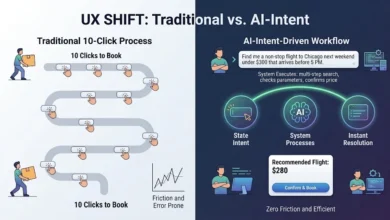
In the wake of the generative AI boom initiated in late 2022, the corporate world entered a phase of rapid, often frantic, integration. Leaders across industries viewed AI as a "magic bullet" capable of modernizing outdated practices and fixing broken internal cultures. However, industry analysts now observe that "AI-powered" is not a self-sustaining value proposition. When AI features are added as "bolt-ons" rather than being deeply integrated into existing infrastructures, they often force users out of their established workflows, requiring them to manage yet another disparate system.
According to research from the Nielsen Norman Group, many AI features currently suffer from low adoption and high abandonment rates. The cost of delivering these features is immense, involving significant expenditures on specialized hardware, energy consumption, and data management. Furthermore, the risk of reputational damage due to AI "hallucinations"—where the system provides confident but incorrect information—remains a primary concern for professionals. Instead of saving time, users frequently find themselves spending more time verifying, editing, and "cleaning up" AI-generated output than they would have spent creating the work from scratch.
A Chronology of the AI Integration Cycle (2022–2024)
The current state of AI adoption can be understood through a timeline of shifts in industry sentiment and technological deployment over the past two years.
- November 2022 – Mid-2023: The Spark and the Gold Rush. The public launch of ChatGPT and subsequent Large Language Models (LLMs) triggered a global race. Companies prioritized "speed to market" above all else, fearing that failing to announce an AI strategy would result in plummeting stock prices and loss of market share.
- Late 2023: The Integration Phase. Major software suites began embedding AI assistants (Copilots) into every interface. This period was characterized by the "AI-first" philosophy, where the technology was prioritized over the specific user problem it was meant to solve.
- Early 2024: The Disillusionment Phase. Reports began to surface regarding the high "compute cost" of AI features versus their actual utility. Organizations started noticing that while AI could generate content quickly, it often amplified existing organizational shortcomings, such as poor data quality and inconsistent decision-making frameworks.
- Late 2024: The Strategic Pivot. A shift toward "AI-second" or "ambient AI" began to emerge. Designers and engineers started advocating for subtle, background automation rather than intrusive chat interfaces, focusing on automating mundane tasks rather than replacing creative or high-stakes decision-making.
Quantitative Analysis of the AI Productivity Gap
While the narrative of AI has focused on "hyper-productivity," empirical data suggests that the current implementation of these tools may be having the opposite effect. A comprehensive study involving data from NBC News, Harvard Business Review (HBR), and the Wall Street Journal highlighted several concerning trends in the American workforce following widespread AI adoption.

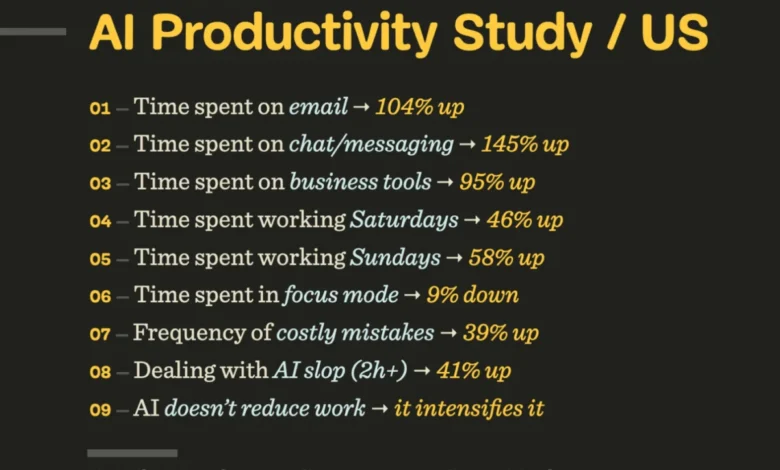
The study found that for many workers, the introduction of AI tools led to a 104% increase in time spent on email and a 145% increase in chat and messaging volume. Business tool usage rose by 95%, while "focus mode"—the time employees spend on deep, uninterrupted work—decreased by 9%. Perhaps most tellingly, the data indicated that working hours on weekends increased significantly, with Saturday work up by 46% and Sunday work up by 58%.
These statistics suggest that AI is not necessarily reducing the volume of work; instead, it is intensifying it. The phenomenon, often referred to as "AI slop," requires humans to act as high-level editors for low-quality machine output. The study also noted that costly mistakes in professional environments rose by 39% when AI was used without rigorous human oversight, further complicating the ROI (Return on Investment) for companies investing heavily in the technology.
Labor Implications and the Exposure of Professional Sectors
The anxiety surrounding AI is not merely a matter of workflow friction but is deeply rooted in job security and the nature of human labor. Data from the Brookings Institution and the Washington Post indicates that certain professions are significantly more "exposed" to AI automation than others.

Software developers and public relations specialists are among the most exposed, as their tasks often involve the generation of code or text—areas where LLMs excel. Conversely, roles that require physical presence and manual dexterity, such as firefighters or healthcare providers performing physical procedures, remain the least vulnerable.
The resistance observed among workers often stems from the fact that AI is frequently targeted at the "rewarding" parts of a job—such as creative writing, strategic planning, or artistic design—while leaving the "boring" parts, such as administrative verification and data cleaning, to the humans. This inversion of the traditional automation model, where machines were supposed to handle the "dirty, dull, and dangerous" tasks, has led to a psychological disconnect. As noted by industry experts, people do not generally desire AI-narrated books or AI-generated art; they desire AI that handles the mental labor of logistics, scheduling, and data entry so they can engage in more meaningful human activities.
Official Responses and Industry Perspectives
The reaction from the tech industry’s leadership has been a mixture of continued optimism and cautious recalibration. Satya Nadella, CEO of Microsoft, has frequently argued that AI will act as a "copilot" for every worker, yet internal UX teams at major firms are increasingly reporting that "prompt fatigue" is a real phenomenon. Users are becoming tired of having to "speak" or "type" into a magical box for every minor task.

UX researchers, such as Vitaly Friedman and the team at Nielsen Norman Group, have begun to advocate for a "calm technology" approach. This philosophy suggests that the best AI is often invisible. It doesn’t present itself as a chatbot but as a smart, background feature that automatically corrects an error, optimizes a schedule, or filters out irrelevant data without requiring a specific command.
Bo Young Lee, a prominent voice in organizational culture, summarized the sentiment of many professionals: "I don’t want AI to teach my children or make my medical decisions. I want AI to do all the physical and mental labor that taxes me so I can read books written by humans and engage with art made by humans." This perspective highlights a critical shift in consumer demand: a move away from "AI as a companion" toward "AI as a utility."
Broader Impact and the Path Toward Meaningful Utility
The long-term success of artificial intelligence in the enterprise and consumer sectors will likely depend on its ability to transition from a "novelty feature" to a reliable infrastructure. For this to happen, several structural changes are necessary:

- Reliability over Speed: Users compare features with other features, not with human performance. If an AI tool is less reliable than a traditional software function, users will abandon it, regardless of how "smart" it is perceived to be.
- Deep Integration: AI must adapt to existing human mental models and workflows rather than forcing users to learn new "prompt engineering" skills that feel unnatural and labor-intensive.
- Predictability: The non-deterministic nature of AI (where the same input can produce different outputs) is a liability in professional environments like law, medicine, and engineering. Increasing the predictability of these systems is a prerequisite for widespread professional adoption.
- Focus on "Boring" Automation: The highest value for AI lies in the tasks that humans find mundane and unrewarding. By automating these "dull" tasks, AI can truly enhance human productivity and job satisfaction.
In conclusion, the narrative that "everyone wants more AI" is being replaced by a more nuanced understanding of human-computer interaction. People do not necessarily want more AI in their lives; they want more time, more headspace, and more reliable tools. The organizations that thrive in the next phase of the digital evolution will be those that use AI not to replace the human experience, but to protect and enhance it by removing the friction of modern labor. The future of AI is likely not "AI-first," but "AI-second"—a supportive, silent, and highly efficient background layer that allows human creativity and connection to remain at the forefront.