As digital advertising budgets continue to scale into the tens of millions of dollars, corporate decision-makers are increasingly scrutinizing the statistical frameworks used by platform operators to justify ad spend. A recent analytical review of official measurement standards promulgated by major technology platforms has ignited a broader industry debate regarding how success is defined, measured, and replicated. At the center of this controversy are Brand Lift, Search Lift, and Conversion Lift studies—proprietary measurement tools utilized by tech giants like Google, Meta, and TikTok to quantify the business impact of multi-million-dollar campaigns.
For chief financial officers (CFOs) and chief marketing officers (CMOs), the core dilemma lies not in whether data is gathered, but in how certainty is communicated and what that certainty means for future capital allocation. Critics and analytical experts argue that current platform guidelines may systematically favor the platform’s commercial interests by encouraging further expenditure based on ambiguous statistical evidence, thereby transferring the financial risk entirely onto the advertiser.
Background and Context of Digital Attribution
For over a decade, digital marketing attribution has evolved from simple last-click models to complex, econometric, and platform-native experimentation. Platforms such as Google and YouTube introduced lift studies to help advertisers measure incremental impact—the actual difference in user behavior caused specifically by seeing an ad, compared to a control group that did not see it.
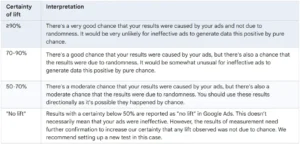
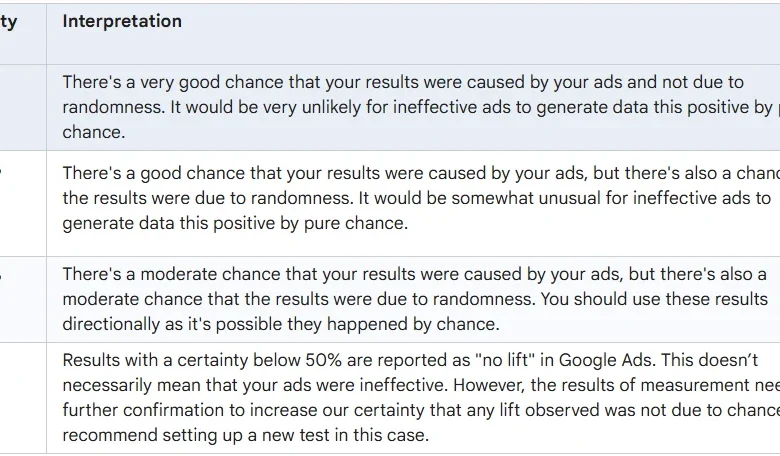
To quantify this, platforms report a metric often referred to as "certainty" or statistical significance. However, interpreting these figures has historically been a point of friction between data scientists, corporate finance departments, and media buyers. The tension reached a focal point following the publication of updated platform guidelines detailing how advertisers should interpret certainty tiers—specifically categorizing metrics ranging from 50% to over 90% certainty.
When platforms frame a 70% to 90% certainty score as a "good chance" of success, and assert that results exceeding 50% offer "valuable, directional insights," it creates a semantic gray area. In corporate finance, however, ambiguity rarely translates to a secure business case.
Two Parties, Two Divergent Risk Profiles
To understand the core conflict, industry analysts suggest examining the fundamental divergence of incentives between the platform and the advertiser.
- The Platform Perspective: As a vendor of advertising inventory, a technology platform operates with a structural incentive to interpret ambiguous data constructively. If a lift study yields weak or moderate evidence that an ad campaign might have worked, the platform finds utility in exploring that hypothesis. The operational philosophy leans toward experimentation, urging brands to iterate and continue spending.
- The Advertiser Perspective: Corporate marketing leaders and financial controllers operate under strict fiduciary responsibilities. Their primary question is not whether a dataset contains interesting anomalies or directional trends, but whether the evidence is sufficiently robust to risk another multi-million-dollar tranche of capital on the assumption that the previous campaign successfully drove business outcomes.
Because technology platforms do not bear the financial consequences of a misallocated budget, an optimistic interpretation of marginal data poses no operational risk to them. Conversely, the advertiser’s enterprise absorbs 100% of the downside if a campaign fails to replicate its purported success.
Translating "Certainty" into Replication Risk
To bridge the gap between platform terminology and financial reality, quantitative marketing experts apply statistical modeling—such as Bayesian replication models inspired by biostatistical frameworks pioneered by researchers like Steven Goodman—to evaluate what is known as "replication risk."
When a platform reports a specific lift metric (such as a +3-point increase in brand consideration) alongside a 70% certainty rating, standard corporate interpretation might treat that as a verified victory. However, replication mathematics addresses a harsher question: If an organization repeats the exact same campaign under identical market conditions with another $5 million budget, what is the mathematical probability of achieving a similarly positive, statistically sound result?
Calculations utilizing these models reveal stark realities for media planners:
- Positive Lift Probability: A reported 70% certainty score often correlates with only a modest probability (approximately 65%) that an identical repeat campaign will yield any positive lift at all, even a negligible fraction of a point.
- High-Certainty Threshold: The probability of hitting a stringent internal corporate standard (such as 90% certainty) on a repeated campaign drops significantly, often hovering near 30% when baseline certainty is only 70%.
- Replication Risk Exposure: The remaining probability represents the risk that the follow-up campaign will fail to meet even moderate evidentiary standards, leaving the marketing team unable to substantiate the ROI to executive leadership.
Consequently, marketing veterans argue that relying on "directional" insights or moderate certainty tiers effectively forces companies to gamble significant capital on odds that would be rejected in virtually any other corporate investment sector.
Industry Implications and Evolving Standards
The debate over platform-reported lift studies extends far beyond a single vendor. As brands navigate tighter macroeconomic conditions and heightened scrutiny on marketing accountability, industry groups are calling for standardized, independent validation of attribution metrics.
Many senior brand media directors now advocate establishing a strict internal floor—such as 90% or even 95% statistical certainty—before approving successive rounds of high-capital campaigns. Proponents of this stricter threshold argue that it lowers replication risk and protects corporate treasuries from the financial pitfalls of interpreting inconclusive data as definitive proof of performance.
Furthermore, independent analysts urge marketing departments to stop outsourcing their risk tolerance to the very entities profiting from ad spend or to agency partners whose compensation is frequently tied to overall media budgets.
As digital advertising continues to mature, the pressure is mounting on both platforms and enterprise organizations to adopt more transparent, rigorous statistical standards—ensuring that corporate investment decisions are driven by verifiable financial returns rather than ambiguous, platform-defined probabilities.