Beyond the Luxury Suite: A Rigorous Framework for Measuring the Business Impact of Sports Marketing

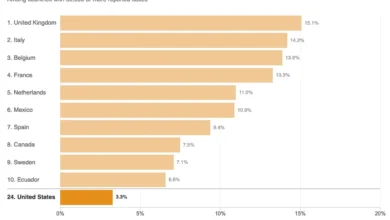
The modern media landscape continues to undergo profound structural transformations, yet live sports remain the definitive titan of television viewership. Recent industry metrics underscore this dominance, revealing that nearly all of the top 50 most-watched telecasts in the United States are tethered directly to sporting events. Outside of rare cultural anomalies—such as the Academy Awards, milestone television anniversary specials, and high-profile news interviews—live athletic competition commands the collective attention of the American public in a way that scripted entertainment and traditional episodic programming can no longer replicate.
This unyielding consumer appetite has triggered a high-stakes corporate migration. Streaming giants, legacy television networks, and global brands are pouring billions of dollars into acquiring broadcast rights and securing high-visibility sports sponsorships. Marketers have enthusiastically embraced this ecosystem, allocating vast budgets to team sponsorships, jersey branding, perimeter stadium boards, athlete endorsements, and stadium naming rights.
However, this golden age of sports sponsorship is increasingly intersecting with financial pragmatism. As corporate budgets face heightened scrutiny, executive leadership is asking fundamental questions regarding return on investment. While hospitality suites, clubhouse access at exclusive golf clubs, and personal interactions with elite athletes offer undeniable intangible perks, corporate boards are demanding hard evidence that multi-million-dollar sports marketing investments translate directly to tangible business outcomes. Transitioning from superficial visibility metrics to rigorous, causal measurement has therefore become the central challenge for modern marketing analytics professionals.
The Foundational Laws of Marketing in Athletic Ecosystems
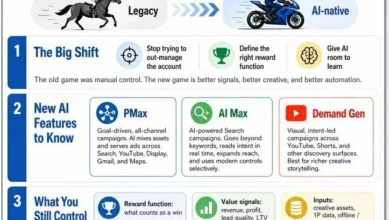
A persistent misconception within corporate boardrooms is that sports marketing operates under a distinct set of economic rules separate from traditional brand advertising. Industry analysts emphasize that every fundamental law of consumer psychology and marketing efficacy applies directly to sports investments.
Foremost among these principles is the primacy of creative execution. Industry benchmarks consistently demonstrate that creative storytelling is responsible for 60% to 70% of total brand marketing success. When a brand’s creative messaging fails to cut through the noise in digital environments characterized by fleeting consumer attention spans, identical vulnerabilities plague corporate logos displayed on racing cars, athletic apparel, or interview backdrops. Because the primary intent of the consumer is to watch the game rather than analyze sponsorships, passive logo exposure often captures even less cognitive bandwidth than traditional advertising.
Furthermore, the pitfalls of sporadic execution are magnified exponentially within sports marketing. In conventional advertising, sudden bursts of visibility followed by prolonged silence—often referred to as the spike-and-silence phenomenon—severely degrade campaign effectiveness. In the context of sports, transferring the positive brand halo of an athlete or a franchise to a corporate entity requires a sustained, multi-channel strategy. Brands cannot rely on occasional organic social media posts from sponsored athletes or single-instance product placements; building genuine consumer affinity demands consistent, disciplined paid media reinforcement.
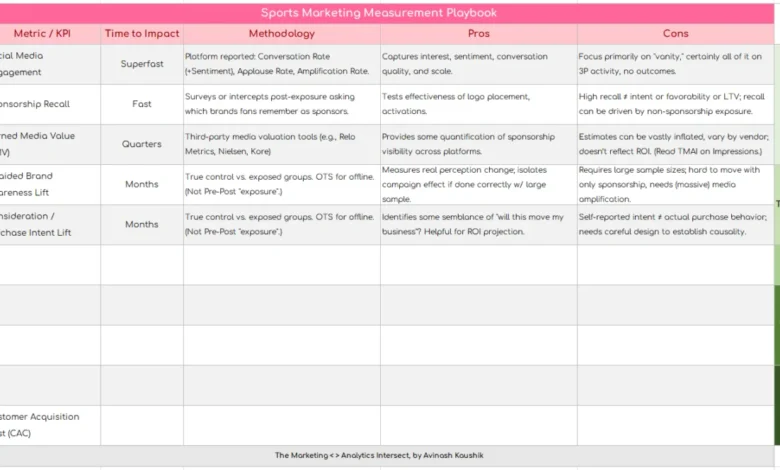
The Five-Level Sports Marketing Measurement Playbook
To address the corporate demand for fiscal accountability, analytics frameworks have emerged to categorize how organizations evaluate their sports marketing investments. Ranging from superficial vanity metrics to advanced econometric modeling, these levels provide a structured roadmap for assessing true business impact.
Level 5: The Opening Gambit of Vanity Metrics
Virtually every organization initiates its sports marketing evaluation at Level 5, though advanced analytics professionals caution against remaining at this stage. Characterized by high-speed data collection and impressive top-line numbers, Level 5 measures operational activity rather than behavioral outcomes.
- Social Media Engagement: Brands track conversation rates, applause rates, and amplification metrics across digital platforms, evaluating both corporate channels and the organic feeds of partnered athletes. While data acquisition is rapid and frequently cost-free, these metrics measure digital noise rather than business value.
- Sponsorship Recall: Post-exposure surveys assess whether fans remember a brand as an official sponsor. Analysts stress the importance of utilizing unaided recall methodologies rather than prompted questions to ensure data integrity, while segmenting results by exposure intensity, such as full-match viewing versus highlights consumption.
- Earned Media Value (EMV): Frequently promoted by sponsorship agencies, EMV calculates the cumulative duration of logo visibility and multiplies it by standard ad rates. Major marketing associations largely discredit EMV, as it assumes all exposure is inherently positive, ignores audience relevance, and fails to account for cluttered environments.
Level 4: The Quest for Brand Impact
Advancing to Level 4 requires transitioning from activity tracking to true test-versus-control methodologies. At this stage, organizations evaluate whether sports sponsorships meaningfully alter consumer perceptions and attitudes.
- Unaided Brand Awareness (UBA) Lift: UBA is notoriously difficult to move, representing a long-term revenue driver. Effective, long-term sports marketing programs are designed to shift these baseline metrics over extended deployment periods.
- Consideration and Purchase Intent Lift: Tracking whether consumers position a brand among their top choices for future procurement provides a direct leading indicator of medium-term revenue growth.
Methodologies at Level 4 rely on traditional brand-tracker surveys administered across comparable exposed and control cohorts. Advanced organizations utilize propensity score matching to ensure demographic and behavioral parity between test and control groups, while isolating external variables such as simultaneous product launches or competitor campaigns.
Strategic Implications and the Path to Incrementality
While Levels 5 and 4 establish baseline visibility and brand perception shifts, the ultimate maturation of sports marketing analytics involves advanced digital attribution and econometric modeling. Reaching advanced tiers—such as Level 3 (Heart and Mind Influence), Level 2 (Digital Traceability), and Level 1 (Incrementality)—enables organizations to prove definitively that sports sponsorships drive incremental revenue that would not have occurred organically.
For enterprise leadership, the takeaway is clear. Sports marketing possesses transformative potential for brands willing to align creative excellence with disciplined analytical rigor. By abandoning superficial vanity metrics and committing to rigorous, long-term impact measurement, organizations can illuminate the true business value hidden behind the hospitality suites and stadium lights.