Navigating the Global Wave of Social Media Bans: What the 2026 Regulatory Landscape Means for Brands and Marketers

The digital public square is undergoing a profound structural transformation. As lawmakers, regulatory bodies, and judicial systems across the globe grapple with the well-documented mental health tolls of the internet—ranging from compulsive doom-scrolling to the psychological pressures of curated highlight reels—public sentiment has decisively shifted toward intervention. According to Sprout Social’s Q1 2026 Pulse Survey, an overwhelming 68% of consumers now support government-enacted social media bans designed to protect children and adolescents, with parents of young children forming the vanguard of this movement.
This surging public mandate has catalyzed a cascade of legislative proposals, enacted bans, and landmark legal settlements. For global brands and social media marketers, this seismic shift transitions the digital landscape away from the unregulated "Wild West" era of the past two decades into a highly structured, legally scrutinized environment. To maintain viability, marketing teams must rapidly adapt their workflows, upgrade brand safety protocols, and recalibrate how they measure digital success.
The Chronology of a Global Crackdown: From Legislative Debates to Judicial Settlements
The movement to restrict youth access to social media has evolved rapidly from localized policy discussions into coordinated international action. While individual nations have approached the issue through distinct legal frameworks, the overarching trajectory points toward strict age verification, limitations on algorithmic feeds, and heightened platform accountability.
The timeline of major international actions highlights the velocity of this regulatory wave:
- Late 2024 to 2025: Various U.S. state legislatures begin passing experimental age-assurance and parental consent laws, though many face immediate constitutional challenges in federal courts regarding freedom of speech.
- April 2026: Turkey passes landmark legislation banning personal social media account creation for children under the age of 15, while instituting strict parental controls for teens aged 15 to 17.
- June 2026: The United Arab Emirates (UAE) officially establishes a minimum age requirement of 15 for independent social media accounts, introducing restricted functionality for users aged 15 and 16.
- August 2026: France’s highest constitutional court strikes down a proposed blanket social media ban for minors under 15, citing infringements on freedom of expression, though legal experts anticipate a revised bill. Simultaneously, Australia aggressively enforces its comprehensive ban prohibiting youth under 16 from holding personal social media accounts, placing the legal and financial burden squarely on tech platforms.
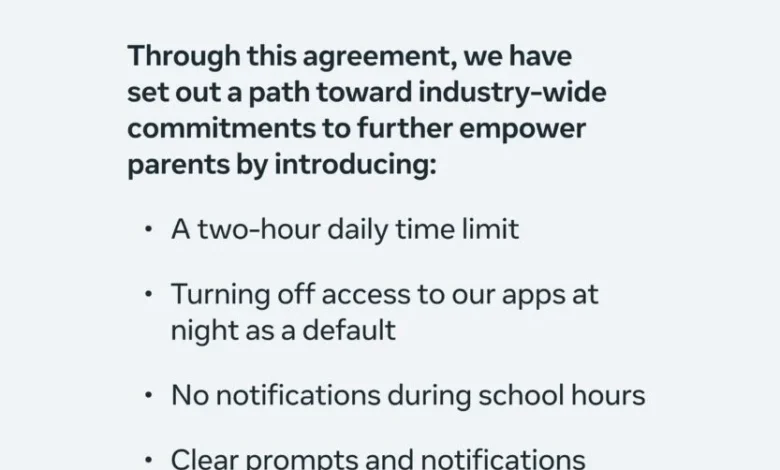
- August 2026: Meta enters a landmark youth safety settlement. Rather than waiting for slow-moving legislative bodies, this judicial agreement fast-tracks sweeping operational changes across Instagram and Facebook. Crucially, the terms of the settlement are contingent upon competing networks—including TikTok, YouTube, and Snapchat—adopting comparable youth protection measures, setting a powerful de facto global standard.
Regional Policy Breakdowns: EMEA, APAC, and the United States
The enforcement mechanisms and target demographics vary significantly across geopolitical regions, yet nearly all current frameworks share a common thread: the legal duty to regulate falls primarily on the technology platforms and application stores rather than the end consumers.
Europe, the Middle East, and Africa (EMEA)
European and Middle Eastern nations have taken aggressive stances on platform accessibility. Beyond individual country mandates—such as the UAE and Turkey’s under-15 restrictions, and pending proposals in the United Kingdom, Greece, and Denmark—the European Commission is currently evaluating a bloc-wide directive to harmonize rules for users aged 16 and under. Meanwhile, nations like the UK are weighing overnight curfews for minors and extending safety requirements into interactive gaming environments where younger demographics congregate.
Asia-Pacific (APAC)
The APAC region has emerged as a pioneer in strict youth access limitations. Australia’s ban for users under 16 is fully active, supported by heavy financial penalties for non-compliant networks. Indonesia employs a tiered model: children under 13 are restricted to dedicated child-friendly experiences, users aged 13 to 16 require verified parental consent, and platforms deemed "high risk" are barred entirely for anyone under 16. Malaysia enforces a strict registration block for new accounts belonging to minors under 16, and New Zealand is actively considering similar high-risk platform restrictions.
The United States Model
Unlike centralized national bans, the United States presents a patchwork of state-level statutes. Nearly half of all U.S. states have introduced or passed bills utilizing distinct regulatory approaches:
- Age Restrictions and Parental Consent: Establishing a floor age for platform access with conditional entry granted through parental authorization.
- Feed and Design Restrictions: Banning addictive algorithmic feeds for minors in favor of chronological displays, alongside mandatory nighttime lockouts and reduced notification frequencies.
- Usage and Time Limits: Enforcing daily operational caps on minor accounts per platform.
- App-Store Verification: Shifting the burden of age verification and parental consent away from social networks and directly onto app store operators like Apple and Google at the moment of download.
Platform Responses and the Meta Settlement Fallout
Faced with mounting regulatory fines and public backlash, major technology companies have pivoted from resistance to proactive self-regulation. Platforms including Meta, Snapchat, WhatsApp, and YouTube have rolled out sophisticated parental supervision suites. These tools empower parents to oversee privacy configurations, restrict direct interactions with generative AI chatbots, establish screen time boundaries, and monitor general platform activity.
The 2026 Meta youth safety settlement, however, has accelerated these changes far beyond basic parental controls. Under the terms of the agreement, Meta is legally bound to dismantle high-engagement features for minor accounts, limit algorithmic visibility, and implement rigorous age-assurance protocols. Because the financial incentives of the settlement rely on industry-wide adoption—requiring platforms like TikTok and YouTube to follow suit—the settlement functions as de facto global legislation. For marketers, this means features designed to capture youth attention are disappearing rapidly across the entire social ecosystem.

Strategic Implications for Global Brands and Marketers
While the primary legislative target of these regulations is the protection of minors—an audience demographic that most mainstream brands do not explicitly target—the downstream operational impacts affect all facets of digital marketing. Industry leaders emphasize that compliance can no longer be treated as an afterthought.
Sam Morgan-Smith, Head of Social at the UK-based PR agency The Romans, characterizes the shift bluntly: "The days of blanket posting (or ‘throwing confetti’ as I refer to it) and trusting the algorithm are over. Brands will need to get far more strategic. Content needs to be age-aware and legally defensible."
To navigate this tightening regulatory environment, marketing organizations are being forced to restructure their internal processes across three distinct pillars:
1. Granular, Age-Aligned Content Strategies
Relying on broad audience targeting and passive algorithmic distribution is no longer sufficient. Brands must develop rigorous first-party data collection methods, refine creator briefings to ensure messaging is strictly age-appropriate, and clearly define performance metrics that do not rely on underage engagement.
Tiffany Sayers, co-founder of Australian agency Loft Social, notes, "If underage users are legislatively restricted or platforms are penalized for blurred lines, we’ll need more rigour in how brands brief talent, capture first-party data and define success."
2. Sophisticated Brand Safety and Compliance Governance
Compliance must be embedded directly into daily workflows rather than bolted on at the final publishing stage. This requires comprehensive governance playbooks that clearly outline permissible content by age, region, and platform. Furthermore, cross-functional training is vital; digital-facing teams across PR, marketing, and legal must stay educated on overlapping international laws—such as the U.S. Children’s Online Privacy Protection Act (COPPA), the UK Online Safety Act, and Australia’s age-verification mandates—to prevent accidental violations.
3. The Resurgence of Real-World Immersion and Hybrid Ecosystems
As organic digital access for younger cohorts faces friction, brands are reinvesting heavily in physical, real-world (IRL) marketing. This includes university activations, micro-events, experiential retail theater, and peer-to-peer word-of-mouth campaigns. Digitally, brands are expanding into youth-safe ecosystems such as closed messaging apps and gaming integrations.
"This isn’t about abandoning digital—it’s about recalibrating to environments where attention, access and trust intersect," Morgan-Smith explains.
Looking Ahead: An Evolution, Not an Erosion
Far from signaling the demise of social media marketing, industry experts view the current regulatory wave as a marker of the medium’s maturation. Much like television and broadcast media decades ago, social media is shedding its unregulated infancy and entering a formalized, accountable maturity.
For brand leaders, the strategic mandate moving forward requires shifting internal metrics away from superficial vanity figures—such as raw likes and unfiltered follower counts—toward deeper engagement quality, brand trust, and verified consent.
"Social still delivers ROI at every stage of the funnel. It just requires smarter systems and more intentional content now," Sayers concludes. "Show leaders that ethical, compliant social is not only possible but powerful. It’s about shifting the conversation with your leaders from ‘how many likes’ to ‘how many hearts and minds.’"
Related posts: