Google Analytics Unveils Advanced AI-Driven Features to Transition Marketers from Reporting to Strategic Decision-Making

Over the past year, Google has rolled out a suite of advanced features within Google Analytics (GA) designed to shift digital analytics from retrospective reporting to forward-looking strategic execution. These new capabilities address long-standing challenges in digital marketing, including the rise of Answer Engine Optimization (AEO), multi-touch attribution (MTA), cross-channel budgeting, and natural language data querying. Industry experts note that these additions empower analytics professionals to elevate their contributions from basic data aggregation to high-value financial and executive decision-making.
Evolution of Google Analytics and Industry Context
Digital marketing analytics has historically faced a structural limitation: platforms traditionally excel at documenting past user behavior rather than forecasting future outcomes. For years, analysts known colloquially in the industry as "reporting squirrels" spent considerable time pulling metrics on historical traffic, clicks, and basic conversions. However, recent shifts in consumer search behavior—most notably the explosive growth of generative artificial intelligence and Large Language Model (LLM) search tools like ChatGPT, Anthropic’s Claude, and Microsoft Copilot—have rendered traditional SEO-centric measurement incomplete.
To address these market dynamics, Google Analytics has introduced several forward-looking capabilities. Because many of these new tools operate on a forward-only data collection model, capturing data exclusively from the moment they are enabled without retroactively backfilling historical information, analytics teams have been urged to activate the features immediately.
Key Feature Breakdown and Analytical Capabilities
- The AI Assistant Channel (AEO Measurement)
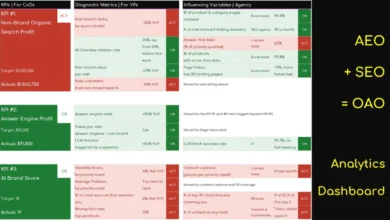
The rapid adoption of generative AI search engines has fundamentally altered the top of the marketing funnel. Industry data indicates a measurable decline in traditional Google SEO traffic, prompting organizations to pivot toward Answer Engine Optimization (AEO).
Google Analytics now natively tracks traffic generated by generative AI tools through a dedicated "AI Assistant" designation within the Default Channel Group, setting the medium to "ai-assistant" without requiring manual regex configuration. Industry retail data from early 2026 published by Adobe and Shopify demonstrates that while AI-referred traffic typically accounts for a small percentage of total sessions (generally between 1% and 5%), its overall business impact is disproportionately high. AI-referred visitors frequently exhibit higher engagement rates, significantly longer average session durations, and conversion rates that outpace traditional organic search traffic.
Despite this inclusion, analytics professionals face ongoing reporting nuances. Mobile applications, desktop clients, and in-app browsers often fail to pass standard referral headers, causing a portion of LLM-driven traffic to default into direct traffic categories. Furthermore, Google categorizes its own integrated AI Overviews under standard organic search, necessitating custom auditing and tagging by internal data teams to capture true aggregate AI-driven revenue.
- Conversion Attribution Analysis
The platform has reintroduced advanced assisted-conversion metrics within its advertising module, reinforcing the value of multi-touch attribution (MTA) frameworks. Traditional last-click attribution models frequently undervalue upper-funnel and mid-funnel acquisition channels by assigning 100% of conversion credit to the final interaction point.
By utilizing the Conversion Attribution Analysis report, marketing teams can evaluate assisted conversions to identify channels that frequently appear along multi-touch consumer journeys without necessarily securing the final click. The system segments touchpoints into early, middle, and late stages, alongside single-touch paths. This granular visibility allows finance and marketing departments to reallocate budgets away from underperforming tactics and protect crucial prospecting channels that spark initial brand demand.
- Cross-Channel Budgeting and Scenario Planning
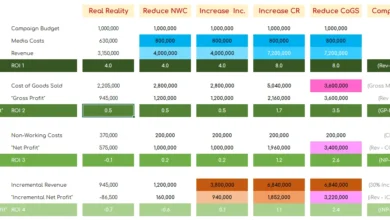
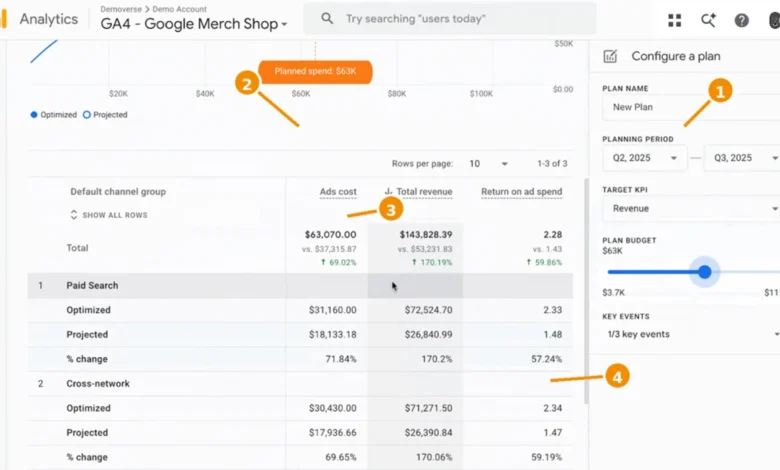
Moving beyond basic performance dashboards, Google Analytics has integrated predictive analytics tools designed to assist chief marketing officers and financial planners with budget allocation. Located within the advertising section, the Cross-Channel Budgeting feature features two core components: Project Plans, which evaluate current spending pacing against projected outcomes, and Scenario Plans, which model the financial impact of shifting capital between disparate channels, such as moving funds from paid social to paid search.
These models incorporate historical performance, seasonality, and diminishing return curves. By running scenario models prior to capital allocation, organizations can identify instances where budget shifts produce minimal variance in projected revenue, thereby revealing structural substitutability across digital advertising platforms. To ensure accuracy, these tools require comprehensive first-party cost data imports from third-party networks, including Meta and TikTok ads.
- Conversational Analysis via Ask Advisor and the GA MCP Server
To bridge the gap between technical data extraction and executive accessibility, Google Analytics has introduced "Ask Advisor," a conversational interface represented by a magnifying glass icon in the platform’s navigation window. This tool allows users to pose complex analytical questions in natural language, enabling the system to synthesize multi-variable datasets regarding traffic shifts, channel performance, and product revenue trends without requiring complex report generation.
For advanced enterprise applications, Google has released a Model Context Protocol (GA MCP) server. This open-source integration connects GA datasets directly to approved enterprise Large Language Models, such as ChatGPT or Claude. By linking analytics repositories with internal media plans and promotional calendars, enterprise teams can conduct holistic cross-channel analyses that extend far beyond standard web metrics.
Additional Enhancements: Source Group Consolidation and LTV Percentiles
Recent platform updates also include Source Group Consolidation, which automatically unifies fragmented traffic sources (such as various historical naming conventions for Meta platforms) into coherent channels retroactively, eliminating the need for manual regex management. Additionally, the introduction of lifetime value (LTV) percentile fields allows businesses to isolate top-tier customers without relying on complex SQL queries through data warehouses like BigQuery. This enables marketers to target high-value user segments directly within ad manager platforms.
Broader Implications for the Analytics Industry
The rollout of these advanced features marks a distinct operational evolution for marketing and analytics departments. By automating routine reporting tasks through conversational AI and providing predictive modeling tools for budget allocation, the platform enables analysts to transition from passive data reporters to active strategic advisors. As enterprises increasingly demand measurable accountability and margin optimization from their digital expenditures, the ability to forecast performance before capital deployment will likely become a definitive competitive advantage in corporate governance.