Four ways Google Analytics delivers actionable insights for your business as it navigates the future of modern measurement.


In the rapidly shifting landscape of digital advertising, the ability to accurately measure return on investment and consumer behavior has become a cornerstone of corporate strategy. As Google moves toward the final phase of its transition from the legacy Universal Analytics (UA) platform to the more robust and privacy-centric Google Analytics 4 (GA4), the company is positioning its measurement suite as an AI-driven engine for business intelligence. With the definitive shutdown of all Universal Analytics properties scheduled for July 1, 2024, organizations are being urged to finalize their data migrations to avoid the total loss of historical records.
The Chronology of a Digital Transition
The shift to GA4 represents one of the most significant architectural changes in web analytics history. Google introduced GA4 roughly five years ago, signaling a move away from session-based, cookie-reliant tracking toward an event-based model. This shift was necessitated by a dual pressure: the decline of third-party cookies as a reliable tracking mechanism and the increasing demand for data privacy from regulators and consumers alike.
The transition timeline has been deliberate. In July 2023, Google stopped processing new data in standard Universal Analytics properties. The upcoming July 1, 2024, deadline represents the final curtain call, where users will lose access to the interface and the ability to retrieve historical data. Analysts warn that for enterprises that have not yet exported their legacy data, the clock is effectively running out. This transition is not merely a technical update but a fundamental change in how marketing performance is quantified, moving from a siloed view of website traffic to a holistic, cross-channel understanding of the customer journey.
Leveraging AI for Actionable Business Intelligence
At the heart of the new GA4 value proposition is the integration of Google AI. Marketing data is often voluminous and fragmented, making it difficult for decision-makers to discern signal from noise. To address this, Google is deploying "generated insights"—a feature designed to distill complex data sets into plain-language summaries.
By utilizing machine learning, the platform can now proactively identify anomalies, such as sudden spikes in purchase events or drops in organic traffic. Rather than requiring a data analyst to manually query the database to determine the "why" behind a fluctuation, the system identifies the contributing dimensions and provides a concise explanation. This capability is expected to save mid-market and enterprise businesses significant man-hours, allowing marketing teams to focus on strategy rather than report generation.
Expanding the Scope of the Customer Funnel
One of the primary challenges for modern marketers is the "walled garden" effect, where data from different advertising platforms often fails to communicate effectively. Google Analytics 4 is attempting to break down these barriers through improved integration with external ecosystems.
Later this year, the platform will enable the inclusion of aggregated impressions from Campaign Manager 360 directly into the advertising workspace. This integration provides a more granular view of the top-of-funnel impact—a critical metric for brands that rely on brand awareness campaigns. Furthermore, Google is simplifying the ingestion of non-Google advertising costs. By enabling direct connections to platforms such as Reddit, Pinterest, and Snap, businesses can consolidate their performance data within a single dashboard. This feature maps external costs, clicks, and impressions to native Analytics traffic sources, allowing for an "apples-to-apples" comparison of return on ad spend (ROAS) across the entire digital ecosystem.
Strategic Budgeting and Media Pacing
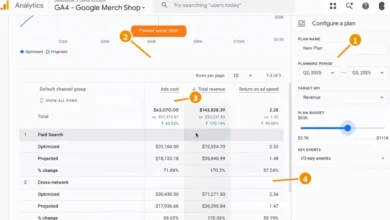
Beyond mere observation, GA4 is moving into the realm of prescriptive analytics. The forthcoming release of cross-channel budgeting tools—currently entering a beta testing phase—is designed to help marketers manage in-flight media more effectively.
The tool will feature a projections report, allowing teams to track how their current spend is pacing against a predefined revenue target. For organizations managing multi-million dollar budgets across diverse channels, this functionality is expected to provide a dynamic feedback loop. Instead of waiting for a monthly post-mortem to realize a budget was over- or under-allocated, managers will be able to make real-time adjustments, reallocating funds to the highest-performing channels as the data dictates.

Building for a Privacy-First Ecosystem
The most significant hurdle facing the analytics industry is the obsolescence of third-party tracking. As browser vendors and regulatory bodies like the European Union’s GDPR and California’s CCPA tighten restrictions, "durable" measurement has become a primary business imperative.
Google’s strategy for a post-cookie future rests on three pillars:
- Privacy Sandbox API Integration: By adopting Chrome’s Privacy Sandbox, Google Analytics 4 aims to maintain audience reach and measurement accuracy without relying on cross-site tracking identifiers.
- Enhanced Conversions: This mechanism allows businesses to leverage first-party data—such as hashed, consented customer emails—to bridge gaps in conversion attribution. By matching this consented data against Google’s own logged-in user data in a privacy-safe, hashed environment, companies can recover visibility into conversions that would otherwise be lost to cookie-blocking software.
- Consent Mode: This feature allows businesses to adjust how their tags behave based on the consent status of their users. When users opt out of tracking, the platform utilizes behavioral modeling to estimate the activity of the non-consenting group, providing a statistically sound, albeit anonymized, view of the overall traffic.
Implications for the Industry
The shift to GA4 is effectively forcing the industry to professionalize its approach to data. The reliance on simple "last-click" attribution, which often favored search-intent platforms at the expense of discovery-based advertising, is being replaced by data-driven attribution models. This change is not just technical; it is economic. Brands that adapt to these new models are finding that their marketing budgets are more efficient, as they can now better value the contributions of early-funnel touchpoints.
However, the transition is not without friction. For small businesses, the learning curve associated with the event-based architecture of GA4 remains steep compared to the session-based legacy system. Additionally, the need to maintain "data durability" requires a sophisticated level of technical expertise, including the management of first-party data pipelines and server-side tagging.
As the industry approaches the July 1, 2024, deadline, the role of Google Analytics is evolving from a simple traffic tracker to a central command center for growth. By marrying the scale of Google’s AI with the necessity of privacy-first architecture, the platform aims to provide a sustainable path forward. Organizations that treat this transition as an opportunity to clean up their data infrastructure and embrace modeling-based insights will likely be the ones to gain a competitive advantage in an increasingly complex digital market. The future of measurement will not be found in tracking every individual, but in modeling the behavior of the many, all while respecting the privacy of the one.