Google Analytics Transforms Into a Predictive Decision Engine with Advanced AI and Cross-Channel Budgeting Features

Google Analytics has rolled out a suite of powerful features designed to transition digital analytics from retrospective reporting to forward-looking, predictive decision-making. Over the past year, the analytics platform has introduced capabilities aimed at addressing complex modern marketing challenges, including Answer Engine Optimization (AEO), advanced conversion attribution, cross-channel budget forecasting, and conversational natural language querying.
These updates reflect a fundamental shift in how digital marketing data is captured, analyzed, and leveraged by corporate leadership, finance departments, and marketing teams. Industry experts note that while some of these capabilities are forward-facing and require immediate activation due to their inability to backfill historical data, they collectively provide a more comprehensive view of user behavior, attribution, and multi-touch customer journeys.
The Rise of Answer Engine Optimization and AI Assistant Traffic
One of the most notable updates in Google Analytics is the native inclusion of the AI Assistant channel within Default Channel Groupings. As search behaviors evolve and consumers increasingly rely on generative artificial intelligence platforms such as ChatGPT, Claude, and Microsoft Copilot for discovery, traditional Search Engine Optimization (SEO) metrics have faced mounting pressure.
Recent retail data highlights the shifting value of traffic originating from AI assistants. According to studies published by major commerce and technology ecosystems in early 2026, AI-referred traffic often demonstrates significantly higher engagement and conversion rates compared to traditional organic search traffic. Visitors arriving via AI platforms have been shown to spend more time on site, exhibit higher average order values, and convert at rates substantially higher than standard non-AI sessions.
Despite these performance advantages, AI assistant traffic typically accounts for a smaller percentage of total sessions—generally ranging between 1% and 5% for most businesses. Analysts emphasize that this dynamic shifts the focus from raw traffic volume to margin and efficiency. However, digital marketers face ongoing tracking challenges, as app-based interactions, desktop applications, and embedded in-app browsers often bypass standard referral tagging, frequently miscategorizing LLM-driven traffic as direct visits. Furthermore, search engine providers often classify their own AI-generated overview traffic under traditional organic search, complicating precise measurement.
Reviving Assisted Conversions and Multi-Touch Attribution
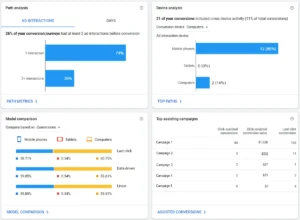
To combat the limitations of siloed performance data, Google Analytics has reintroduced and refined its conversion attribution analysis tools. Recognizing that last-click attribution models frequently undervalue upper-funnel and mid-funnel marketing efforts, the platform now provides granular visibility into assisted conversions across earned, owned, and paid channels.
By evaluating multi-touch customer journeys, analytics professionals can better understand how channels like paid social or display advertising contribute to the consideration phase, even if they do not secure the final conversion click. The platform’s enhanced funnel analysis categorizes touchpoints into early, middle, and late stages, allowing organizations to quantify the exact share of conversion credit assigned to each phase of the consumer lifecycle.
Industry professionals caution that while assisted conversions offer vital context, they must be paired with accurate cost data and rigorous marketing mix modeling (MMM) to determine true incrementality. To achieve reliable cross-channel visibility, organizations are increasingly required to import comprehensive campaign expenditure data from external advertising platforms, including Meta and TikTok, directly into their analytics environment.
Predictive Cross-Channel Budgeting and Scenario Planning
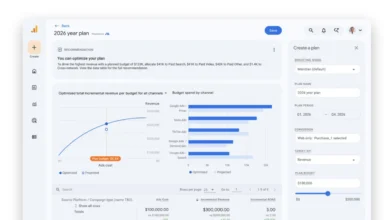
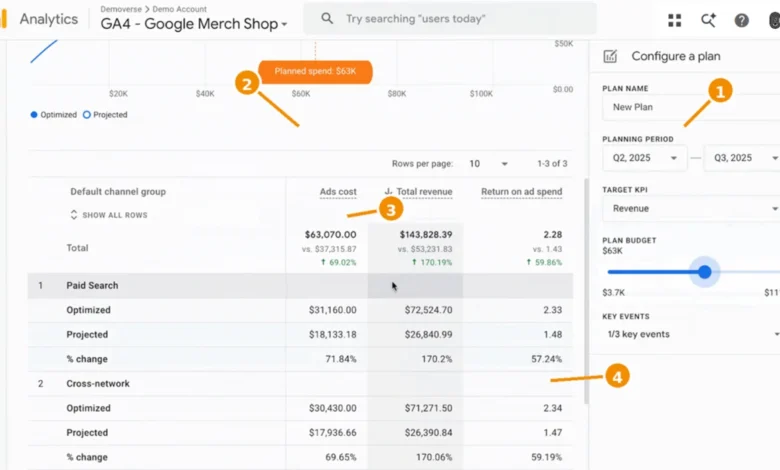
Moving beyond descriptive analytics, the integration of predictive cross-channel budgeting tools allows organizations to simulate financial outcomes before capital is deployed. Located within the advertising section of the platform, the new budgeting tools offer project plans to track ongoing spending efficiency alongside scenario plans designed to evaluate reallocation strategies.
These predictive models train on historical organizational data while accounting for seasonal fluctuations and external variables. By analyzing diminishing return curves, decision-makers can determine whether shifting capital between channels—such as moving funds from paid social to paid search—will meaningfully impact revenue generation. This capability bridges the gap between marketing analytics and corporate finance, equipping executives with data-driven projections rather than speculative forecasts.
Conversational Analysis and Modern Integration Capabilities
The integration of natural language processing within Google Analytics has redefined user accessibility through features such as Ask Advisor. By enabling users to query complex data sets using conversational prompts, the platform lowers the technical barrier to entry for senior leadership and non-technical stakeholders. Complex multi-variable analyses that previously required extensive manual navigation can now be synthesized rapidly.
To extend analytical capabilities beyond the confines of the web interface, Google has also introduced a first-party Model Context Protocol (MCP) server. This tool connects analytics data directly with approved large language models, allowing organizations to cross-reference web performance metrics with internal media plans, promotional calendars, and offline customer data.
Broader Implications for Marketing and Finance
The cumulative effect of these updates is a restructuring of the responsibilities held by analytics and marketing professionals. By automating routine reporting and introducing predictive financial modeling, the platform enables teams to focus on strategic resource allocation and customer lifetime value (LTV) optimization. Additional features, such as source group consolidation—which automatically harmonizes fragmented traffic sources like various social media naming conventions—and native LTV percentile segmentation, further reduce manual data cleaning requirements.
As organizations adapt to these advanced capabilities, the emphasis has shifted decisively toward proactive planning. Industry observers note that the tools now available within digital analytics environments empower enterprises to model outcomes, optimize budgets with precision, and justify marketing expenditures using rigorous, empirical evidence.