Why Authentic Thought Leadership Remains the Ultimate B2B Differentiator in the Age of Artificial Intelligence

The modern business-to-business (B2B) purchasing landscape is undergoing a profound transformation, driven heavily by the rapid integration of artificial intelligence and automated discovery tools. Yet, even as algorithms and machine learning models reshape how enterprise buyers scout for vendors, human expertise and authentic professional insights continue to reign supreme. According to the newly released 2026 B2B Thought Leadership Impact Report by global communications firm Edelman, the value of genuine thought leadership has not diminished in the digital era; rather, it has become an indispensable differentiator for brands navigating a crowded, AI-driven marketplace.
Surveying more than 1,100 management-level professionals globally, the comprehensive study sheds light on shifting buyer behaviors, decision-making criteria, and the critical interplay between automated search mechanisms and human validation. The findings offer a timely roadmap for marketing executives, communications professionals, and corporate strategists seeking to capture attention and secure long-term commercial partnerships in an increasingly automated world.
The Evolving B2B Discovery Process and the Rise of AI
To understand the weight of Edelman’s latest findings, it is necessary to examine the broader context of how B2B procurement has evolved over the past decade. Historically, enterprise buyers relied on traditional networking, trade publications, direct sales outreach, and search engine queries to compile shortlists of potential vendors. Over the last three years, however, the proliferation of generative artificial intelligence has fundamentally accelerated this initial research phase. Today, corporate decision-makers frequently leverage AI-powered assistants and specialized research bots to synthesize market intelligence, aggregate vendor capabilities, and draft preliminary supplier lists.
This technological shift initially sparked anxiety among traditional content marketers and brand strategists. The concern was straightforward: if AI tools can instantaneously summarize industry trends, analyze product specifications, and compare competitor offerings, what is the utility of long-form corporate blogs, white papers, and LinkedIn thought leadership posts?
Edelman’s 2026 report answers this question definitively. Far from rendering human-generated content obsolete, the rise of AI has actually heightened the demand for original research, firsthand experience, and verified professional insight. Because generative AI systems fundamentally rely on existing information to synthesize outputs, they cannot generate novel, hands-on industry expertise or proprietary corporate data that does not already exist in the public domain. Consequently, buyers utilizing AI for initial discovery routinely hit a validation wall, prompting them to cross-reference algorithmic recommendations directly with original brand content, executive commentary, and peer-reviewed professional insights.
Key Data Insights: What the Numbers Tell Us

The empirical data compiled in the 2026 B2B Thought Leadership Impact Report highlights several compelling trends that quantify the direct link between high-value content and commercial success.
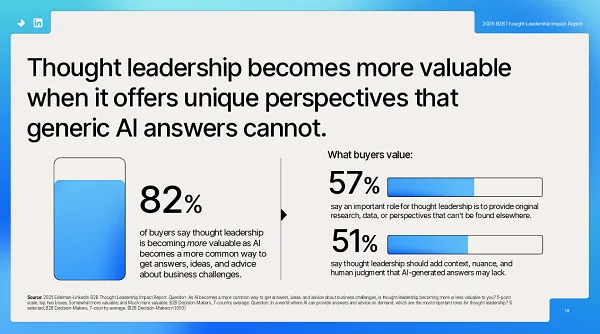
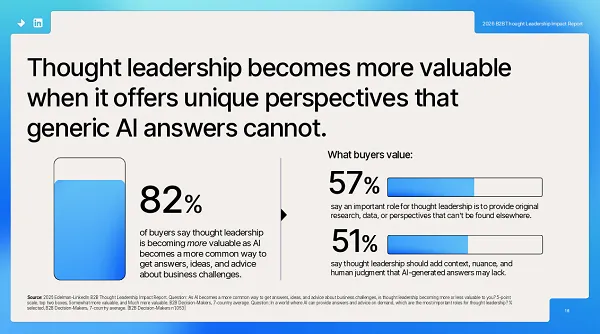
First, an overwhelming 82% of surveyed management-level buyers stated that thought leadership is becoming increasingly valuable to their organizations. In an environment where competing vendors often offer near-identical software features, pricing structures, and service-level agreements, original research, proprietary data, and deep professional experience serve as the ultimate competitive separators.
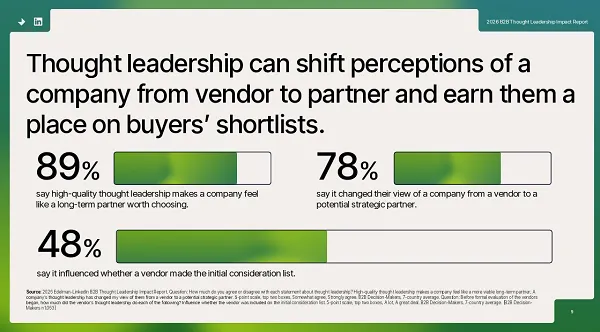
Second, the psychological impact of thought leadership on brand perception cannot be overstated. The data reveals that 89% of enterprise buyers view high-quality thought leadership content as a primary driver in making a company feel like a long-term partner worth choosing. In the complex world of B2B sales—where procurement cycles often span months or even years—building foundational trust is paramount. Buyers want assurance that their chosen vendors possess the institutional stability, intellectual rigor, and operational maturity required to navigate unforeseen market disruptions. Consistent, high-caliber thought leadership acts as a public demonstration of these qualities.
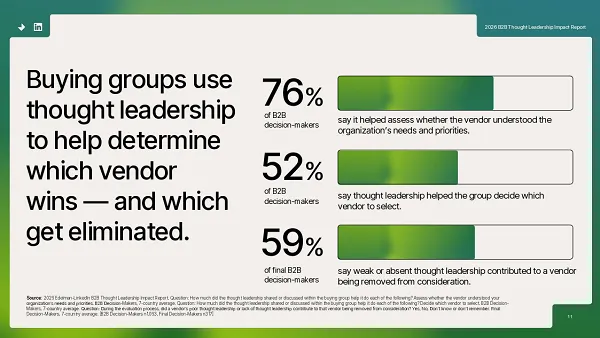
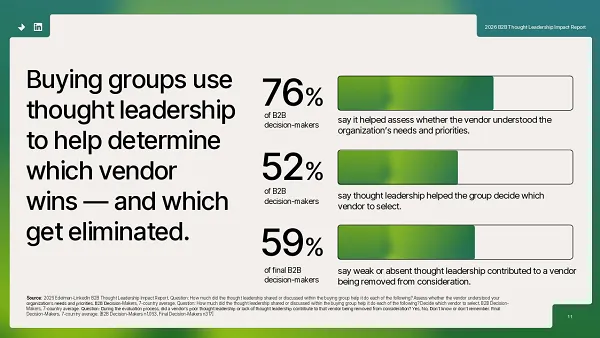
Conversely, the report issues a stark warning to organizations that neglect their content output: brands that fail to actively share thought leadership face a very real risk of being entirely eliminated from consideration during the preliminary vendor selection phase. In modern procurement committees, silence is rarely interpreted as neutrality; rather, a lack of visible expertise is frequently equated with obsolescence or a lack of industry leadership.
Furthermore, the study sheds light on the mechanics of how professional content is consumed and distributed within corporate hierarchies. According to Edelman’s findings, B2B buyers are increasingly inclined to share thought leadership content through private channels—such as encrypted messaging applications, internal Slack or Microsoft Teams channels, and direct email threads—rather than public social media feeds. This indicates that high-value professional content frequently sparks internal debate and influences consensus-building behind closed doors, long before a formal sales inquiry is ever submitted.
Industry Reactions and Expert Analysis
Following the publication of the report, marketing analysts, B2B sales consultants, and corporate communications leaders have weighed in on the broader implications for enterprise strategy.
Industry observers note that the report validates a strategic pivot that many forward-thinking enterprises began making late last year: moving away from generic, keyword-stuffed content designed strictly for search engine optimization, and pivoting toward deeply reported, executive-driven insights. In an internet increasingly saturated with low-cost, AI-generated text, buyers have developed a sophisticated radar for inauthentic or superficial material.
"We are witnessing the death of commodity content," notes a senior B2B marketing strategist specializing in enterprise technology. "When anyone can press a button and generate a passable 1,000-word article on industry trends, volume ceases to be a competitive advantage. The only currency that matters now is proprietary perspective—real data, real mistakes learned from, real case studies, and real leadership."
Moreover, Edelman’s research emphasizes the growing influence of external industry experts and third-party influencers in endorsing corporate capabilities. While internal executive positioning remains vital, enterprise buyers place immense trust in recognized subject-matter experts who can independently validate a brand’s claims. This trend underscores the necessity for integrated communications programs that combine executive visibility with strategic influencer partnerships.
Strategic Implications for Corporate Communications and Marketing
For marketing and communications leaders tasked with allocating budgets for the upcoming fiscal years, the Edelman report provides a clear blueprint for strategic resource allocation.
-
Prioritize Proprietary Research and Original Data
To cut through the noise of AI-generated summaries, brands must invest in generating their own primary research. Surveys, market benchmarks, proprietary analytics, and case studies grounded in real-world operational experience provide the raw material that algorithms cannot replicate and competitors cannot easily copy. -
Cultivate Authentic Executive Voices
Corporate thought leadership cannot be effectively outsourced to junior copywriters using automated drafting tools. To resonate with discerning management-level buyers, content must reflect the authentic voice, strategic vision, and hands-on experience of C-suite executives, product architects, and senior practitioners. LinkedIn remains a critical ecosystem for this type of professional engagement, serving as the primary digital town square where B2B decision-makers evaluate prospective partners. -
Optimize for Private Sharing and Internal Consensus
Because a significant portion of B2B thought leadership consumption now occurs within private digital channels, content creators must design materials that are easily digestible and shareable among internal procurement committees. White papers, executive summaries, and data-rich infographics that can be easily forwarded from a chief technology officer to a chief financial officer carry immense internal currency. -
Maintain Continuous Content Reinforcement
Thought leadership is not a one-time campaign or a static lead-generation tactic; it is an ongoing commitment to industry dialogue. The data indicates that continuous content production is essential not only for winning new business but also for reinforcing existing client partnerships, reducing customer churn, and maintaining brand relevance over the lifespan of long-term commercial relationships.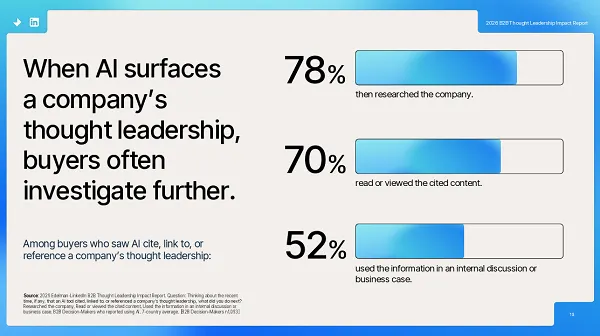
Conclusion: The Human Advantage in an Automated Market
As artificial intelligence continues to mature and automate routine aspects of business operations, the human element of commerce is paradoxically becoming more critical than ever. Technology can accelerate research, streamline communication, and synthesize vast oceans of data, but it cannot replace strategic intuition, ethical responsibility, or the lived experience of industry professionals solving complex, real-world problems.
Edelman’s 2026 B2B Thought Leadership Impact Report serves as both an empirical validation and a strategic warning. Brands that rely on generic, automated output risk fading into obscurity in a sea of digital uniformity. Conversely, companies willing to invest in authentic expertise, original research, and courageous thought leadership will find themselves uniquely positioned to win the trust—and the business—of tomorrow’s enterprise buyers.
Related posts: