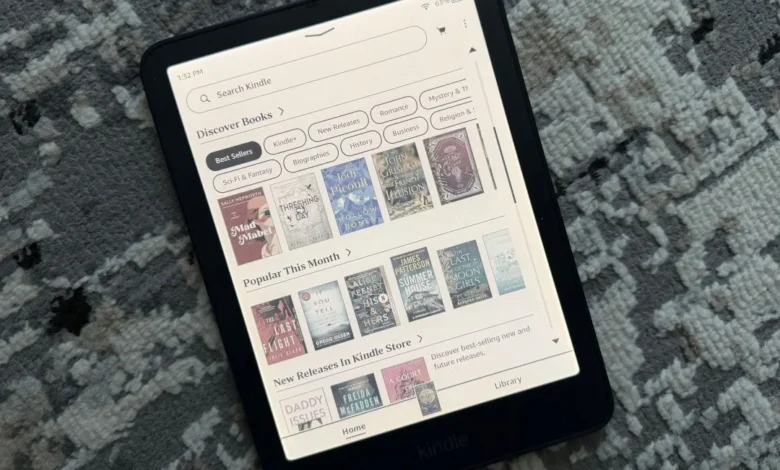
Amazon has once again shaken up the e-reader market with its latest hardware refresh, rolling out a comprehensive new lineup that includes a revamped basic Kindle, an updated Paperwhite, and the highly anticipated second-generation Kindle Colorsoft. As consumers increasingly look for versatile devices that bridge the gap between traditional monochrome reading and multimedia consumption, Amazon’s updated color e-reader arrives with significant ergonomic adjustments, a sleeker profile, and a targeted pitch for fans of graphic novels, illustrated cookbooks, and digital note-takers who rely on color-coded annotations.
Priced starting at $290 for the standard model, with the premium 32GB Signature Edition commanding a $320 price tag, the new Kindle Colorsoft enters a competitive and expanding market for E-Ink color displays. While the baseline model offers 16GB of internal storage, the Signature Edition doubles that capacity while introducing a sophisticated aluminum back available in graphite and a deep, maroon-toned Fig finish. These hardware refinements represent Amazon’s continued refinement of its color e-reader strategy, building upon the initial foundation laid by the first-generation Colorsoft introduced in 2024.
Evolution of the Kindle Colorsoft Lineup
The journey of color E-Ink technology in mainstream consumer electronics has been gradual. When Amazon first entered the color e-reader space in 2024, the original Colorsoft was praised for introducing color capabilities to a loyal Kindle user base, though it faced criticism regarding muted saturation and initial software optimization. With this latest iteration, Amazon has focused heavily on physical form factor improvements rather than a complete overhaul of the display panel.
The new Colorsoft is noticeably lighter and thinner than its predecessor, featuring an edge-to-edge display that lends it a modern, premium aesthetic. Despite these physical enhancements, the core reading mechanics remain consistent with the previous generation. Both models utilize a 7-inch color E-Ink display, delivering a crisp 300 pixels per inch (ppi) for standard black-and-white text, which drops to 150 ppi when rendering color content.
For existing owners of the first-generation Colorsoft, industry analysts and early reviewers note that there may be limited incentive to upgrade, as the core visual fidelity and resolution remain largely unchanged. However, for prospective buyers who have delayed transitioning to a color e-reader due to past limitations in design or ergonomics, the second-generation model presents a compelling, albeit expensive, proposition.
Ergonomic Refinements and Hardware Design

One of the most practical improvements in the new Kindle Colorsoft addresses a common user complaint from the previous generation: the placement of the power button. On the older model, the power button was situated along the bottom edge of the device directly adjacent to the USB-C charging port, a placement that frequently led to accidental presses and premature shutdowns while handling or resting the e-reader.
Amazon has relocated the power button to the upper-right edge of the device, creating a more intuitive and accidental-touch-free user experience. This subtle modification significantly enhances daily usability, particularly for readers who frequently change positions or hold the device with one hand.
The premium Signature Edition further distinguishes itself through the tactile quality of its aluminum back. While Amazon bundles protective folio options with review units, testing reveals that the metallic finish is durable enough to withstand daily handling without a case, maintaining its aesthetic appeal over weeks of use. Furthermore, the slim profile improves overall ergonomics, making extended reading sessions more comfortable compared to legacy Kindle hardware.
For readers who enjoy outdoor environments, the Colorsoft retains its robust waterproof rating. This inclusion ensures that users can read safely near pools, at the beach, or in the bath without risking accidental water damage from splashes or spills.
Display Performance, Lighting, and Battery Efficiency
Evaluating an E-Ink color display requires balancing expectations between traditional paper and backlit tablet screens. The Colorsoft utilizes color filtering over an electronic paper display, meaning hues remain relatively muted and lack the high-contrast vibrancy found on conventional LCD or OLED tablets like an iPad. Nevertheless, the injection of color transforms the digital reading experience for specific genres.
Readers navigating graphic novels, comic books, illustrated children’s stories, or complex cookbooks will find the color capability transformative. Additionally, the ability to highlight text in multiple distinct colors provides a tangible workflow advantage for students and researchers.
Visual comfort remains a hallmark of Amazon’s ecosystem. The Colorsoft allows users to manually or automatically adjust screen color temperature, shifting toward a warmer, amber-toned backlight that reduces eye strain during nighttime reading sessions.

In terms of power management, E-Ink technology continues to outpace traditional consumer electronics by a wide margin. Amazon estimates that the Colorsoft can achieve up to eight weeks of battery life on a single charge under moderate usage conditions—slightly lower than the monochrome Paperwhite, which boasts up to 12 weeks, but exceptionally robust when measured against smartphones or tablets. Real-world testing confirms that users can go weeks between charges, largely eliminating battery anxiety.
Furthermore, screen refresh rates have been noticeably optimized. Unlike larger color E-Ink devices such as the Kindle Scribe Colorsoft, where page refreshes can feel sluggish, the standard-format Colorsoft refreshes efficiently with minimal lingering ghost text from previous pages.
Broader Market Implications and Pricing Analysis
Despite its impressive feature set, the primary barrier to widespread adoption for the Kindle Colorsoft remains its aggressive pricing structure. At $290 for the base configuration and $320 for the Signature Edition, the device represents a steep capital investment for a single-purpose reading tool.
For the average consumer, the financial delta between the Colorsoft and Amazon’s monochrome offerings is substantial. The standard monochrome basic Kindle and Paperwhite models start at $169.99 and $199.99, respectively, offering exceptional reading performance at a fraction of the cost. Industry observers suggest that while color e-readers represent the cutting edge of E-Ink hardware development, they will likely remain a niche category targeted at enthusiasts until manufacturing efficiencies drive production costs down.
For dedicated fans of illustrated content and multi-color note-taking, the Kindle Colorsoft is a polished, highly functional device that successfully justifies its existence. For casual readers, however, the traditional black-and-white Kindle lineup remains the more pragmatic and economical choice. As Amazon continues to iterate on its color E-Ink ecosystem, the trajectory of future firmware updates and hardware drops will likely depend on how receptive the broader consumer market proves to these premium pricing tiers.