The Evolution of Collaborative Robotics: How Robust AI is Redefining Human-Robot Integration in Warehouses and Factories

The modern industrial landscape stands at a critical technological crossroads, where automation is no longer just about replacing human labor, but rather about optimizing the synergistic capabilities of people and machines. At the forefront of this paradigm shift is Robust AI, a pioneering robotics company co-founded by industry luminary Rodney Brooks and veteran entrepreneur Anthony Jules. Rather than pushing for complete, cost-prohibitive lights-out manufacturing, Robust AI has engineered a practical approach to automation that prioritizes human agency, operational flexibility, and seamless integration into existing industrial ecosystems.
In complex environments such as dynamic warehouses, bustling manufacturing floors, and fast-paced logistics hubs, the ultimate metric of success is not standalone machine efficiency, but rather overall system performance. According to Anthony Jules—an MIT alumnus (’92, SM ’92) who serves as the company’s chief innovation officer—success relies entirely on a balanced division of labor. The robot handles repetitive physical strains, human workers apply cognitive decision-making and dexterity, and backend systems manage the data flow. By ensuring that human operators retain an appropriate level of agency and input, the entire ecosystem continually moves forward without friction or worker alienation.
A Legacy of Innovation: The Brooks and Jules Partnership
The founding of Robust AI is rooted in decades of robotics research and entrepreneurial pedigree. Rodney Brooks, a towering figure in the field of artificial intelligence, spent over two decades as a faculty member at the Massachusetts Institute of Technology (MIT) from 1984 to 2010. During a crucial decade from 1997 to 2007, he directed MIT’s prestigious Computer Science and Artificial Intelligence Laboratory (CSAIL).
During his tenure at MIT, Brooks co-founded iRobot, a company that revolutionized consumer robotics with the invention of the ubiquitous Roomba vacuum cleaner and subsequently achieved a successful initial public offering in 2005. Following his departure from iRobot, Brooks co-founded Rethink Robotics, pioneering early models of collaborative robots, often referred to as cobots, designed to work safely alongside humans.
Anthony Jules crossed paths with Brooks as a graduate student at CSAIL during the 1990s. Though their specific labs did not directly collaborate, they shared the same academic floor, fostering a professional relationship that endured long after graduation. Jules went on to co-found Sapient, a digital consulting and technology firm that also achieved a public stock offering before its eventual acquisition by Publicis in 2015.
The convergence of these two seasoned innovators occurred serendipitously in 2019 at a robotics conference. Brooks approached Jules with a concept for a new robotics software venture—an enterprise he colloquially compared to a video game engine designed specifically for training and contextualizing robots. This chance encounter laid the structural foundation for Robust AI, which was officially incorporated later that year.
From Pandemic Pivot to Industrial Logistics
The trajectory of Robust AI, like many technology firms founded in the cusp of the 2020s, was profoundly altered by the onset of the Covid-19 pandemic. Initially, the founding team pivoted their nascent technology toward developing autonomous mobile robots capable of sanitizing surfaces in public and corporate spaces. However, as epidemiological data evolved and public health authorities established that Covid-19 transmission was primarily airborne rather than surface-driven, the market demand for UV-disinfection robots rapidly contracted.
Faced with a shifting global landscape, the leadership team was forced to re-evaluate the core utility of the software and hardware they had developed. The technology was fundamentally designed to help robots understand the physical world with greater semantic depth and situational awareness.
Jules recalls presenting the pivot to Brooks with a mixture of excitement and apprehension. Recognizing that customers in the logistics and manufacturing sectors were desperately seeking solutions to persistent labor and operational bottlenecks, Jules noted that the only viable path forward involved designing and manufacturing physical hardware—a notoriously difficult and capital-intensive endeavor for a young software-centric startup.
Extensive market research and years of direct interviews with prospective industrial clients eventually steered Robust AI toward its primary target markets: logistics and manufacturing.
The Reality of Industrial Automation
When economists and technologists discuss factory automation, public perception is often shaped by the top 5 percent of industrial facilities worldwide—massive, highly capitalized operations boasting investments ranging from $50 million to $200 million for fully automated, pristine assembly lines. These hyper-automated environments rely on fixed infrastructure, specialized conveyor networks, and proprietary machinery that leaves little room for human intervention.
However, this elite segment represents a tiny fraction of the global industrial footprint. The vast majority of factories, warehouses, and fulfillment centers operate without comprehensive automation. Many of these facilities lack even basic conveyor belt systems, relying instead on manual transport and traditional workflows. For these businesses, tearing down existing infrastructure to install a $200 million automated system is financially impossible and operationally disruptive.
Recognizing this market gap, Robust AI designed its products to be modular and non-disruptive. The company’s flagship systems can be phased into existing floor plans incrementally, requiring zero architectural overhauls.
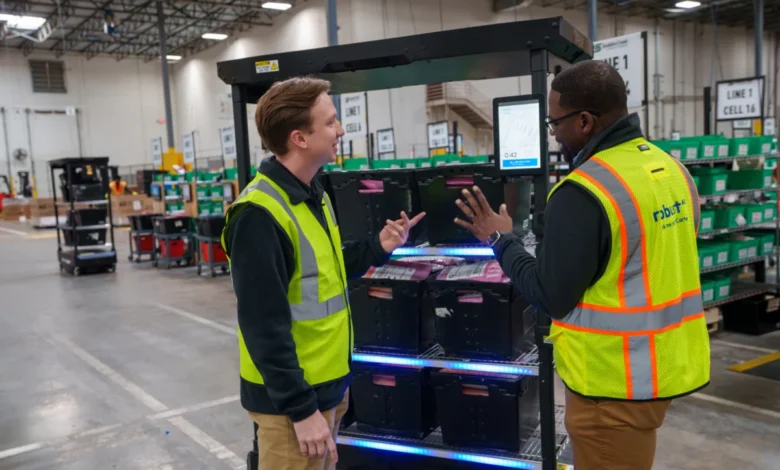
The primary embodiment of this philosophy is the Carter robot family. In massive distribution centers and manufacturing plants, human workers walk an estimated average of 30,000 steps per day just moving inventory from one station to another. Because these facilities often span hundreds of thousands of square feet, workers frequently walk hundreds of feet between tasks while carrying heavy or bulky loads.
Brooks, serving as the company’s chief technology officer, explains the operational simplicity: a worker can load items onto a Carter robot, designate a destination up to 400 feet away, and simply issue a digital command indicating the task is complete. The robot autonomously navigates the space to deliver the payload, freeing the human operator to focus on localized, high-value tasks. Crucially, the integration model remains completely flexible, allowing individual facilities to adapt the technology to their unique workflows rather than forcing operations to bend to rigid machine schedules.
The Human-Robot Interaction Challenge
To ensure successful deployment, Robust AI places immense emphasis on human-robot interaction (HRI). Leila Takayama, the company’s vice president of human-robot interaction, recently reviewed peer-reviewed studies examining the implementation of autonomous mobile robots in hospital settings. These robots had been deployed to handle logistical chores such as gathering used meal trays, transporting medical linens, and moving diagnostic equipment.
Paradoxically, researchers discovered that a high percentage of these hospital robots had been intentionally deactivated by staff and pushed against the walls, with nurses reporting that the machines frequently "broke."
Upon deeper investigation, the mechanical failure was largely a misdiagnosis. The root cause was operational interference. Nurses rushing down hospital corridors with critical patients on gurneys would encounter an autonomous robot that, adhering strictly to its safety programming, would stop dead in its tracks. Lacking the agility to maneuver the gurney around the stationary machine, medical staff found that the robots were actively obstructing their primary, life-saving duties. Consequently, out of frustration and necessity, the staff turned them off.
This cautionary tale serves as a core design principle for Robust AI. The company’s engineering philosophy mandates a deep understanding of workers’ primary workflows. Whether a specific physical task is executed by a human or a machine, the technology must accelerate that task rather than impede it.
Evolutionary Division of Labor
The ultimate vision of Robust AI is anchored in a pragmatic understanding of biological and digital strengths. Humans have spent millions of years of evolutionary history developing advanced physical dexterity, spatial reasoning, and adaptability in complex, unstructured environments. Digital systems, conversely, excel at high-speed data processing, tireless repetition, long-range spatial navigation, and maintaining precise inventories.
By allowing humans to execute tasks in the physical world that align with their evolutionary strengths, and pairing those capabilities with responsive digital systems that excel at data management and logistics, Robust AI aims to bridge the persistent gap between theoretical automation and practical industrial reality. As industries worldwide grapple with labor shortages, rising supply chain demands, and the economic pressures of modernization, this collaborative approach offers a sustainable path forward—one where machines empower human workers rather than displacing or obstructing them.