Google Analytics Unveils Advanced AI and Attribution Tools to Shift Marketing from Descriptive Reporting to Predictive Strategy

Over the past year, the development team behind Google Analytics (GA) has rolled out a sophisticated cluster of enterprise-grade features designed to elevate digital analytics from historical reporting to forward-looking strategic decision-making. These updates introduce advanced data collection capabilities, predictive budget modeling, and conversational AI interfaces aimed at integrating marketing metrics more closely with corporate finance and executive leadership goals.
While historical analytics platforms have traditionally served the passive function of documenting web traffic after the fact, the latest iterations of Google Analytics focus on anticipating consumer behavior, optimizing multi-touch attribution, and capturing emerging traffic streams generated by Answer Engines and Large Language Models (LLMs). Analysts note that several of these new functionalities operate on a forward-only data collection model, meaning they do not backfill historical data from prior periods, requiring immediate activation by enterprise digital teams.
The Rise of Answer Engine Optimization (AEO) and AI Assistant Channels
One of the most significant updates in the recent GA rollout is the automatic tracking of AI Assistant traffic within the standard Traffic Acquisition reports. As search behaviors migrate from traditional search engine results pages to generative AI platforms, conversational bots, and answer engines, digital marketers have faced a quantifiable decline in standard organic search traffic—historically estimated by industry analysts to range between 20% and 30%.
Google Analytics now isolates traffic originating from AI assistants under a dedicated default channel group, designating the medium as "ai-assistant" without requiring manual tagging from site administrators. Data compiled across the digital ecosystem indicates that while Answer Engine traffic typically represents a modest share of total site sessions—generally hovering between 1% and 5%—its underlying economic value is disproportionately high. Industry benchmarks published by digital commerce platforms such as Adobe and Shopify in early 2026 revealed that visitors arriving via answer engines demonstrate conversion rates up to 42% higher, spend significantly more time on product description pages, and deliver higher average order values compared to standard organic search traffic.
Despite these advancements, data specialists caution that native GA reporting undercounts total LLM engagement. Traffic originating from mobile and desktop applications, in-app browsers, and proprietary platform interfaces often lacks standard HTTP referrers, causing it to default into direct traffic categories. Furthermore, industry observers note that Google categorizes its own AI Overviews and AI Mode traffic under traditional organic search, complicating efforts to isolate pure conversational AI metrics. Organizations are increasingly relying on custom channel groupings and Regex configurations to capture the full spectrum of dark traffic driven by AI agents.
Enhanced Conversion Attribution and Multi-Touch Analysis
To address long-standing frustrations with last-click attribution models, Google Analytics has reintroduced and expanded its Conversion Attribution Analysis tools within the Advertising workspace. Last-click attribution has historically penalized upper-funnel marketing channels by assigning 100% of the conversion credit to the final interaction before a purchase, ignoring the foundational awareness generated by paid social campaigns, display advertising, and content marketing.
The updated GA interface provides granular visibility into assisted conversions, allowing analysts to quantify how often a specific marketing channel appears along multi-touch customer journeys. By contrasting last-click revenue against assisted conversion volume, digital teams can accurately evaluate the supporting role of channels that do not immediately close sales.
In parallel, Google Analytics utilizes an advanced funnel analysis framework that categorizes marketing touchpoints into early, middle, and late stages of the consumer journey, while isolating single-touch conversion paths. This structural breakdown helps marketing executives identify undervalued prospecting channels and reassess budget allocations that might otherwise be prematurely cut based on narrow last-click performance metrics. Industry standards recommend pairing these multi-touch insights with incrementality testing and Marketing Mix Modeling (MMM) to verify whether assisted conversions translate into true net-new business growth.
Cross-Channel Budgeting and Predictive Scenario Planning
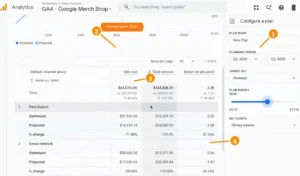
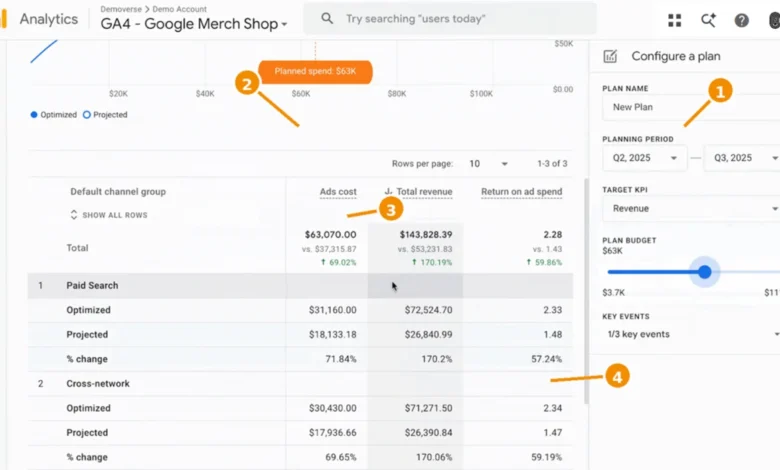
Bridging the gap between analytical insights and executive financial planning has historically challenged marketing departments. To streamline this process, Google Analytics has introduced Cross-Channel Budgeting tools, featuring project pacing and predictive scenario planning modules designed to forecast business outcomes based on historical performance, seasonality, and media spend.
The platform’s scenario planning tools enable finance and marketing leaders to model the financial impact of shifting capital between competing channels, such as reallocating budgets from paid social to paid search. By analyzing diminishing return curves and projected Return on Ad Spend (ROAS), organizations can test hypotheses before committing capital to live campaigns.
To ensure the accuracy of these predictive models, GA has streamlined first-party campaign data imports from major external advertising ecosystems, including Meta and TikTok. Analysts emphasize that comprehensive cost data is a mandatory prerequisite for generating reliable optimization recommendations. While predictive models trained on historical data inherently carry a degree of estimation error, they provide a standardized quantitative baseline for cross-functional budget negotiations between marketing, analytics, and finance departments.
Conversational Analytics and LLM Integration via Model Context Protocol
Streamlining data accessibility for executive leadership has been a persistent hurdle for analytics teams. Google Analytics has sought to resolve this friction by introducing "Ask Advisor," a conversational AI interface accessible via the platform’s primary navigation.
Ask Advisor allows users to execute complex analytical queries using natural language, bypassing the need to manually navigate through multi-layered report menus. Enterprise stakeholders can query the system regarding revenue fluctuations, channel mix shifts, and promotional impacts, thereby accelerating decision-making cycles and reducing the operational burden on dedicated data analysts.
To extend analytical capabilities beyond the native boundaries of the web interface, Google has released a first-party Model Context Protocol (MCP) server for Google Analytics. This developer tool allows organizations to connect their GA data directly to enterprise-approved Large Language Models, such as ChatGPT or Claude. By integrating web analytics with internal corporate data repositories, including media plans, promotional calendars, and offline customer sales databases, analysts can execute cross-platform studies that examine visitor behavior in the broader context of overall business operations.
Broader Implications and Strategic Shift
The cumulative impact of these feature releases marks a structural evolution in digital analytics. For over two decades, web analytics platforms functioned primarily as retrospective record-keepers, documenting user traffic and transactional outcomes after they occurred.
The integration of automated AI categorization, predictive budget modeling, conversational query engines, and advanced attribution frameworks repositions Google Analytics as a proactive engine for business strategy. By equipping organizations with tools to anticipate consumer behavior, optimize cross-channel investments, and integrate web data with enterprise finance systems, these updates empower analysts to transition from routine reporting to driving executive-level decision-making.