Global Public Opinion Hits New Low Regarding Social Media and Its Detrimental Impact on Modern Democracy

Public sentiment surrounding social media platforms has reached an unprecedented low, according to comprehensive new research published by the Pew Research Center. Over the past four years, a sweeping global shift in perspective has taken place, with populations across dozens of countries increasingly viewing the digital ecosystem as a corrosive force against democratic institutions. This souring mood is not distributed evenly across demographics; adults harbor significantly deeper anxieties than teenagers regarding the societal footprint of these applications. As lawmakers worldwide grapple with the mounting pressure to regulate digital spaces, this definitive data offers critical insight into the widening generational and cultural divides over the future of the internet.
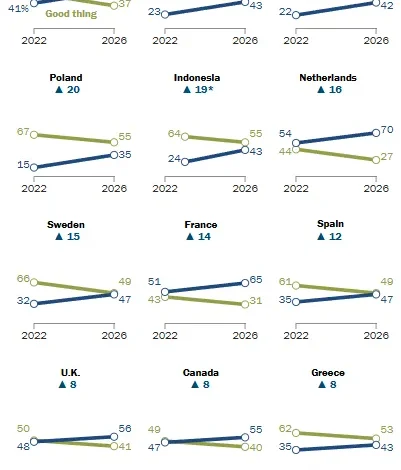
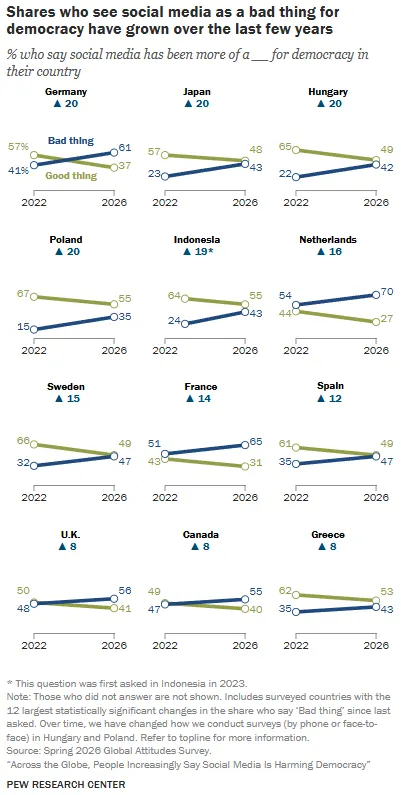
The latest findings are drawn from an extensive 37-nation survey conducted by the Pew Research Center, which mapped international opinions regarding the intersection of social media, governance, and societal stability. The empirical data reveals a stark universal trend: in every single nation surveyed, public sentiment concerning the positive utility of social media has deteriorated since Pew last measured these metrics in 2022. What was once viewed broadly as a revolutionary tool for democratic empowerment and global connectivity is now frequently characterized as a destabilizing catalyst that exacerbates political polarization and erodes public trust.
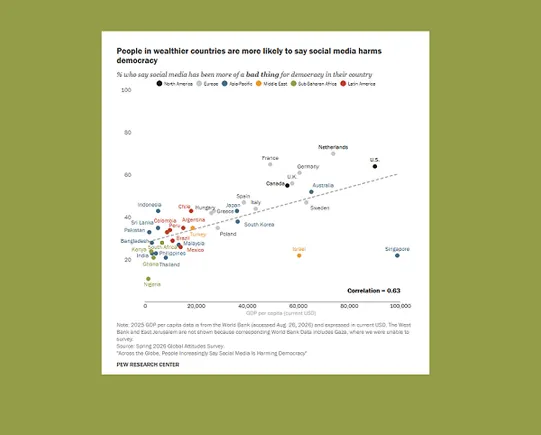
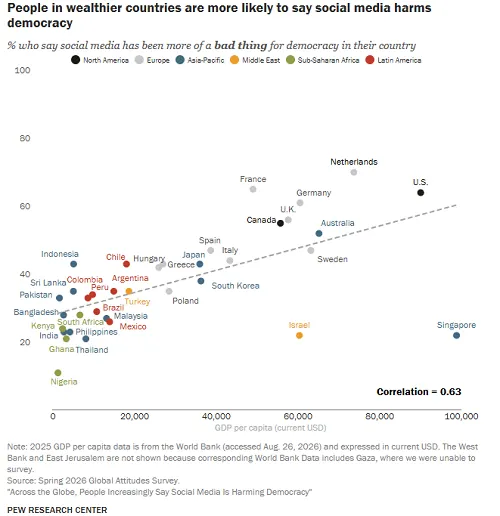
Among the countries evaluated, the United States stands out for harboring particularly severe skepticism. A commanding 64% of American adults now explicitly state that social media has a negative impact on democracy. This pervasive pessimism is not isolated to North America; the study highlights a distinct economic correlation. Citizens residing in wealthier, highly developed nations are consistently more likely to believe that social media exerts a detrimental influence on their domestic political systems and social cohesion, whereas developing nations display a more nuanced or occasionally optimistic outlook.
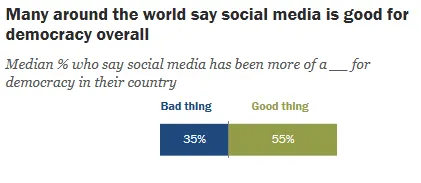
Despite the prevailing gloom, the survey also captures underlying complexities within public opinion. Approximately 55% of respondents globally acknowledged that social media maintains some form of positive impact on democracy, often citing its capacity for rapid information dissemination, grassroots mobilization, and civic engagement. Crucially, this positive sentiment is most pronounced among young adults. Younger demographics remain significantly more likely than their older counterparts to view social platforms as fundamentally beneficial, creating a profound generational chasm regarding digital utility and safety.
This generational friction is acutely visible in debates surrounding youth access to digital platforms. In a companion study recently released by Pew Research, an overwhelming 82% of Australian adults expressed active support for legislative measures restricting children’s access to social media. Further data demonstrates that older audiences are consistently the most ardent supporters of strict age-gating and total teen social media bans, viewing such restrictions as a necessary protective measure against the backdrop of widespread digital harm. Similar polling trends across the United States, the United Kingdom, France, Italy, Norway, and Sweden confirm that adult majorities across the Western world favor similar interventions.
The Chronology of Disenchantment: A Four-Year Trajectory
To understand how global sentiment deteriorated so rapidly, it is necessary to examine the trajectory of public opinion over recent years. In the early 2010s, social media platforms were widely celebrated by policymakers and international organizations as engines of democratization, famously credited with facilitating the movements of the Arab Spring and offering marginalized voices an unvarnished public forum.

By 2018, however, the tide began to turn. Revelations regarding data privacy breaches, the unchecked proliferation of foreign disinformation campaigns during major national elections, and internal whistleblower leaks exposed the darker mechanics of engagement-driven algorithms. These algorithms, designed to maximize user retention and advertising revenue, were shown to systematically amplify emotionally charged, highly polarizing content. By prioritizing outrage and controversy over nuanced debate, the platforms inadvertently stoked societal divisions and entrenched political tribalism.
When the Pew Research Center conducted its baseline global survey in 2022, the lingering effects of the COVID-19 pandemic had temporarily highlighted the vital connective tissue of digital platforms, yet deep-seated structural concerns were already bubbling to the surface. Over the subsequent four-year window leading up to the 2026 findings, a relentless succession of mental health crises among adolescents, high-profile congressional hearings, and escalating geopolitical cyber-interference solidified public disillusionment. The drop in sentiment recorded between 2022 and the present day reflects an accumulation of fatigue and fear regarding the unchecked power of Big Tech corporations.
Analyzing the Algorithmic Driver and Societal Division
At the core of the public’s growing frustration is the fundamental business model underpinning contemporary social media. Engagement-driven algorithms are optimized to capture human attention through emotional resonance. Because anger, fear, and indignation are potent drivers of digital interaction, posts that provoke these reactions naturally receive wider distribution.
Independent researchers and sociologists have noted that this structural reality has systematically altered political discourse. Rather than serving as neutral town squares, platforms function as echo chambers that reinforce pre-existing biases and compel individuals to deepen their political ideologies. Over time, exposure to hostile political rhetoric degrades empathy and civil discourse, laying the groundwork for the democratic decay cited by survey respondents.
Furthermore, the psychological toll on younger users has transformed abstract academic debates into urgent public health crises. Clinical psychologists and child development experts have increasingly pointed to the correlation between excessive, unmonitored social media consumption and rising rates of anxiety, depression, and body dysmorphia among teenagers. This mounting body of clinical research directly underpins the vast adult consensus favoring legislative intervention and age restrictions.
Global Policy Responses and the Inevitability of Teen Bans
As public anxiety crystallizes into measurable political pressure, governments around the globe are shifting from a laissez-faire regulatory approach to active interventionism. The overwhelming support among voters for teen social media bans—ranging from 82% in Australia to strong majorities across Western Europe and North America—makes restrictive legislation politically irresistible for elected officials.
In Australia, lawmakers have advanced aggressive frameworks aimed at establishing minimum age requirements for social media accounts, sparking international interest and debate. Similar legislative proposals are advancing through state and federal legislatures in the United States, despite legal and constitutional challenges regarding free speech protections. In Europe, stringent enforcement of the Digital Services Act (DSA) has forced major tech platforms to be more transparent about their algorithmic processes and content moderation practices, though critics argue these measures do not go far enough to protect minors.
Tech industry representatives, meanwhile, have defended their platforms by emphasizing ongoing investments in safety tools, parental controls, and mental health resources. Industry stakeholders frequently argue that outright bans are ineffective solutions that merely drive youth activity into unmonitored digital shadows, rather than addressing the root causes of online harm. Instead, tech advocates promote the development of robust verification systems and educational frameworks that empower teens to navigate digital spaces safely.
Implications for the Future of Democratic Institutions
The widening chasm between the technocratic optimism of Silicon Valley and the stark pessimism of the global voting public signals a profound crisis of legitimacy for social media corporations. When nearly two-thirds of adults in the world’s leading democracy view these platforms as a threat to governance, the social license under which these companies operate is fundamentally compromised.
Looking ahead, the tension between maintaining open global communication and safeguarding democratic stability will likely define the next decade of technology policy. If platforms fail to self-regulate or successfully address the algorithmic incentives that foster division, governments will likely step in with increasingly heavy-handed restrictions.
Ultimately, the Pew Research Center’s findings serve as a stark warning to both policymakers and tech executives. The global public is no longer willing to trade social cohesion and democratic health for the convenience of instant connectivity. Navigating this new reality will require unprecedented cooperation between international regulators, civil society, and the tech industry to redesign digital spaces that prioritize public well-being over algorithmic outrage.