MIT Researchers Develop First Sensory and Compute-Autonomous Aerial Microrobot Capable of Precise Flight and Landing

Over the past decade, the rapid advancement of miniature robotics has unlocked new possibilities for navigating confined environments, monitoring fragile ecosystems, and performing delicate industrial tasks. Among the most promising innovations in this field are aerial microrobots, engineered to mimic the speed, agility, and durability of biological insects like bumblebees. Until recently, however, these featherweight machines faced a critical limitation: they were physically incapable of carrying the necessary computing hardware, sensors, and navigational electronics onboard. This restricted their operation to specialized laboratory environments tethered to external motion-capture camera systems.
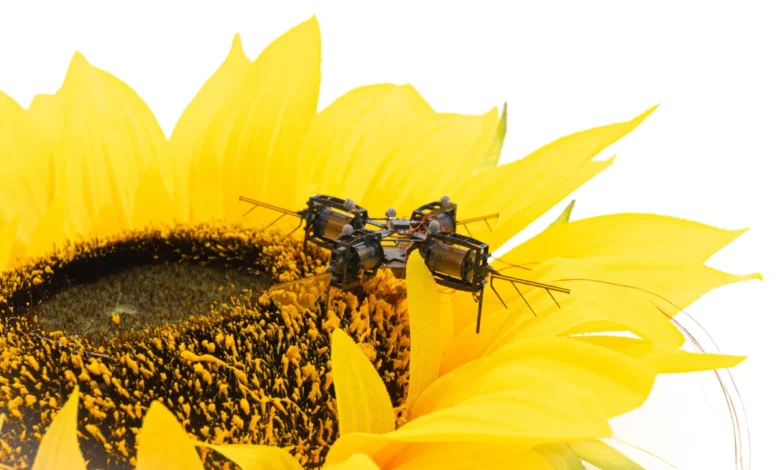
A team of engineers at the Massachusetts Institute of Technology (MIT) has shattered this technological barrier. Researchers have successfully designed and demonstrated the world’s first sensory and compute-autonomous flapping-wing aerial microrobot. Weighing less than a standard paperclip and roughly the size of a microcassette, the newly unveiled device carries its own suite of onboard sensors and a miniature microcontroller. During recent laboratory trials, the microrobot demonstrated the ability to autonomously follow complex flight trajectories, execute precise point-to-point maneuvers, and land delicately on a real sunflower outside of a motion-capture facility.
While the prototype remains tethered to an offboard power source for energy supply, this breakthrough marks a monumental leap forward. It bridges the historical gap between untethered macro-drones and nimble, insect-scale flight systems, bringing humanity one step closer to deploying autonomous micro-agents for precision agriculture, ecological monitoring, and industrial surveillance.
The Engineering Challenge: Lifting the Invisible Burden
The fundamental hurdle in microrobotics has always been scaling. When an aerial robot is miniaturized to the scale of a bumblebee, every milligram of added weight drastically alters its aerodynamics and power requirements. Previously, MIT engineers developed a swift, agile four-winged microrobot powered by soft actuators—essentially artificial muscles that contract and expand rapidly when subjected to electrical voltage. These muscles drive the wings to flap at high frequencies, granting the craft exceptional maneuverability and resilience against physical collisions.
However, carrying traditional microelectronics was impossible without overwhelming the robot’s lift capacity. To solve this dilemma, the research team engineered a method to scale up the artificial muscles without compromising their output performance. By meticulously tuning the geometry, radius, and length of the soft actuators, the engineers increased their physical size by 50 percent while boosting the robot’s net lift force by an impressive 46 percent.
This optimization yielded a remarkable lift-to-weight ratio of 1.9. This means the tiny machine can effortlessly generate nearly twice as much lift as it weighs, providing a critical surplus of force capable of supporting an ultra-lightweight onboard electronics package weighing a mere 244 milligrams.
Packing a Brain and Senses into a Micro-Package
Designing a computing and sensing suite for a robot the size of a microcassette required unprecedented hardware miniaturization. The research team integrated a specialized assembly of micro-sensors onto a resilient fiberglass substrate, protecting the delicate circuitry from the violent, high-frequency vibrations generated by the flapping wings.
The onboard sensor suite includes an inertial measurement unit (IMU) to monitor and estimate attitude, an optical flow sensor to calculate lateral flight speed and real-time positioning, and a time-of-flight sensor to accurately gauge altitude. Managing this incoming data stream required a specialized computational approach. Without the absolute spatial awareness previously provided by external motion-capture cameras, raw sensor data can quickly accumulate errors, causing the robot to drift off course.
To counteract this, the research team developed a streamlined sensing algorithm. By optimizing calculations to run at an exceptionally high frequency rather than prioritizing slower, hyper-accurate positional computations, the robot achieved unprecedented stability. Continuous, rapid position estimation dramatically reduced flight drift, allowing the microrobot to maintain positional accuracy comparable to systems guided by external laboratory cameras.
Jonathan P. How, a Ford Professor of Aeronautics and Astronautics at MIT and co-corresponding author of the study, emphasized the complexity of the design process. When dealing with computational systems of this scale, every single component must be carefully engineered to handle both perception and flight control simultaneously while remaining lightweight and fast enough to maintain structural and aerodynamic stability mid-air.
Chronology and Development Timeline
The realization of an autonomous aerial microrobot is the culmination of years of iterative engineering and cross-disciplinary research at MIT’s Soft and Micro Robotics Laboratory and the Laboratory for Information and Decision Systems (LIDS).
Over the past ten years, foundational work established the aerodynamics of flapping-wing flight and the development of high-performance soft actuators. Subsequent phases focused on improving structural durability, payload capacities, and maneuverability. The most recent breakthrough phase—culminating in the publication in Science Robotics—involved the integration of localized sensor algorithms and the physical expansion of artificial muscles to lift the newly engineered electronics package.
During public demonstrations of the completed prototype, the research team tested the platform through a variety of rigorous flight profiles. The robot successfully hovered at varying altitudes, executed precise point-to-point trajectories, and responded dynamically to remote navigational commands. In a striking display of precision, operators used a joystick to guide the aerial vehicle through a simulated garden environment before executing a soft, controlled landing directly upon the petals of a sunflower.
Expert Reactions and Collaborative Effort
The research paper, published in the journal Science Robotics, represents a major collaborative achievement across multiple academic institutions. The work was spearheaded by co-lead authors and MIT graduate students Yi-Hsuan (Nemo) Hsiao, Quang Phuc Kieu, and Zhongtao Guan. Co-corresponding authors include Kevin Chen, an associate professor in the Department of Electrical Engineering and Computer Science (EECS) and head of the Soft and Micro Robotics Laboratory, alongside Jonathan P. How of MIT and Elizabeth Farrell Helbling, an assistant professor at Cornell University.
Reflecting on the milestone, Kevin Chen highlighted the unique niche that micro-scale technology occupies in modern robotics. There are numerous operational environments—ranging from tightly packed agricultural canopies to delicate industrial machinery—where larger robotic systems simply cannot fit or safely operate without causing destruction. Small-scale robots are uniquely positioned for these tasks, and achieving sensory and compute autonomy is a vital stepping stone toward real-world deployment.
Broader Implications and Future Horizons
The successful demonstration of a sensory-autonomous aerial microrobot opens up transformative applications across several critical industries. Foremost among these is precision agriculture and artificial pollination. In regions heavily impacted by habitat loss, natural pollinator populations such as bees have experienced severe declines. Autonomous microrobots could eventually be deployed to weave seamlessly through rows of almond trees, blueberry bushes, and delicate floral crops, delivering targeted pollination without damaging fragile blossoms.
Furthermore, these microrobots could serve as vigilant agricultural sentinels. Operating in close proximity to crops without causing mechanical damage, they could continuously monitor plant health, detect early signs of disease, and spot invasive pests long before infestations become widespread.
Despite these exciting possibilities, the research team acknowledges that significant hurdles remain before commercial or field deployment becomes feasible. Currently, the microrobot’s energy consumption is heavily weighted toward propulsion, with the onboard electronics accounting for only about 6 percent of total power usage.
Looking ahead, the MIT researchers have established two primary research objectives. First, they aim to integrate an ultra-lightweight micro-camera onto the platform to enable true autonomous object recognition and real-time obstacle avoidance. Second, they are working on developing compact power electronics and micro-batteries capable of sustaining flight without an external electrical tether. Once achieved, these milestones will transition the microrobot from a tethered laboratory marvel into a fully untethered autonomous agent capable of operating independently in the open world.
Funding for this landmark research was provided by the U.S. National Science Foundation, the U.S. Office of Naval Research, the U.S. Air Force Office of Scientific Research, MathWorks, and the Zakhartchenko Fellowship.
Related posts: