The Optimal Length for Instagram Reels in 2026: A Data-Driven Analysis of 2.7 Million Posts

For digital creators and social media strategists, the question of how long an Instagram Reel should be has transitioned from a matter of creative preference to a rigorous exercise in algorithmic optimization. While Instagram technically permits video uploads of up to 20 minutes in duration, the platform’s underlying mechanics—specifically the discovery algorithms that dictate content distribution—impose strict practical limits on those seeking to expand their reach. A comprehensive analysis of over 2.7 million Instagram Reels published between January 1 and August 15, 2026, reveals that the duration of a video is a significant variable in determining both reach and audience engagement.
The Evolution of Instagram’s Video Architecture
To understand the current landscape, one must consider the platform’s shifting priorities. Historically, Instagram was a static image-sharing application. The introduction of Reels was a direct response to the meteoric rise of short-form video competitors, most notably TikTok. As the platform matured, the maximum allowed length for Reels expanded incrementally—from 15 seconds to 30, then 60, 90, and eventually up to 20 minutes.
This expansion was designed to provide creators with more flexibility for storytelling, educational tutorials, and serialized content. However, this flexibility created a "black box" scenario for creators: while they gained the ability to upload longer content, it remained unclear whether the algorithm would reward or penalize such additions. The 2026 data analysis, conducted in collaboration with Buffer’s data science team, provides the first large-scale, quantitative evidence regarding these performance trade-offs.
The Three-Minute Threshold: A Critical Algorithmic Divide
The most significant finding in the 2026 study concerns the three-minute mark. Instagram’s internal recommendation engine currently functions under a binary condition: videos under 180 seconds are eligible for broad distribution, including placement on the Reels tab, the Explore page, and the feeds of non-followers. Conversely, videos exceeding this three-minute threshold receive an explicit notification from the platform: "Reels over 3 minutes won’t be recommended to new audiences."
This limitation is not merely a soft suggestion but a functional barrier to growth. The data confirms this: Reels exceeding 180 seconds suffered a 49.3 percent decline in reach compared to an account’s established baseline. This drop is attributed to the fact that content longer than three minutes is effectively siloed, restricted primarily to an account’s existing follower base. For creators prioritizing audience acquisition and virality, the three-minute limit acts as a hard ceiling.
Statistical Performance by Duration
The study utilized a methodology that compared each account’s performance against its own historical baseline, effectively neutralizing the skewing effects of high-profile influencers with massive follower counts. The results across six duration categories reveal a clear hierarchy:
- 90 to 179 Seconds: This bracket proved to be the "sweet spot" for reach, yielding a 7.4 percent increase in unique account exposure compared to an account’s average performance.
- 30 to 59 Seconds: These videos saw a 2.7 percent increase in reach.
- 60 to 89 Seconds: This category maintained a modest 1.6 percent growth.
- Under 15 Seconds: These short-form clips saw a slight decline in reach of 1.5 percent.
- 15 to 29 Seconds: These clips saw a negligible decline of 0.9 percent.
- 180 Seconds or Longer: The aforementioned 49.3 percent decline in reach.
These figures suggest that for the objective of reach, there is a distinct advantage to producing content that occupies the 90-to-179-second window. The data indicates that shorter clips, while popular in the early days of Reels, have become less effective for discovery than mid-length, information-dense storytelling.
The Engagement Paradox
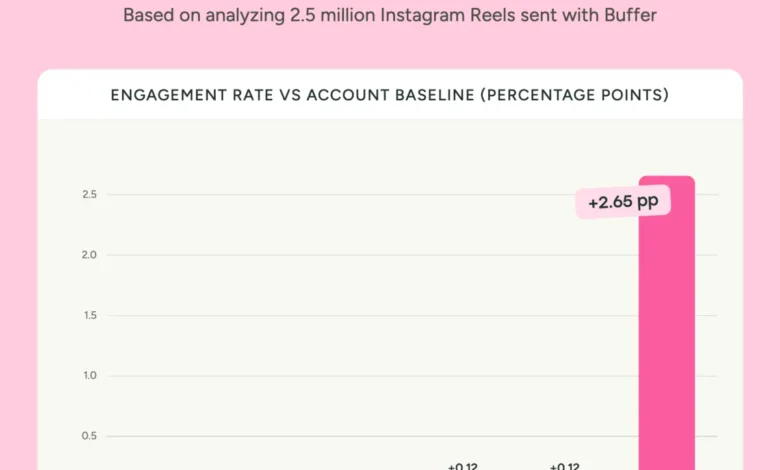
While long-form content (over 180 seconds) is statistically detrimental to reach, it serves a different purpose: engagement depth. The study found that while long-form Reels reached fewer people, those who did view them were significantly more likely to interact. These videos boasted an engagement rate 2.65 percentage points higher than the account’s baseline.
This phenomenon represents a classic trade-off in digital strategy: breadth versus depth. Longer content acts as a retention tool, nurturing an existing community and fostering higher-quality interactions such as comments, shares, and saves. In this context, the reduced reach is not necessarily a failure, but a shift in target audience from "discovery-phase" users to "committed-fan" users.
Strategic Implications for Content Creators
For businesses and individual creators, these findings necessitate a clear definition of goals before production begins. If the primary KPI is reach—aiming to put a brand in front of new potential customers—the data strongly advocates for a length between 90 and 179 seconds. This duration allows enough time for a compelling hook, substantive value, and a call to action without triggering the algorithm’s "long-form" suppression.
However, the "below 90 seconds" data provides a sense of relief for creators who struggle with tight editing. The variance in performance for videos under 90 seconds is minimal, hovering within a three-percent range. This suggests that the quality of the edit, the strength of the opening hook, and the relevance of the topic are far more influential than the specific length of the video. The obsession with cutting a video from 45 seconds to 30 seconds may be a misuse of resources, as the marginal gains are statistically insignificant.

Competitive Context: Reels vs. TikTok vs. YouTube Shorts
The competitive landscape for short-form video has forced platforms into a delicate balancing act. TikTok currently allows up to 10 minutes for in-app recordings and up to 60 minutes for uploaded content, signaling a push toward longer-form mobile consumption. YouTube Shorts, meanwhile, maintains a strict three-minute limit.
Instagram’s position is unique. By allowing 20-minute uploads but throttling their distribution, the platform is effectively saying it is not a destination for long-form, linear video consumption in the way YouTube is. It remains a discovery-first platform where high-velocity, mid-length content is the primary currency. For creators who cross-post, the three-minute threshold is the common denominator. Adhering to this limit ensures compatibility across all major platforms, simplifying the workflow and maximizing the potential for organic reach without the need for platform-specific re-edits.
Methodology and Data Integrity
The conclusions drawn from the 2026 dataset were subject to rigorous statistical controls. By log-transforming views and reach data, the researchers successfully mitigated the influence of "outlier" posts—the rare viral hits that can artificially inflate averages. Furthermore, by requiring accounts to have posted at least three times within a duration bucket and to have utilized at least two different buckets for comparison, the study ensured that the data reflects consistent creator behavior rather than random variance. The engagement rate was also capped at the 99th percentile to remove anomalies where extremely low view counts produced mathematically impossible engagement percentages.
Conclusion
The data indicates that the "best" length for an Instagram Reel is entirely dependent on the strategic intent of the creator. For those seeking to grow a brand, the window of 90 seconds to three minutes provides the most favorable algorithmic environment. For those focused on deepening relationships with an existing audience, long-form content—despite its reach limitations—remains a powerful tool for engagement.
As the digital ecosystem continues to evolve, the distinction between "discovery" content and "community" content will likely become even more pronounced. Understanding the interplay between video duration and algorithmic distribution is no longer optional; it is a fundamental requirement for any creator looking to maintain visibility in an increasingly saturated attention economy. The "black box" of the algorithm may never be fully transparent, but the data suggests that for 2026, the path to performance is found in balance, consistency, and a clear understanding of the platform’s constraints.