The Complete Guide to LLM Evaluation: A Framework for Systematic Model Testing and Deployment

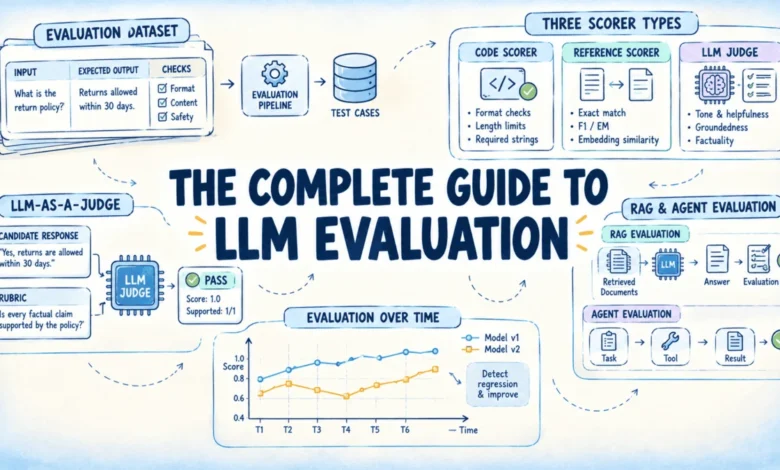
The rapid integration of Large Language Models (LLMs) into production software has outpaced the development of traditional quality assurance frameworks. Unlike deterministic software, where a specific input consistently yields a predictable output, LLMs are probabilistic by nature. This shift has rendered traditional unit testing insufficient, forcing engineering teams to move away from simple spot-checking toward a rigorous, data-driven approach to evaluation. By implementing systematic evaluation pipelines—ranging from automated code-based assertions to sophisticated LLM-as-a-judge architectures—organizations can effectively mitigate the risks of hallucination, bias, and performance drift in AI-powered applications.
The Failure of Traditional Testing in an AI World
For decades, software reliability has been anchored in the concept of unit testing, where developers assert that a specific function returns an expected value. However, LLM outputs are inherently non-deterministic, varying with temperature settings, model updates, and even underlying hardware fluctuations. A prompt change, a shift in the retrieval strategy for a RAG (Retrieval-Augmented Generation) system, or a model version upgrade can introduce regressions that are invisible to legacy testing tools.
The industry is currently witnessing a paradigm shift as developers realize that "reading a few outputs" is no longer a viable quality control strategy. When deployment decisions are based on subjective, ad-hoc observations, organizations risk deploying models that may pass a human developer’s cursory check but fail under edge-case scenarios or real-world user interactions. Systematic evaluation addresses this by treating LLM outputs with the same rigor applied to traditional code: establishing datasets, defining objective scorers, and maintaining a historical record of performance benchmarks.
Categorizing Scorer Methodologies
Effective evaluation requires a tiered approach to grading, categorized primarily by the level of abstraction required to assess the output.
- Deterministic Code Scorers: These represent the gold standard for reliability. When an application requires a specific JSON format, a character count limit, or the inclusion of a mandatory disclaimer, simple programmatic assertions are sufficient. These scorers are cost-effective, instantaneous, and provide 100% reproducibility.
- Reference-Based Metrics: For tasks where a "ground truth" exists—such as translation, summarization of specific documents, or factual lookup—reference-based metrics remain essential. While older metrics like BLEU or ROUGE have been criticized for focusing on n-gram overlap (often penalizing high-quality paraphrasing), newer approaches like BERTScore utilize cosine similarity between token embeddings to assess semantic closeness.
- LLM-as-a-Judge: This is the most complex yet versatile category. By employing a more capable model to evaluate the output of a target model, developers can measure abstract criteria like tone, helpfulness, and logical consistency.
Architecting the LLM-as-a-Judge Framework
The "LLM-as-a-Judge" architecture has become the cornerstone of modern AI quality assurance. To implement this effectively, developers must move beyond simple "rate this on a scale of 1-10" prompts, which often yield unstable, biased results.
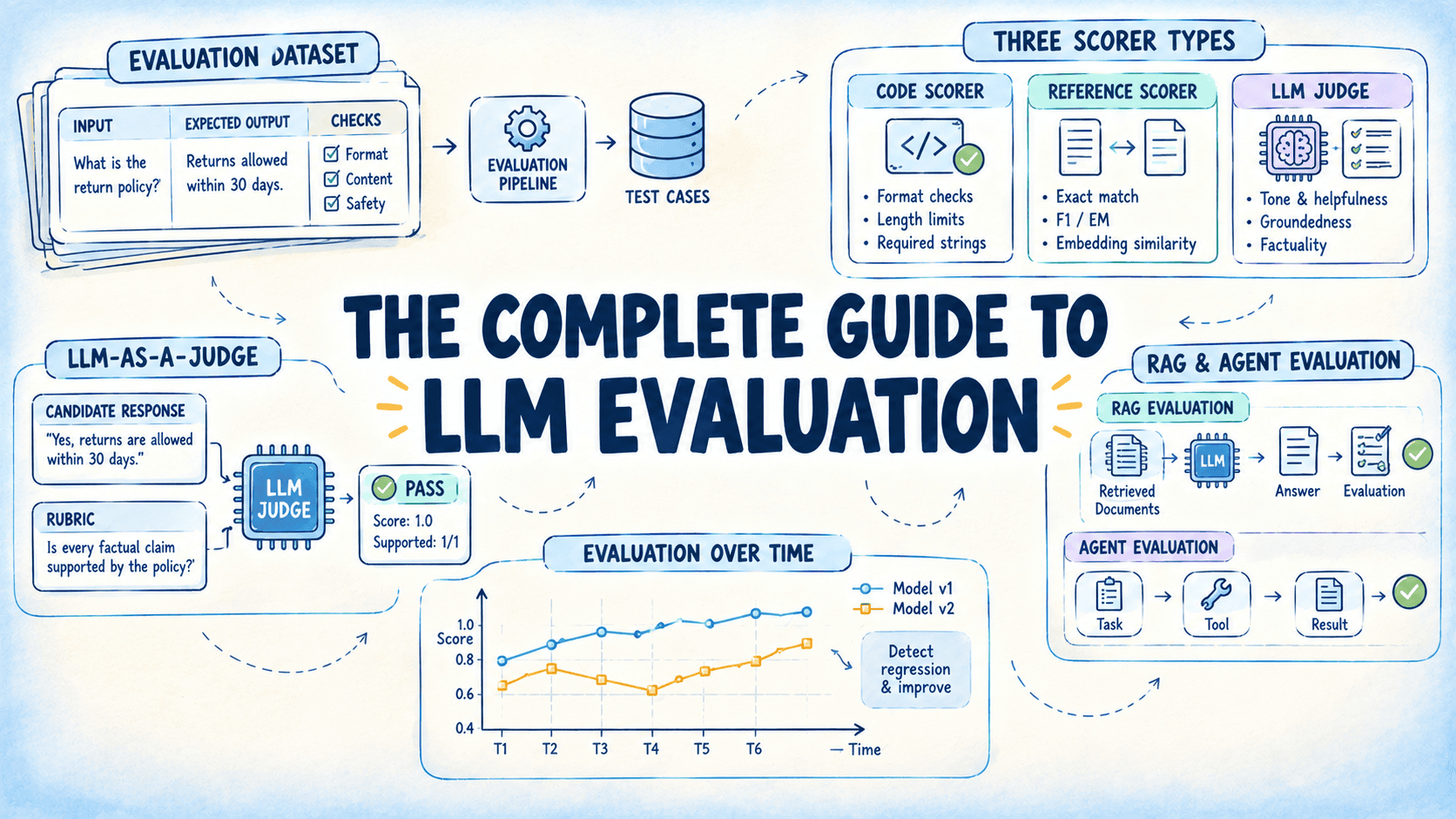
Instead, state-of-the-art implementations utilize Question-Answer Generation (QAG) or G-Eval. In QAG, the judge is tasked with breaking down an answer into individual, verifiable claims. Each claim is then checked for factual support against the source context. This turns a subjective quality assessment into a series of objective, yes/no classification tasks. Mathematically, the final score is the ratio of supported claims to total claims, a metric that is significantly more reproducible than a raw sentiment score.
G-Eval, conversely, targets subjective metrics like coherence or style. By using an "Automatic Chain-of-Thought" (Auto-CoT) approach, the framework decomposes the evaluation criteria into actionable steps. The final scoring process often involves calculating the probability-weighted sum of output tokens, providing a granular resolution that prevents the "model collapse" where a judge consistently assigns the same numerical score to varying levels of quality.
Addressing Bias and Calibration
Research into LLM judging has revealed systemic biases, including positional bias (the tendency to favor the first answer in a pair) and verbosity bias (the tendency to equate longer answers with better quality). Mitigation strategies are now becoming industry standard:
- Positional Swapping: Every pairwise comparison should be run twice, with the order of answers reversed. A verdict is only accepted if the judge remains consistent across both runs.
- Calibration via Human Labels: The "Golden Dataset" is vital. By manually labeling 30 to 50 representative cases, developers can establish a baseline for their judge. Cohen’s Kappa is the standard statistical metric used to measure the agreement between human judges and the automated model. A Kappa score exceeding 0.6 is generally considered the threshold for "substantial agreement."
Evaluating RAG Systems and Autonomous Agents
RAG systems present a unique challenge because they involve two distinct failure points: the retriever (which fetches context) and the generator (which synthesizes the answer). Evaluating these as a single unit masks the root cause of failure. High-performance teams now evaluate retrieval precision and recall separately from generation faithfulness. If an answer is inaccurate, knowing whether the fault lies in the provided context or in the model’s reasoning is essential for rapid debugging.
Autonomous agents, which operate through multi-step planning and tool usage, require an even more advanced evaluation structure. The industry is moving toward "trajectory evaluation," where the entire sequence of tool calls and decision-making steps is logged and audited. If an agent fails to complete a task, diagnostic metrics—such as tool-call accuracy, argument validation, and goal-completion rate—allow developers to pinpoint the exact step where the chain of logic broke down.
The Evolution of the Release Cycle: Offline vs. Online
The integration of evaluation into the software development life cycle (SDLC) is now mandatory for enterprise-grade applications.
Offline Evaluation: Before any code reaches production, it must pass a "Golden Dataset" suite. This dataset should contain a balanced mix of standard queries, edge cases, and adversarial examples designed to probe the model’s safety boundaries. Versioning this dataset alongside the code ensures that performance regressions are caught during the pull request phase, rather than in the production environment.
Online Evaluation: Once a model is live, the focus shifts to monitoring. Because live traffic contains unpredictable queries, teams must employ reference-free metrics to monitor faithfulness and drift in real-time. Each "failure" identified by an online metric should be transformed into a new test case for the offline suite, creating a continuous improvement loop that strengthens the system with every interaction.
Broader Implications and Future Outlook
The transition toward automated, systematic evaluation marks the maturation of the LLM field. As organizations move from proof-of-concept projects to mission-critical infrastructure, the ability to quantify "quality" is becoming a competitive advantage. The future of this field lies in the standardization of evaluation benchmarks and the development of specialized "eval-model" architectures—smaller, highly-tuned models designed specifically to act as impartial judges.
Ultimately, the goal of these frameworks is not to remove human judgment entirely, but to provide a consistent, objective baseline. By codifying what "good" looks like—through structured rubrics, rigorous calibration, and persistent testing—developers can move away from the anxiety of unpredictable model behavior. In this new era of software development, the quality of the evaluation pipeline is arguably as important as the quality of the model itself. As the ecosystem continues to evolve, the reliance on these diagnostic tools will only grow, establishing a permanent requirement for transparency and accountability in the deployment of generative AI.