
The evolution of modern software architecture often begins with simple, clean functions designed to perform a singular, well-defined task. However, as production requirements scale, these functions inevitably become cluttered with peripheral concerns—boundary logic that handles monitoring, error recovery, performance optimization, and input sanitation. In the Python ecosystem, this "code bloat" is a common technical debt indicator. When developers manually inject timing code, retry loops, or validation checks into every function, the codebase becomes fragile, inconsistent, and difficult to maintain. Python decorators provide an elegant, standardized mechanism to extract this boundary logic, allowing developers to wrap function calls in reusable, transparent, and testable code.
The Problem of Boundary Logic Drift
In a typical production environment, a feature pipeline might start with three lean functions: one for data ingestion, one for network-based service requests, and one for mathematical transformation. Six weeks later, these functions are often unrecognizable. A data ingestion function may now contain extensive file-system path checks and batch size verification. A service request function might be buried inside a complex retry loop with exponential backoff and logging. A transformation function could be shadowed by a local cache dictionary and performance monitoring hooks.
This manual injection of "boundary code" leads to architectural drift. Because the logic is pasted into each function independently, the implementation of a "retry" in one module may differ slightly from the implementation in another, leading to unpredictable behavior during system outages. Furthermore, this logic obscures the core business function, making it harder for new developers to determine exactly what the function is intended to do versus what it is intended to manage.
Understanding the Decorator Pattern
At its core, a Python decorator is a function that takes another function as an argument and returns a new function (the "wrapper") that modifies or extends the original’s behavior. The syntax, denoted by the @ symbol, is syntactic sugar for function reassignment. When a developer writes @decorator above a function definition, Python essentially executes function = decorator(function) at import time.
This reassignment is critical. Because decorators run when the module is first imported, they are ideal for registering functions, setting up monitoring, or initializing resources. However, this also means that errors in the decorator—such as failing to return the wrapper or failing to call the original function—can manifest as cryptic runtime errors, such as a function name unexpectedly resolving to None.
The Anatomy of a Robust Wrapper
A production-grade decorator must respect the contract of the original function. If a decorator fails to properly handle positional and keyword arguments—typically via *args and **kwargs—it risks breaking the interface of the wrapped code. Furthermore, every decorator must utilize functools.wraps to preserve the original function’s metadata, including its name, docstring, and annotations.
Without functools.wraps, debugging becomes nearly impossible. If every decorated function reports its name as wrapper during a stack trace or in a profiler, identifying the source of a bottleneck or a runtime exception becomes a labor-intensive manual process. By copying metadata, developers ensure that documentation tools, unit tests, and IDEs can continue to interact with the function as if it were the original.
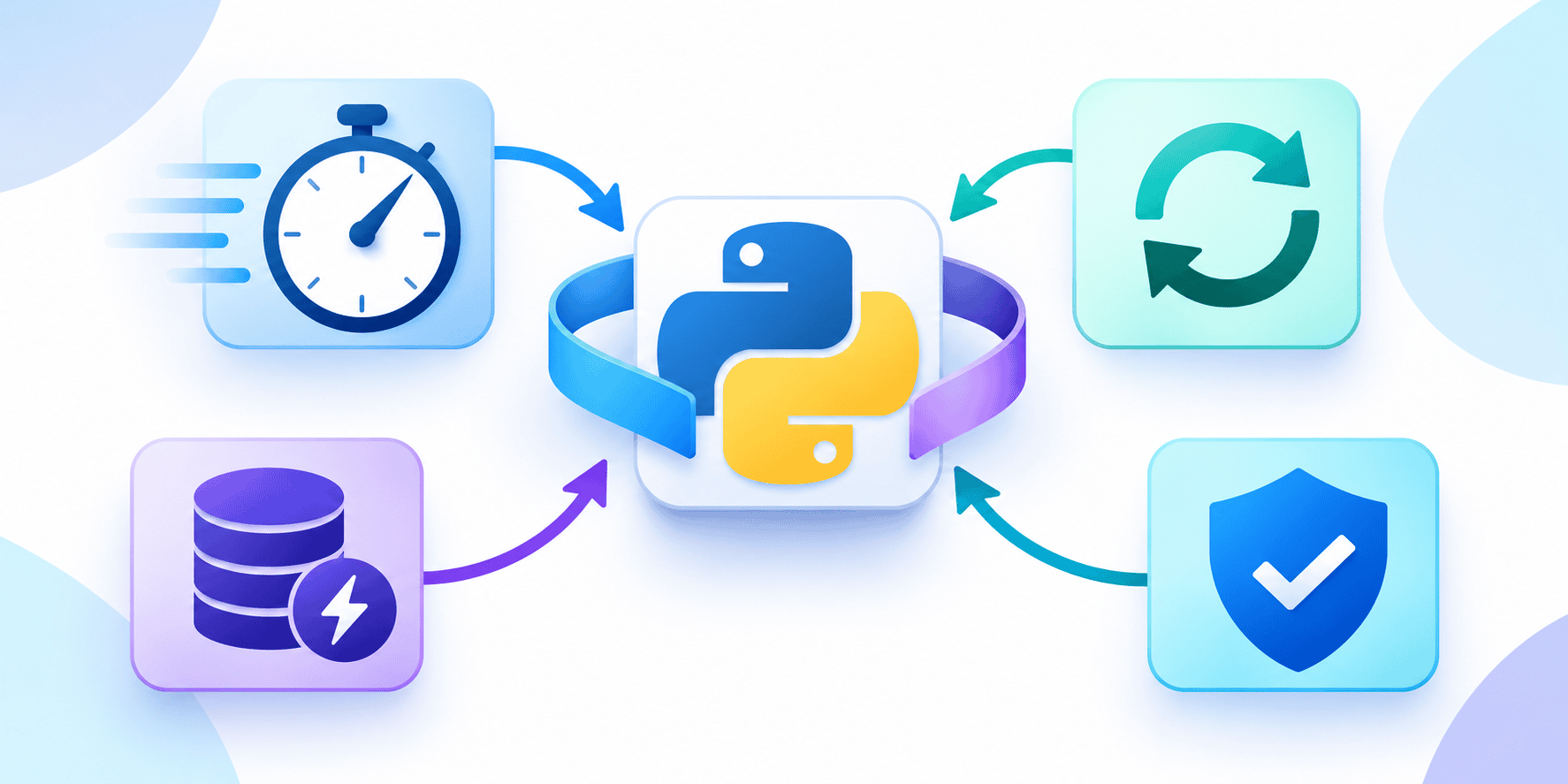
Implementing Boundary Behaviors: A Four-Fold Approach
1. Performance Monitoring (Timing)
Performance observability is a requirement for any production pipeline. Using time.perf_counter(), developers can wrap functions in a try...finally block. This ensures that even if a function crashes, the execution time is logged, providing critical data for diagnosing whether a failure was caused by a timeout or a logical error. Unlike time.time(), which is sensitive to system clock adjustments, perf_counter() provides the high-resolution, monotonic measurement required for measuring execution duration.
2. Fault Tolerance (Retries)
Retry logic is often implemented as a decorator factory—a decorator that accepts arguments. By allowing developers to specify the number of attempts, the delay interval, and the specific exceptions to catch, the retry decorator becomes a versatile tool for handling transient network failures. It is imperative that these decorators follow the principle of "selective catching." A decorator that catches a broad Exception might inadvertently hide critical programming errors, such as KeyError or TypeError, leading to silent failures that are difficult to debug.
3. Efficient Computation (Caching)
Memoization is perhaps the most common use case for decorators. The standard library’s functools.lru_cache provides an efficient, thread-safe implementation that stores the results of function calls based on input arguments. However, caching is not a universal solution. It should only be applied to "pure" functions—those that return the same result for the same input and have no side effects. Caching functions that modify mutable objects or interact with external state can lead to "state pollution," where a cached result is returned even if the underlying data has changed.
4. Input Sanitization (Validation)
Validating inputs at the boundary prevents "garbage in, garbage out" scenarios. Using the inspect.signature module, a decorator can bind arguments to a function’s parameters before execution, allowing it to apply validation rules to specific variables regardless of how they were passed. This ensures that downstream logic is shielded from invalid data, moving the error handling closer to the point of origin.
Strategic Considerations and Trade-offs
While decorators offer a powerful way to clean up code, they are not a panacea. Over-reliance on "magic" decorators can lead to a codebase where it is unclear how data is being processed or where errors are being handled.
Table 1: Decision Matrix for Decorator Patterns
| Pattern | Best Used For | Risk |
|---|---|---|
| Timing | Identifying performance bottlenecks | Over-instrumentation of trivial functions |
| Retry | Transient network/IO failures | Hiding bugs that should crash early |
| Cache | Pure, CPU-intensive calculations | Memory leaks and stale data |
| Validate | Input integrity for critical APIs | Increased overhead for simple calls |
Broader Implications for Software Engineering
The trend toward using decorators reflects a broader industry movement toward "declarative programming." By declaring behaviors like @retry or @cache above a function, developers communicate their intent clearly to other engineers and to the runtime environment. This reduces the cognitive load required to read and understand complex systems.
However, the responsibility remains with the architect to ensure that decorators do not become black boxes. When a decorator grows too complex—for example, if it requires a significant amount of external state or performs complex conditional logic based on the environment—it may be a sign that the logic belongs in a service object or a configuration-driven middleware rather than a decorator.
Conclusion
Effective Python development relies on the ability to distinguish between essential business logic and the infrastructure required to run that logic reliably. Decorators, when used with functools.wraps, proper argument forwarding, and selective exception handling, transform messy, redundant code into a modular, professional architecture. By mastering the closure-based structure of these wrappers, engineers can ensure their systems remain performant, resilient, and, most importantly, maintainable as they scale to meet the demands of modern production environments. The goal of a decorator is not to hide the boundary, but to manage it with clarity and precision.