The Economic and Privacy Landscape of Modern AI
The proliferation of generative AI has introduced a new paradigm in software development: the agentic workflow. Unlike standard chatbots that provide static text responses, agents are designed to interact with the environment, execute shell commands, edit files, and browse the web. However, this functionality comes at a price. Cloud-based API providers monetize the computational overhead required for these recursive tasks. For a hobbyist, student, or freelance developer, these costs are often prohibitive.
Beyond the financial burden, there is the issue of data privacy. Every prompt, code snippet, and file path shared with a cloud-based AI provider is processed on remote servers. For enterprises or individuals working with sensitive intellectual property, this reliance on external infrastructure creates a significant security vulnerability. The local-first movement seeks to bridge this gap, ensuring that the "agent" functions as a local extension of the user’s workspace rather than an external service provider.
Understanding the Architecture: Hermes Agent and Ollama
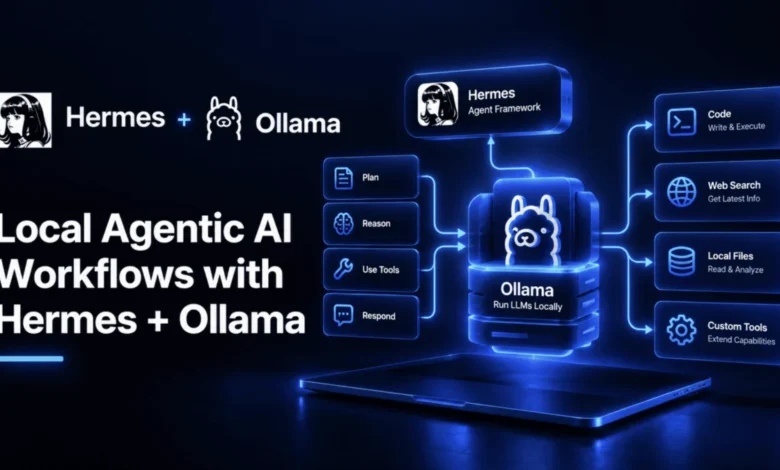
At the core of this localized architecture are two primary technologies. Ollama serves as the backend engine, responsible for managing and serving open-weight LLMs locally. It abstracts the complexities of model deployment, exposing an API that mimics the standard OpenAI /v1/chat/completions endpoint. This compatibility is crucial, as it allows sophisticated agents to interact with local models as if they were cloud-based services.
Hermes Agent, developed by Nous Research, acts as the intelligent layer above the model. Released under an MIT license, the current iteration of the agent supports cross-platform deployment on Windows, macOS, and Linux. Its architecture is specifically built for autonomy. Unlike simple interfaces, Hermes features persistent memory, allowing the AI to learn project-specific nuances over time. It also employs a robust sandboxing system, supporting multiple isolation backends such as Docker, SSH, and Modal, ensuring that any command the agent executes remains safely within defined parameters.
Chronology of Implementation
The transition to a local agentic workflow follows a structured technical path. The process begins with the deployment of Ollama. By executing the official installation script, the user initializes a local server that listens on port 11434. Once the service is operational, the user must pull a model capable of "tool calling"—a critical requirement for agentic behavior.
- Model Selection: The choice of model determines the success of the workflow. Models such as
gemma4:31bare recommended for tasks requiring high-level reasoning and tool execution, whereas smaller models likellama3.2:3bare optimized for speed but lack the sophisticated logic required to manage files or execute terminal commands. - Endpoint Configuration: Once the model is active, the Hermes configuration file (
~/.hermes/config.yaml) must be updated to point to the local Ollama endpoint. By setting theproviderto "custom" and defining thebase_urlashttp://localhost:11434/v1, the agent is successfully tethered to the local model. - Operational Testing: Following the configuration, users can issue commands to the agent, such as requesting a summary of a directory or writing a Python script to fetch real-time weather data. These tasks demonstrate the agent’s ability to manipulate the filesystem and interface with the internet locally.
Technical Requirements and Hardware Scaling
Performance in a local AI environment is strictly dictated by hardware. For those intending to run 31B-parameter models, a minimum of 32GB of RAM and a dedicated NVIDIA GPU with at least 8GB of VRAM is highly recommended. While CPU-only execution is technically possible, the latency—often resulting in only 2 to 5 tokens per second—can make interactive sessions cumbersome.
To optimize the experience, users should leverage specific configurations:
- Context Window Expansion: Default context windows in many models are insufficient for complex agentic workflows. By creating a custom
Modelfilewith an increasednum_ctx(e.g., 64,000 tokens), users can ensure the agent retains long-term memory of large codebases. - Model Persistence: By default, Ollama unloads models after short periods of inactivity. Configuring the system to keep models loaded for extended durations (e.g., 24 hours) prevents the "cold-start" latency that would otherwise occur when resuming work.
Expanding the Workflow: Gateways and Fallbacks
The utility of a local agent is further enhanced by its ability to interface with external communication platforms. By configuring the Telegram gateway within the Hermes config.yaml, users can maintain access to their local agent from any mobile device. This enables a unique hybrid model: the heavy lifting of code generation and file analysis occurs on the local workstation, while the user interacts with the results via a secure, private bot interface.
Furthermore, developers can implement a "fallback" strategy. By defining a list of fallback_providers—such as an integration with OpenRouter—the agent can be instructed to offload only the most complex, high-reasoning tasks to cloud-based models when local hardware reaches its limits. This approach ensures cost-efficiency, as 90% of routine operations remain free and local, while premium compute is reserved for exceptional circumstances.
Broader Implications and Industry Impact
The rise of local agentic workflows signals a significant shift in the AI industry. As hardware capabilities continue to improve and the efficiency of open-weight models increases, the barrier to entry for private, high-performance AI is rapidly falling. This transition forces a re-evaluation of the current "API-first" cloud model.
For the average user, the ability to maintain a private, zero-cost, persistent agent represents a fundamental change in personal productivity. It allows for the integration of AI into sensitive workflows without the risks associated with data exfiltration. As Nous Research and other open-source contributors continue to refine the Hermes architecture, it is likely that such local-first setups will become the standard for developers, researchers, and privacy-conscious professionals. The implications are clear: the future of AI is not solely in the cloud, but increasingly on the machines we use every day.
Related posts: