The Four Failure Points of Naive RAG: Why Context Engineering is Crucial for Accurate AI Answers

In the evolving landscape of artificial intelligence, Retrieval-Augmented Generation (RAG) systems have emerged as a powerful tool for extracting and synthesizing information from large document repositories. However, the path to accurate and reliable answers is often paved with subtle yet significant challenges, particularly for the foundational, or "naive," RAG implementations that many developers first encounter. This article delves into the critical differences between a basic RAG pipeline and an upgraded, more robust system, demonstrating why the former frequently falters and highlighting the indispensable role of "context engineering" in achieving dependable AI-driven insights.
The journey began with an upgraded RAG pipeline, meticulously built and tested against diverse documents, including a complex research paper, a stringent NIST standard, and a report hobbled by a corrupted table of contents. The outcome was consistently impressive: the system returned precise, cited answers, irrespective of the document’s complexity or structural integrity. This success naturally prompts a crucial question: why does this advanced pipeline perform so effectively, and would a simpler, more common RAG approach yield the same results? The answer, unequivocally, is no. The fundamental limitations of a naive RAG system manifest not in a single point of failure, but at each of its four core components: document parsing, question parsing, retrieval, and generation. Each of these stages, when implemented with less rigor, can deliver incorrect context to the AI model, leading to flawed outputs.
The limitations of naive RAG are not rectified by common troubleshooting reflexes such as refining prompts, reducing chunk sizes, or swapping embedding models. These superficial adjustments often fail because the root cause of the error lies upstream, in the corrupted context provided to the model, rather than in the model’s interpretation of the prompt itself. The series of analyses, including the one presented here, posits that achieving accurate RAG outputs hinges on perfecting all four foundational "bricks" of the system. This holistic approach is termed "context engineering." Every failure illustrated in this analysis is derived from actual, real-world test runs, meticulously reproduced and available in a companion notebook for verification. This contrasts with theoretical assumptions, offering tangible evidence of where and why RAG systems can falter.

To illustrate these points, a comprehensive suite of tools and data has been made available. The runnable notebook, hosted on GitHub under the repository doc-intel/notebooks-vol1, provides a side-by-side comparison of a naive baseline RAG system and the upgraded pdf_qa pipeline. This interactive tool allows users to execute these comparisons on various documents, view both pipelines’ answers alongside their confidence scores, and reproduce every critical discrepancy highlighted in this article on their own machines. This commitment to transparency and reproducibility underscores the importance of rigorous testing and validation in AI development.
The Naive Baseline: A Brick-by-Brick Breakdown
The naive RAG pipeline, often the starting point for many developers, typically comprises around 100 lines of code. Its methodology involves parsing a PDF, transforming the user’s question into keywords, selecting the most relevant pages based on these keywords, and then feeding this context to a language model for an answer. While this approach can be effective for straightforward, prose-heavy documents, its limitations become starkly apparent when faced with more complex or structurally nuanced content. For instance, on seminal papers like "Attention Is All You Need" or the original RAG paper, both naive and upgraded systems often produce correct answers, suggesting that the baseline is not inherently flawed but rather sensitive to document characteristics.
The upgraded RAG pipeline, in contrast, retains the same four fundamental components but imbues each with a more rigorous contract and enhanced functionality. Document parsing, for example, yields a relational line_df (a data structure representing lines with their associated metadata) rather than plain text. Question parsing goes beyond simple keyword extraction to expand the query using the document’s own vocabulary. Retrieval is optimized by leveraging structural elements like the table of contents. Finally, generation is refined to produce typed, verifiable answers. A naive RAG system, by operating with looser implementations of these bricks, provides a clear contrast. The critical gap emerges precisely at the point where each inadequately defined brick passes flawed context to the subsequent stage, ultimately leading to an incorrect final answer.
The accompanying visualization clearly depicts this phenomenon: the same symptom—a confidently delivered but incorrect answer—manifests in four distinct ways, each attributable to a specific brick’s failure. The subsequent sections of this article will meticulously examine each of these failure points, isolating one brick at a time by substituting its naive implementation while keeping the others reasonably robust. This controlled approach ensures that the identified failure and its corresponding fix are directly attributable to the brick under scrutiny.

Parsing: A Table Flattened into Noise
One of the most common and debilitating failure points for naive RAG systems is in the document parsing stage. Consider a report such as the World Bank’s Commodity Markets Outlook, which is heavily reliant on detailed price tables. If a user queries, "What is the 2025 annual average price forecast for U.S. natural gas (Henry Hub)?", a naive RAG system employing standard PDF parsing techniques will likely fail.
The typical parsing method involves extracting all text from the PDF and then segmenting it into fixed-size chunks. This approach, while adequate for narrative text, is disastrous for tabular data. A price table, by its nature, is a grid where relationships between row labels and corresponding data cells are paramount. When this grid is linearized into a stream of text, and then arbitrarily chopped into fixed-size segments, the crucial alignment between elements is destroyed. For example, the row label "Henry Hub" might end up in one chunk, while its corresponding price value of "3.5" could fall into an entirely different chunk.
Consequently, the retrieval mechanism, which operates on these fragmented chunks, will fail to find a single chunk containing both the identifier and the value. The language model, presented with this incomplete context, will honestly report its inability to find the information, stating something like, "not stated in these lines," often with a confidence score as low as 0.00. It’s important to note that no hallucination has occurred here; the data was present in the document, but the parsing process rendered it unintelligible.
The solution lies in adopting "relational parsing." Instead of outputting flat text, the upgraded parsing brick generates a line_df. This data structure preserves the integrity of each line and includes its bounding box, allowing for a more nuanced understanding of the document’s layout. With this relational representation, the model can process "Henry Hub" and "3.5" as being on the same line, leading to an accurate answer such as, "$3.5 per mmbtu," with a high confidence score of 0.99. This principle, detailed further in Article 5 of the series, emphasizes the critical need to move beyond flat text extraction and preserve the inherent relational structure of information within documents.

Question: A Word the Document Never Uses
Another significant hurdle for naive RAG systems arises in the question parsing stage, particularly when user queries employ terminology that differs from the document’s specific vocabulary. Take, for instance, the NIST SP 800-207, which outlines the Zero Trust Architecture. A user might ask, "What are the pillars of zero trust architecture?"
The challenge here is that the document itself might not use the word "pillars." Instead, it may refer to these foundational concepts as "tenets" or "principles." A naive RAG pipeline, which relies on direct keyword matching for retrieval, will score poorly when searching for "pillars" because this word is absent from the document. Consequently, the system might return a response like, "the specific pillars are not listed," with a relatively low confidence score of 0.20. The correct information is present, but the retrieval mechanism never even reaches the relevant pages because the user’s query words do not align with the document’s lexicon.
This is not a problem that can be solved by simply increasing the number of retrieved chunks (top_k). The issue is a fundamental mismatch in vocabulary. The user’s term and the document’s term are synonyms, and a raw string comparison is insufficient to bridge this semantic gap.
The solution is enhanced "question parsing." Before the retrieval process begins, the query is normalized and expanded. This involves mapping domain-specific synonyms (e.g., "pillars" to "tenets" or "principles") so that the retrieval engine searches for words that are actually present in the document. Once the relevant sections are identified, the system can anchor its search to the "tenets" section and present all seven tenets, correctly identifying the document’s terminology and achieving a confidence score of 0.95. This synonym expansion capability is crucial for bridging the gap between user intent and document content, a concept further explored in Article 7quinquies, which examines retrieval failures in RAG.

Retrieval: The Answer Below the Cutoff
The retrieval stage is where a RAG system identifies the most relevant document segments to answer a user’s query. Naive RAG systems typically rely on keyword frequency or vector similarity to rank and select these segments. However, this approach can fail when the relevant information is buried among many semantically similar but contextually distinct passages.
Consider the NIST Cybersecurity Framework 2.0, a comprehensive document with a native table of contents. If a user asks, "How is a Profile defined in CSF 2.0?", the word "Profile" appears on numerous pages. It is used as a section heading, within prose, and in example scenarios. However, only one specific section provides the definitive explanation. A naive retrieval system, ranking pages by the raw frequency of the term "Profile," might select several pages that mention the word but do not contain the definition. The actual defining page could fall below the top_k cutoff, meaning it is never passed to the generation model. The output, therefore, might be an unhelpful, "not defined in these lines," with a low confidence score of 0.10.
The critical limitation here is that simple frequency-based ranking fails to account for the document’s inherent structure. The problem is not that the term isn’t found, but that the correct instance of the term, the one that provides the definition, is not prioritized.
The fix lies in "retrieval that routes on structure." The upgraded system utilizes a small language model to interpret the document’s table of contents. By recognizing the section titled "CSF Profiles," it can intelligently route the retrieval process to that specific area, bypassing the noise of less relevant mentions. This structural routing ensures that the defining paragraph is retrieved, allowing the generation model to provide the complete definition with a verifiable citation and a high confidence score of 0.95.

This structural routing approach scales effectively, especially with increasingly large documents. For instance, on the 400-plus-page NIST SP 800-53 control catalog, a query for a specific control like "AU-2 Event Logging" would overwhelm a naive keyword-based retrieval system. It would dilute the target control among thousands of similar entries, likely resulting in an "NA" response with 0.00 confidence. In contrast, the structural router can directly navigate to the "AU" family and the specific "AU-2" entry, retrieving the full requirement with clauses intact and a confidence of 0.98. This demonstrates that structural routing maintains its efficacy as document size increases, whereas frequency-based ranking degrades significantly.
Generation: A Confident Answer with No Self-Check
Even when the parsing, question interpretation, and retrieval stages have successfully delivered accurate context, the final generation stage in a naive RAG system can still introduce errors, particularly through hallucination. This occurs when the model, tasked with providing a free-text answer, attempts to fill in gaps in the provided information.
Consider the World Bank Commodity Markets Outlook, April 2024. This report contains price forecasts that extend up to 2025, but not beyond. If a user asks, "What is the 2026 annual average price forecast for crude oil (Brent)?", both naive and upgraded systems might retrieve the correct energy pages containing the price table. However, the document simply lacks the requested 2026 data.
A naive RAG system’s generation brick, designed for free-text responses, will often attempt to answer the question even if the information is not present. Faced with the 2025 price of $79, the model might extrapolate or simply use the closest available number, generating a confident, fluent, but incorrect answer: "the 2026 Brent forecast is $79 per barrel." This is a classic example of hallucination, where the model invents information to satisfy the query, despite having accurate context. The fundamental issue is that a free-text output format offers no mechanism for the model to explicitly state that the information is missing.

The antidote to this is a "typed generation contract." The upgraded system does not solicit a free-text response. Instead, it demands a structured output that includes a complete_answer_found field, an evidence span to cite, and a confidence justification. When the model encounters missing data, it cannot simply invent an answer. It must set complete_answer_found: false and report that the requested information is not available, for example: "the 2026 forecast is not provided; the latest is 2025." This structured approach doesn’t make the model inherently smarter; rather, it makes the absence or incompleteness of an answer transparent, preventing partial or fabricated information from being presented as a complete solution. This complete_answer_found field is equally vital for flagging partially answered queries, ensuring that fragments of information are not misrepresented as whole answers.
One Root, Four Doors to Failure
The four distinct failure modes—parsing errors, vocabulary mismatches, retrieval limitations, and generation inaccuracies—all stem from a single root cause: the provision of incorrect context to the AI model. In each instance, the model faithfully processes the information it is given. The errors arise not from the model’s inherent intelligence or lack thereof, but from the flawed data it receives from upstream components. The label "hallucination," while commonly applied, often misdirects attention from the true source of the problem, which lies in the preceding stages of the RAG pipeline.
The common remedies often attempted—rewriting prompts, increasing chunk sizes, or upgrading the embedding model—are frequently ineffective because they fail to address the fundamental issue of corrupted context. The effective solution lies in "context engineering," a methodical approach that defines and enforces specific contracts for each stage of the RAG pipeline. This includes preserving the document’s relational structure during parsing, ensuring the search utilizes the document’s own vocabulary during question parsing, employing structural routing for accurate retrieval, and binding the final answer to a typed, verifiable contract during generation. By ensuring that the context provided is accurate and relevant, the RAG system eliminates the possibility of the model generating confident but incorrect answers.
It is important to acknowledge that naive RAG is not universally inadequate. For simple, prose-based documents, it can perform adequately, as evidenced by comparative tests. However, its limitations become pronounced when dealing with the complexities common in enterprise environments: intricate tables, specialized vocabularies, lengthy documents, and complex structures. The failures highlighted in this analysis are not manufactured scenarios; they are the result of real-world testing on diverse documents and queries. Where the naive baseline performed adequately, it is acknowledged as such, rather than fabricating a failure to fit a narrative.

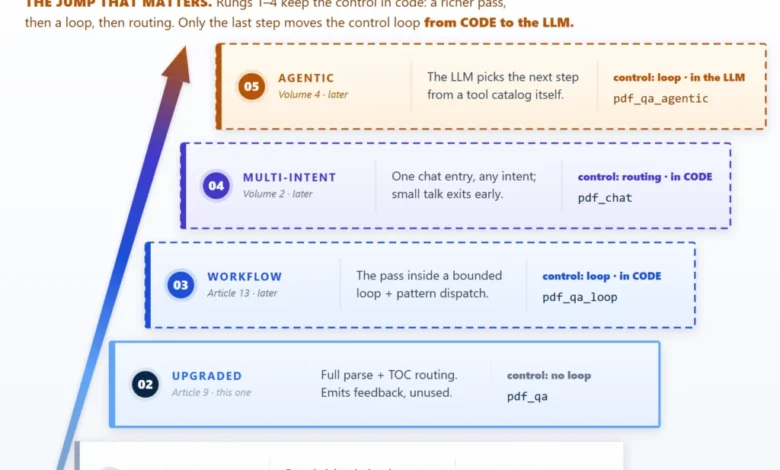
The upgraded pipeline, presented as "rung 2 of 5" in a broader series of RAG advancements, signifies a crucial step in ensuring that AI systems can reliably extract and synthesize information. The overarching principle is that achieving accuracy and trustworthiness in AI-driven insights is fundamentally about mastering the quality and integrity of the context provided to the models, not merely optimizing the models themselves.
Sources and Further Reading
The failure cases discussed are derived from direct comparisons between a naive RAG baseline (pdf_qa_baseline, incorporating a flat-chunk parser and a free-text generator) and the upgraded pdf_qa system, as detailed in Article 9. Each instance is a verified run, reproducible via the companion notebook. The implementation of structured outputs, particularly the responses.parse(text_format=Schema) pattern for typed answers, leverages OpenAI’s Structured Outputs guide.
Earlier in the Series:
- Article 1: Minimal RAG
- Article 5: Relational Parsing
- Article 7quinquies: Most RAG Hallucinations are Retrieval Failures
- Article 9: The Upgraded Pipeline
Documents Used (all openly licensed):
- World Bank Commodity Markets Outlook
- NIST SP 800-207, Zero Trust Architecture
- NIST Cybersecurity Framework 2.0
- "Attention Is All You Need" paper
- RAG paper
Related posts: