MIT Researchers Unveil CheMeleon: A Breakthrough Open-Source AI Foundation Model Set to Revolutionize Drug Discovery and Materials Science

The pursuit of novel molecules has long served as the fundamental bedrock of industrial progress, underpinning vital advancements across the pharmaceutical, electronic, and renewable energy sectors. For decades, however, this endeavor has remained an arduous, capital-intensive trial-and-error undertaking. Because current scientific methodologies cannot perfectly predict how a complex chemical compound will behave across a myriad of environmental conditions, biological targets, and structural responses, researchers and corporate laboratories have been forced to synthesize and test thousands of candidates to discover a single viable product.
This paradigm of chemical engineering and drug discovery is now facing a profound transformation. A team of researchers at the Massachusetts Institute of Technology (MIT), in close collaboration with chemical giant BASF, has developed an innovative artificial intelligence framework known as CheMeleon. This deep-learning foundation model is specifically designed to excel in "low-data" scenarios—instances where scientists have access to only a handful of experimental measurements for a newly discovered cellular target or technologically relevant material property. By outperforming existing predictive models, CheMeleon is poised to dramatically streamline the pipeline of chemical innovation, cutting down months of laboratory labor and millions of dollars in research and development costs.
The findings detailing this breakthrough were formally published in the September issue of the Journal of Chemical Information and Modeling. The research cohort behind the model includes MIT graduate student Akshat Shirish Zalte, recent PhD graduate Jackson Burns ’26, Research Scientist Charlles Abreu, Hoyt Hottel Professor of Chemical Engineering William Green, and three principal investigators from BASF SE in Germany: Jochen Sieg, Christian Feldmann, and Miriam Mathea.
The Genesis and Chronology of CheMeleon
The trajectory of CheMeleon’s rise within the scientific and industrial communities highlights the urgent market demand for advanced predictive chemical modeling. Although the peer-reviewed study officially appeared in print on September 14, the genesis of the project traces back significantly further. An early-access preprint of the foundational paper had been made publicly available online the previous year, accompanied by the release of the open-source model itself.
CheMeleon was constructed utilizing ChemProp, a widely utilized open-source machine-learning package maintained and developed by Professor Green’s research group at MIT. Because the code and the model were made openly available for public download, computational chemists and pharmaceutical researchers quickly began adopting the technology, fine-tuning it to meet their proprietary corporate requirements.
A major proving ground for the technology materialized earlier this year through a predictive modeling contest organized by OpenADMET. The international competition challenged research teams to accurately forecast the biological and chemical properties of a diverse library of novel molecules that had never previously been synthesized in a laboratory setting. According to Professor Green, the competition drew massive global participation from elite academic labs and corporate research divisions alike. When the competition winners were officially tallied and announced, the influence of the MIT model became strikingly apparent: nine of the top twenty entries had incorporated CheMeleon into their computational pipelines.
This unexpected tournament sweep ignited an immediate wave of commercial interest. Inquiries from multinational pharmaceutical corporations flooded the MIT chemical engineering department, despite the fact that the foundational academic paper was still undergoing peer review. The operational impact within industry was swift; at least one major pharmaceutical enterprise issued an internal corporate policy mandating that all research teams must utilize CheMeleon as their primary baseline tool whenever evaluating the molecular properties of potential drug candidates.
Deconstructing the Technology: How CheMeleon Works
Traditional deep-learning artificial intelligence models generally suffer from a severe limitation: they require vast, comprehensive datasets to achieve functional accuracy. In the realm of cheminformatics, successful deep-learning architectures often rely on exhaustive literature reviews, ingesting thousands of published papers from academic journals to parse out molecular relationships.
CheMeleon adopts a fundamentally distinct philosophy. Developed as a pre-trained foundation model—conceptually similar to how large language models like ChatGPT or Claude ingest massive corpuses of internet text to understand human language—CheMeleon is trained on a curated baseline of approximately one million unique chemical structures sourced from PubChem, a freely accessible chemical information repository maintained by the U.S. National Institutes of Health.
Rather than reading narrative text from scientific literature, the MIT-BASF team programmed CheMeleon to analyze approximately 1,600 distinct molecular descriptors. These descriptors represent decades of accumulated chemical knowledge, measuring objective, quantifiable characteristics such as molecular weight, the precise number of oxygen atoms present, chain branching, spatial bulkiness, and solubility indicators.
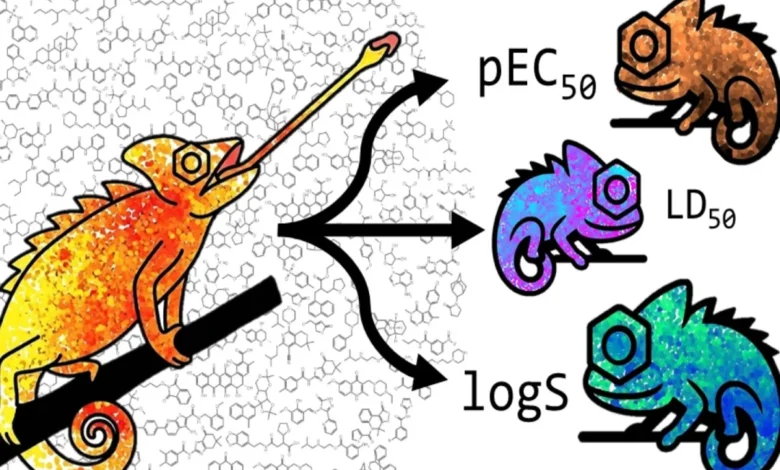
Through this pre-training regimen, the neural network examines one million baseline molecules not to learn a single target property, but to autonomously discover the underlying physics, chemistry, and structural patterns that govern molecular behavior. Once the foundational training phase is complete, the model possesses a generalized "understanding" of chemistry. Consequently, when a researcher feeds the model a completely novel, unstudied molecule alongside a sparse dataset—perhaps as few as five or ten experimental data points—CheMeleon does not need to learn the laws of chemistry from scratch. It effortlessly maps the new molecule against its pre-existing structural framework to predict complex characteristics ranging from basic physical traits like viscosity and solubility to highly specialized biological properties, such as enzymatic reactivity or binding affinity with specific cellular protein targets.
Rigorous Benchmarking and Comparative Performance
To validate the practical utility of their framework, Zalte and his colleagues conducted extensive comparative benchmarks. They pitted CheMeleon against a robust suite of competitors, including other contemporary machine-learning foundation models and classical expert-driven models built on manually coded chemical rules.
Across a rigorous series of 58 distinct test cases encompassing diverse industrial applications, CheMeleon consistently outperformed competing methodologies. This superiority was most pronounced in low-data regimes—situations where traditional expert systems fail due to a lack of historical experimental data, and where standard deep-learning models overfit due to insufficient training samples.
"The CheMeleon foundation model drastically reduces the number of molecules that need to be tested experimentally to accurately predict the properties of new molecules," Professor Green emphasized. "This is a huge advantage, since synthesizing and testing a large number of molecules is slow and expensive."
Broader Economic and Industrial Implications
The commercial and scientific implications of the CheMeleon framework extend far beyond the academic confines of MIT and the corporate labs of BASF. In the pharmaceutical sector, the discovery of new small-molecule therapeutics is notoriously bottlenecked by the "hit-to-lead" optimization phase. Researchers must synthesize hundreds of chemical analogs to find one that binds effectively to a disease target while avoiding toxic side effects. By providing highly accurate predictions from minimal initial data, CheMeleon can dramatically accelerate the identification of promising drug candidates while culling dead-end compounds before physical synthesis ever begins.
A parallel revolution is underway in materials science and green technology. As global industries race to discover advanced electrolytes for high-density batteries, durable catalysts for green hydrogen production, and specialized polymers for electronics, the chemical search space is practically infinite. Tools that can accurately interpolate molecular behaviors across uncharted chemical domains act as an essential compass for industrial researchers.
Furthermore, the open-source nature of the project ensures democratization across the scientific community. By releasing CheMeleon through the established ChemProp ecosystem, the MIT research group has empowered academic institutions, startup biotechnology firms, and mid-sized industrial manufacturers—entities that may lack the massive proprietary data vaults of multi-billion-dollar conglomerates—to leverage cutting-edge artificial intelligence in their daily research operations.
Financial and institutional support for the development of CheMeleon was provided by the Machine Learning for Pharmaceutical Discovery and Synthesis consortium, alongside targeted fellowship funding from the U.S. Department of Energy and MathWorks. As academic refinement continues and industrial adoption broadens, CheMeleon stands as a prime exemplar of how targeted foundation models can bridge the gap between theoretical cheminformatics and tangible, real-world industrial innovation.