Data processing in modern software engineering often encounters a critical bottleneck when the volume of information exceeds the available Random Access Memory (RAM). A common scenario involves legacy scripts designed for manageable datasets that suddenly fail when confronted with enterprise-scale logs or massive telemetry files. When a Python application attempts to load an entire 9 GB log file into a list, the program will inevitably trigger a MemoryError, crashing the system before any analysis can occur. This failure is not a flaw in the parsing logic but rather a consequence of an eager evaluation strategy that treats data as a monolithic block rather than a continuous stream. By adopting Python’s iterator and generator protocols, developers can construct pipelines that process data incrementally, ensuring that only a small, manageable fragment of the dataset occupies memory at any given time.
The Evolution of Data Handling and the "Eager" Problem
Historically, early programming paradigms frequently relied on loading datasets into memory buffers to facilitate rapid access. However, as the volume of global data increased exponentially—a phenomenon accelerated by log rotation policies and high-frequency IoT telemetry—these traditional methods became obsolete. In many corporate environments, IT infrastructure teams have observed that nightly batch jobs, which once performed flawlessly, began to collapse as log file sizes grew from megabytes to gigabytes.
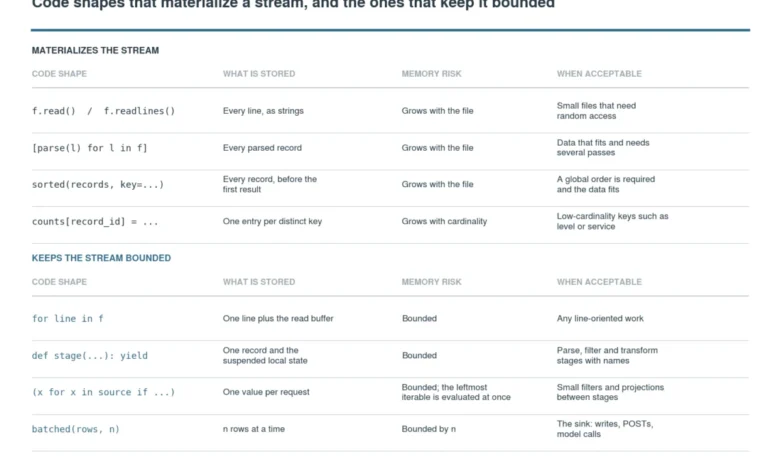
The "eager" approach—characterized by functions like .readlines() or list comprehensions—instructs the interpreter to hold every record in memory simultaneously. This creates a linear correlation between input size and memory consumption. If an input file is 10 GB, the application requires at least 10 GB of RAM just to store the initial list, not accounting for the additional overhead of Python object wrappers. The shift toward lazy evaluation is a response to this physical limitation, allowing developers to treat massive files as infinite streams.
Anatomy of the Iterator Protocol
At the heart of Python’s memory-efficient architecture lies the iterator protocol, a fundamental contract between the data source and the consumer. An iterable object—such as a file, list, or generator—implements the __iter__() method, which returns an iterator. The iterator, in turn, provides the __next__() method. When a for loop executes, it repeatedly calls next() on the iterator until a StopIteration signal is raised, indicating that the stream is exhausted.
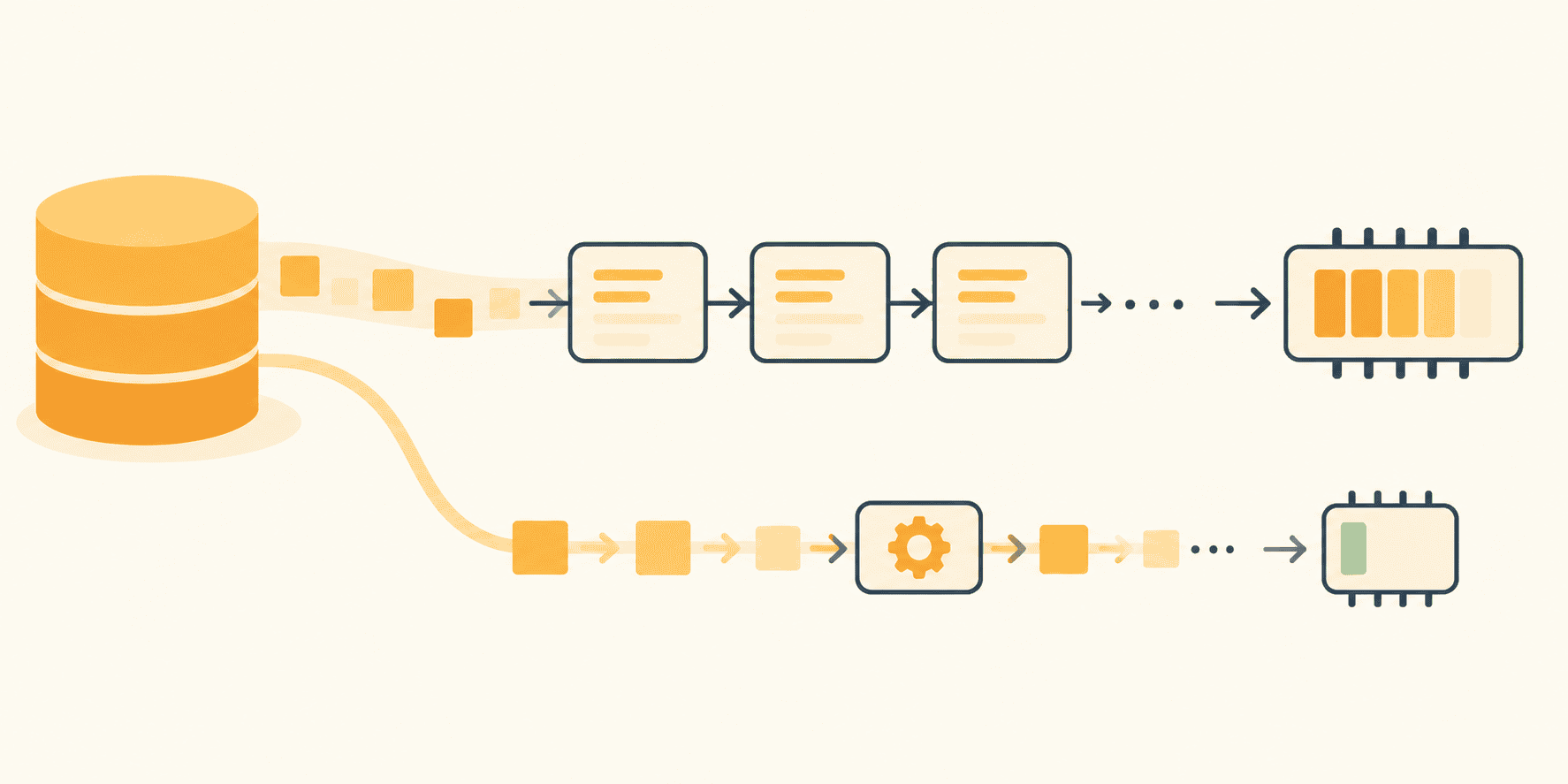
This mechanism is inherently "lazy." It does not copy the contents of the file; it maintains a cursor that tracks the current position. When reading a 9 GB file line-by-line, the system only buffers a few kilobytes at a time. This fundamental shift allows developers to perform complex operations—such as filtering, mapping, and transforming—without ever requiring more than a few megabytes of RAM, regardless of the total file size.
Building a Resilient Pipeline: Step-by-Step
To transition from an eager, crash-prone script to a robust, streaming pipeline, engineers must decompose the logic into distinct, modular stages. A well-architected pipeline typically follows a four-part structure:
- Source Iteration: Utilizing the file object itself as an iterator. By avoiding
f.readlines(), the developer ensures the file is read in buffered chunks. - Generator Functions: Encapsulating parsing logic within functions that utilize the
yieldkeyword. A generator function saves its local state (variable bindings, instruction pointers) upon yielding, making it significantly more memory-efficient than a standard function returning a list. - Lazy Transformations: Using generator expressions—the one-line, parenthesis-enclosed cousins of list comprehensions—to filter or project data.
- The Sink (Boundary): Materializing the data only at the final point of consumption, such as writing to a database or a new file.
This approach transforms the script from a monolithic block of code into a series of interconnected stages. For example, if a log parser needs to filter by "ERROR" level and then identify high-latency requests, these can be implemented as independent generator functions. Each stage processes a single record and passes it to the next, maintaining the "lazy" chain throughout the execution path.
The Role of itertools and Standard Library Utilities
The Python standard library provides powerful utilities to manage these streams. The itertools module, particularly the islice and batched functions, serves as an essential toolkit for developers. islice allows for the examination of data samples without consuming the entire file, which is invaluable for testing and debugging complex pipelines.
With the introduction of itertools.batched() in Python 3.12, the task of grouping data for bulk database inserts or API calls has become standardized. This allows for a "batch-at-the-boundary" strategy: the pipeline remains lazy and streaming throughout, but the final output is collected into small, fixed-size chunks (e.g., 1,000 records). This balances the need for efficient I/O operations with the strict requirements of memory management.

Measuring Success: The Importance of Benchmarking
A critical aspect of professional data engineering is the verification of memory usage. Developers should not assume a pipeline is lazy simply because it uses generator syntax; one inadvertent list() call or a sorting operation can force the entire stream into memory, reintroducing the original bottleneck.
Tools such as tracemalloc are essential for monitoring these processes. By comparing the "peak" memory usage—the maximum amount of RAM allocated at any point during execution—against the baseline, engineers can identify where leaks occur. In a properly optimized system, the peak memory usage should remain constant, regardless of whether the input file is 10 MB or 100 GB. If the peak scales with the file size, the pipeline is not truly streaming.
Broader Implications and Industry Best Practices
The shift toward streaming architectures has profound implications for machine learning and data science. Many "out-of-memory" errors in modern LLM (Large Language Model) fine-tuning or preprocessing tasks are actually failures in the data pipeline rather than the hardware. By standardizing on iterator-based architectures, data scientists can process datasets that are significantly larger than their local hardware capacity.
Furthermore, these pipelines are inherently more testable. Because each generator stage is independent, developers can unit test individual components with small, synthetic inputs. This modularity improves code quality and maintainability, as different team members can iterate on the parsing logic, the filtering logic, or the output formatting without interfering with the rest of the stream.
Conclusion: Maintaining the Chain of Laziness
The transition to memory-efficient processing is not merely a technical optimization but a shift in architectural philosophy. It requires a disciplined approach to code design where every stage of the pipeline respects the stream. From the initial file read to the final batch sink, the goal is to prevent any operation that would force the materialization of the entire dataset. By leveraging Python’s built-in iterator protocols and adhering to the "lazy-by-default" principle, developers can build systems that are not only crash-proof but also highly performant and easy to maintain. In an era where data growth shows no signs of slowing, these techniques are essential tools for any professional software engineer.
Related posts: