Google Ads Promotional Credits Under Fire as Advertisers Face Unexpected Invalidation After Meeting Spending Thresholds

The digital marketing community is grappling with a growing wave of concern following reports that Google Ads promotional credits are being invalidated after advertisers have already fulfilled the financial spending requirements necessary to qualify for them. This unexpected policy enforcement has left numerous businesses, ranging from small enterprises to larger brands, facing significantly higher advertising expenditures than anticipated, with little to no recourse to recover their invested capital.
The issue, which has recently gained traction across professional marketing circles, brings to light underlying vulnerabilities in how tech platforms manage promotional incentives. As businesses increasingly rely on financial buffers to offset the high costs of customer acquisition in competitive auctions, the sudden revocation of these credits threatens to disrupt digital marketing budgets on a broad scale.
Reports of Lost Credits After Significant Financial Commitments
The controversy came to light primarily through the documentation of PPC consultant David Melamed, who publicly shared details of multiple clients encountering the issue within a remarkably short time frame. According to Melamed’s findings, advertisers are being lured into aggressive spending commitments under the explicit promise of matching funds or rebate credits, only to see those anticipated financial offsets disappear months after the capital has already been deployed.
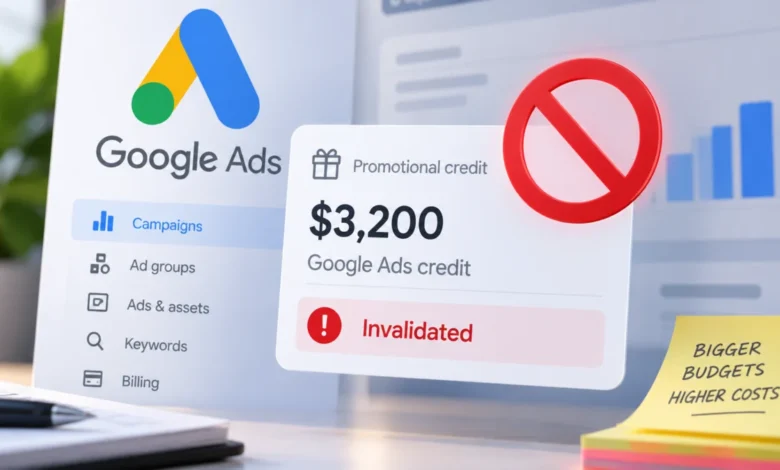
In one prominent case highlighted by Melamed, a participating advertiser structured their initial campaign rollout around the expectation of receiving a $3,200 promotional credit. To earn this bonus, the business was required to invest an equivalent amount of $3,200 of their own capital into Google Ads. The advertiser successfully met this spending threshold, executing the required budget over a sustained period. However, more than a month after the funds had been fully depleted and the campaigns had concluded, the status of the promotional credit was abruptly altered within the dashboard and marked as "Invalidated."
Melamed pointed out a fundamental psychological and financial flaw in how these promotions operate: the advertiser in question would not have authorized the initial $3,200 expenditure if they had known the promised promotional safety net would be stripped away. Because digital advertising budgets are frequently tightly capped, the unbudgeted loss of thousands of dollars can severely impair a company’s cash flow, particularly for small-to-medium-sized businesses operating on strict margins.
Ambiguous Triggers and the Absence of an Appeal Mechanism
Compounding the financial shock for advertisers is the complete lack of transparency regarding why these credits are being revoked, coupled with the absence of a clear, standardized appeal process. When digital marketers encounter erroneous billing charges, policy flags, or account suspensions, they typically look to support channels or dispute forms to rectify the issue. However, in the case of invalidated promotional credits, standard pathways for resolution appear largely nonexistent.
In a second distinct case brought forward by Melamed, a newly onboarded advertiser had their promotional credit invalidated due to a technicality involving their billing profile setup. Specifically, the account was initially established using a billing profile linked to a manager account. While platform terms of service often contain granular clauses regarding account hierarchies and payment setups, advertisers argue that these technicalities are rarely communicated clearly upfront, leading to penalties that feel disproportionate to the perceived infraction.
In the first major case, however, no clear explanation or policy violation was readily apparent to the consultant or the advertiser. The lack of diagnostic feedback from the platform leaves businesses guessing as to whether algorithmic automation, human oversight error, or hidden compliance clauses triggered the revocation.
Because the underlying ad spend—the money spent to qualify for the promotion—cannot be clawed back or refunded by Google, the advertiser bears 100% of the financial loss. Once an ad impression is served and clicked, the capital is permanently consumed within the auction ecosystem, regardless of whether the accompanying promotional incentive is ultimately honored.
Broader Economic Implications for the Google Ads Auction Ecosystem
Beyond the immediate financial damage sustained by individual businesses, industry analysts are beginning to examine the broader macroeconomic implications that promotional credits exert on the Google Ads auction ecosystem as a whole.

Promotional credits are not merely passive marketing gifts; they are strategic tools designed to alter advertiser behavior. By effectively discounting the cost of customer acquisition during the critical onboarding phase, these credits encourage new or expanding advertisers to bid more aggressively and allocate larger budgets than they otherwise might.
When an advertiser factors a $3,000 credit into their initial $6,000 projected spend, their psychological threshold for maximum cost-per-click (CPC) bids shifts upward. They view their blended cost as significantly lower, prompting them to enter more aggressive bids across competitive keyword landscapes.
Consequently, these additional capital injections flow directly into Google Ads auctions, potentially increasing overall competition and driving up keyword costs for all other participating advertisers bidding for the same digital real estate. While industry observers note that definitive empirical data proving revoked credits materially inflate market-wide auction prices is still lacking, the theoretical impact remains a subject of intense discussion among paid search professionals. If thousands of advertisers are spending unbudgeted funds under the false assumption that credits will offset their costs, the aggregated effect on auction dynamics could be non-trivial.
Official Responses and the Demand for Accountability
As discussions surrounding the invalidated credits gained momentum across social media and professional forums, Google leadership took initial notice of the public complaints. Ginny Marvin, the official Google Ads Liaison, responded directly to Melamed’s detailed breakdown on LinkedIn.
Acknowledging the visibility of the issue, Marvin stated: "Thank you for bringing this to our attention, David. I’ve passed this along to the team."
Despite this acknowledgement, Google has not yet provided a comprehensive public explanation clarifying the precise systemic triggers behind the invalidations. Furthermore, the tech giant has not signaled whether it intends to introduce policy reforms, establish a dedicated dispute resolution workflow, or offer retroactive compensation to advertisers who fulfilled spending criteria only to have their credits revoked.
The silence from platform representatives regarding structural fixes has left the digital marketing community anxious for clearer guidelines.
Best Practices and What Advertisers Should Watch Moving Forward
The recent incidents serve as a cautionary tale for media buyers, agency leads, and in-house marketing teams. Industry experts emphasize that promotional credits should never be treated as guaranteed liquidity or hard assets when forecasting quarterly marketing budgets.
Moving forward, paid search professionals are advised to adopt a more rigorous approach to promotional offers:
- Thoroughly audit the terms, conditions, and eligibility criteria of any promotional code before launching campaign structures dependent upon them.
- Avoid relying on manager-level billing profiles for new accounts if promotional terms explicitly restrict or penalize consolidated billing setups.
- Maintain a conservative cash flow buffer, ensuring that the business can absorb 100% of the required qualification spend without collapsing if the credit is ultimately withheld.
- Document all communications, account setup procedures, and dashboard notifications regarding promotional credit statuses to maintain a paper trail should future dispute channels become available.
The Bottom Line
Google Ads promotional credits have long served as a vital onboarding mechanism, enticing businesses to invest thousands of dollars to kickstart their digital marketing initiatives. However, the emerging pattern of credits being invalidated long after qualification thresholds have been met introduces a troubling layer of unpredictability into media planning.
As affected businesses continue to search for answers and recourse, the situation highlights a pressing need for greater platform transparency, predictable enforcement of terms, and robust support infrastructure. Until Google implements clearer pathways for advertisers to challenge these decisions, businesses participating in promotional programs must navigate the landscape with heightened caution, fully aware that the promised reward may not always materialize at the finish line.