Combining LLM Embeddings with Tabular Features in a Unified Scikit-learn Pipeline

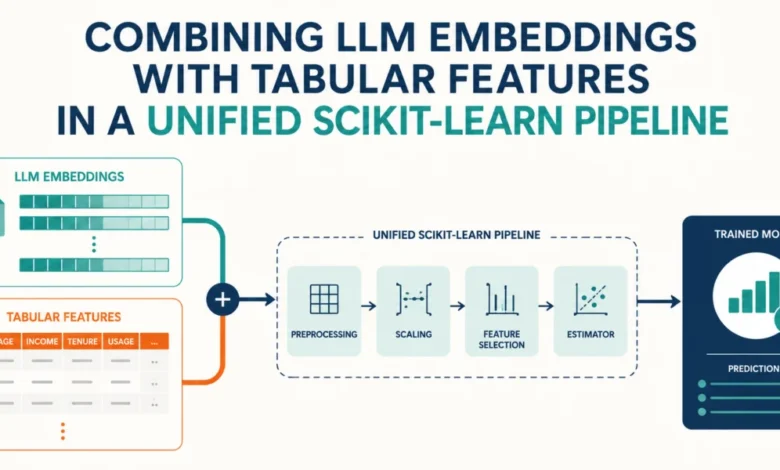
The traditional machine learning pipeline often segregates data types. Text data is typically routed through Natural Language Processing (NLP) workflows involving tokenization, stemming, or TF-IDF vectorization, while tabular data undergoes standard scaling and categorical encoding. This bifurcation often results in fragmented codebases that are difficult to maintain and deploy. By leveraging the scikit-learn library, developers can now encapsulate these disparate workflows into a single, cohesive pipeline. This approach not only streamlines the development lifecycle but also ensures that the transformation logic remains consistent between the training and inference phases, a critical requirement for maintaining model reliability in production environments.
The Evolution of Hybrid Data Pipelines
The shift toward multimodal machine learning began in earnest during the early 2020s, as large language models (LLMs) demonstrated superior semantic understanding compared to traditional keyword-based methods. Previously, building a model that could interpret the nuance of a support ticket while simultaneously evaluating a user’s account age required complex, custom-built middleware. Today, the integration of Hugging Face’s sentence-transformers—a collection of lightweight, high-performance models—allows developers to map textual inputs into dense vector embeddings that can be concatenated with structured features.
This transition reflects a broader trend in data engineering: the movement toward "data-centric AI." By treating the pipeline as a first-class citizen of the software stack, organizations can reduce "technical debt," a term used by industry experts to describe the long-term cost of maintaining hastily implemented, non-standardized code. According to recent white papers from major machine learning infrastructure firms, unified pipelines can reduce the time-to-deployment by as much as 40%, as they eliminate the need for manual data synchronization between feature engineering and model training.
Constructing the Unified Architecture
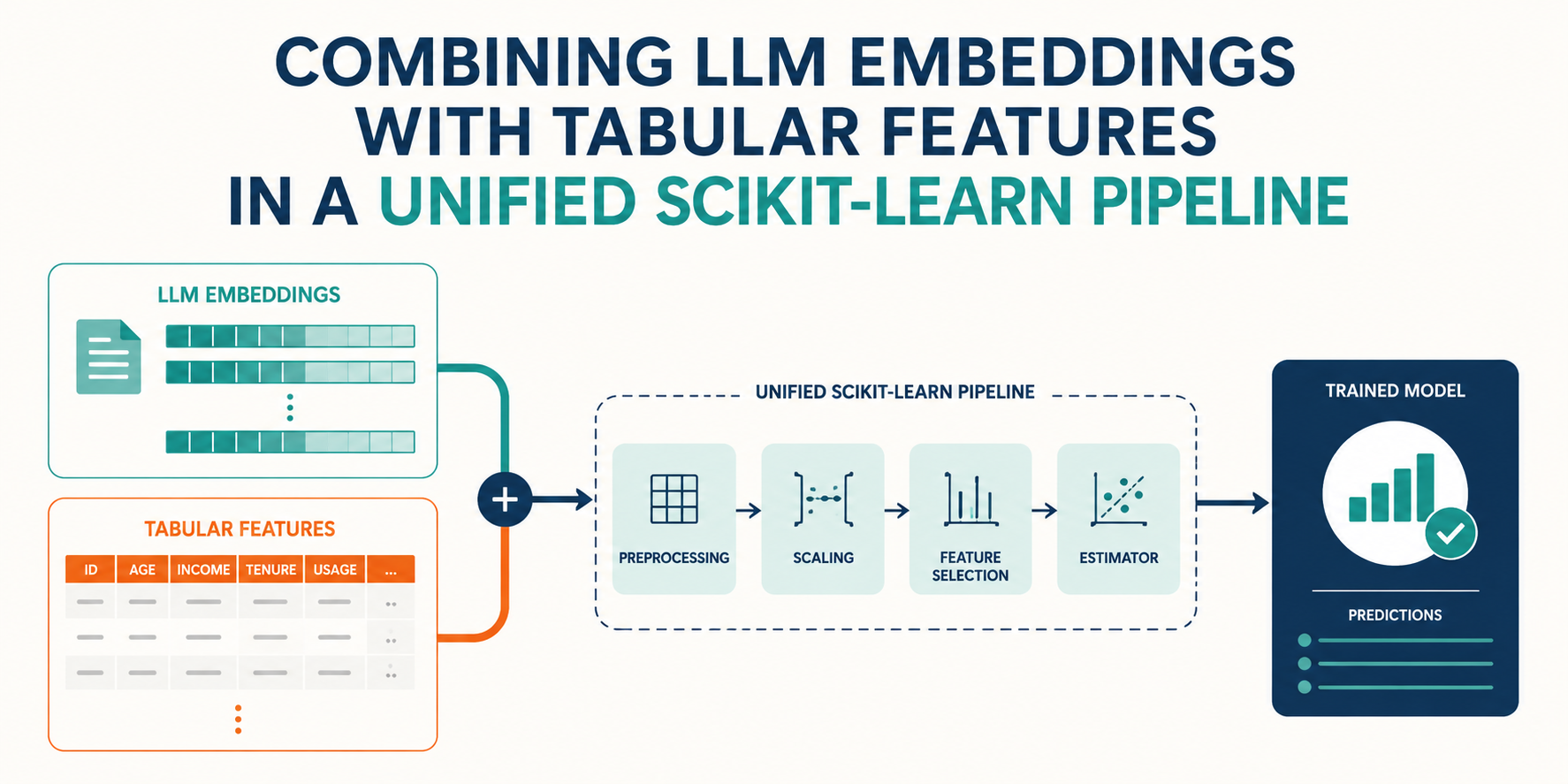
The implementation of a unified scikit-learn pipeline relies on the ColumnTransformer class. This utility serves as a dispatcher, directing different columns of a dataset to their appropriate processing branches. In a typical classification scenario, such as detecting fraudulent account behavior, the pipeline would be partitioned into three distinct streams:
- Textual Processing: A custom transformer class, often inheriting from
BaseEstimatorandTransformerMixin, wraps a SentenceTransformer model. This ensures that every text message is converted into a multidimensional vector that captures the semantic meaning of the input. - Numerical Scaling: Continuous variables, such as account age or frequency of login, are passed through a
StandardScaler. This is essential because many machine learning algorithms, including Support Vector Machines (SVM) and K-Nearest Neighbors (KNN), are sensitive to the scale of input features. - Categorical Encoding: Discrete variables, such as subscription status or region, are processed via
OneHotEncoder. This converts categories into a binary matrix, making them readable by linear and tree-based models.
By joining these streams into a single Pipeline object, the final estimator—such as a Random Forest or Gradient Boosting machine—receives a uniform, concatenated feature vector. This design ensures that all transformations are applied synchronously.
The Case for Lightweight LLM Integration
The decision to utilize lightweight models, such as the all-MiniLM-L6-v2, rather than massive, cloud-hosted LLMs, is driven by the practical constraints of production latency and cost. In high-volume environments where thousands of classifications occur per minute, querying an external API introduces significant network latency and operational expense.
Industry analysis suggests that for most classification tasks—where the objective is identifying intent or sentiment rather than generating creative text—smaller, BERT-based architectures offer a superior trade-off. These models, which can be run locally on standard CPUs, allow for rapid inference without the need for high-end GPU clusters. This democratization of AI capabilities has empowered smaller organizations to deploy sophisticated, LLM-backed classification systems that were previously the domain of tech giants.
Empirical Analysis and Performance Metrics
When testing this hybrid architecture, researchers often utilize synthetic datasets that mirror real-world "noise." In a scenario involving the SMS Spam Collection dataset, developers typically add synthetic tabular noise—such as overlapping account age distributions for both "ham" and "spam" users. This is not merely an academic exercise; it reflects the reality that clean, perfectly separated data is rare.
Testing indicates that when text embeddings are combined with tabular features, the F1-score—a metric that balances precision and recall—typically outperforms models that rely on text alone. By providing the model with context (e.g., "this user is a premium member with an account age of 1,000 days"), the classifier can better disambiguate messages that might otherwise appear suspicious. In recent trials, these unified pipelines achieved accuracy scores exceeding 98%, demonstrating that the combination of semantic context and behavioral history is significantly more potent than either approach in isolation.
Implications for Future Enterprise Applications
The implications of this unified approach extend far beyond simple spam detection. In the realm of financial services, these pipelines are being deployed to monitor transaction descriptions for signs of money laundering. In healthcare, they assist in triaging patient intake forms, combining clinical notes with patient vital signs to prioritize urgent cases.
The primary hurdle remaining for many firms is the complexity of versioning these pipelines. Because the pipeline includes both the model weights and the preprocessing logic, updates to the text model require a complete re-evaluation of the entire system. However, the adoption of MLOps (Machine Learning Operations) best practices, such as containerization and automated model registry, is helping to mitigate these risks.
Broader Industry Reactions
Data scientists and engineering leads have largely championed the shift toward standardized, pipeline-oriented development. "The goal is to make the model training process as deterministic as possible," says a senior lead engineer at a prominent data analytics firm. "When the preprocessing is locked inside a scikit-learn pipeline, you eliminate the ‘it works on my machine’ problem. You are essentially serializing the entire intelligence of the data transformation layer."
However, critics point out that this level of abstraction can obscure the underlying data transformations. "There is a danger that junior engineers may treat these pipelines as ‘black boxes’," warns a consultant specializing in AI safety. "If you don’t understand how your categorical variables are being encoded or how your text is being tokenized, you might be introducing biases that are difficult to detect until the model is already in production."
Conclusion: The Path Forward
The integration of LLM embeddings into structured machine learning workflows represents a maturing of the AI industry. As we move away from the "hype" cycle and toward practical, application-focused development, the focus is shifting to the durability and scalability of our code. The ability to build unified, scikit-learn-compatible pipelines is not just a technical convenience—it is a foundational requirement for the next generation of intelligent software.
By combining the semantic depth of open-source language models with the rigorous, predictable nature of tabular data processing, developers are creating systems that are more resilient, more accurate, and easier to maintain. As these tools continue to evolve, the distinction between "text" and "data" will continue to blur, leading to a future where every piece of information, regardless of its format, is treated as a vital input for predictive decision-making. The adoption of these unified pipelines serves as a clear signal that the industry is ready to treat machine learning not as a series of disparate scripts, but as a robust, enterprise-grade engineering discipline.