Decoding the Data Divide: How Big Tech Analytics Metrics Shift Financial Risk onto Advertisers

The digital advertising ecosystem has long relied on probabilistic metrics to justify multi-million-dollar corporate budgets. However, a critical examination of interpretation frameworks provided by dominant advertising platforms has brought a longstanding tension between platform incentives and corporate financial risk management into sharper focus. At the heart of this discussion is how platforms like Google define statistical certainty for Brand Lift, Search Lift, and Conversion Lift studies, and whether these definitions adequately protect the financial interests of enterprise advertisers.
Background Context of Digital Lift Studies
For decades, digital marketing has moved away from simple direct-response tracking toward advanced econometric and experimental methodologies designed to measure brand incrementality. Tools such as YouTube’s Brand Lift studies attempt to answer a fundamental question: Did exposure to an advertisement cause a statistically significant change in consumer behavior or perception, such as consideration or purchase intent, compared to an unexposed control group?
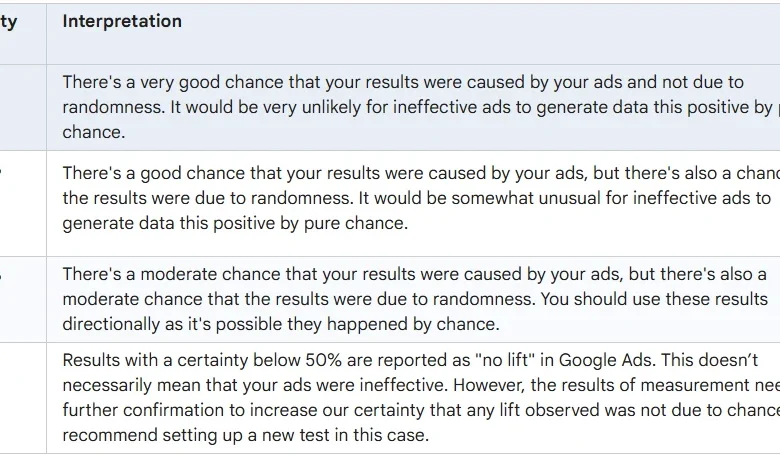
To communicate the reliability of these findings, platforms categorize results using tiered confidence levels. Official documentation from major ad providers typically classifies certainty scores above 90 percent as a very good chance of success, 70 to 90 percent as a good chance, and 50 to 70 percent as a moderate chance, while anything below 50 percent indicates no observable lift. Platform guidance frequently suggests that studies achieving a score of 50 percent or higher provide valuable, directional insights that can guide ongoing campaign strategies.
The Divergence in Institutional Incentives
The core controversy centers on the disparate consequences experienced by the two primary stakeholders in a digital advertising transaction: the platform selling the media space and the enterprise buyer funding the campaign.
From the perspective of the advertising platform, the primary objective is ecosystem liquidity and continuous experimentation. Platforms operate under business models where sustained ad spend drives revenue. If an empirical study yields weak or suggestive evidence that a campaign might have worked, the platform maintains a structural incentive to encourage further testing. A moderate or directional result keeps the capital flowing, offering a speculative foundation for subsequent marketing outlays.
Conversely, the corporate buyer—represented by senior brand media directors, chief marketing officers (CMOs), and chief financial officers (CFOs)—bears direct fiduciary responsibility for capital allocation. For a corporate executive, the standard of evidence required to authorize a subsequent multi-million-dollar expenditure must account for fiduciary duty. A result characterized merely as a moderate chance or a directional indication introduces severe financial vulnerability. The enterprise assumes the entirety of the capital risk if the initial optimistic interpretation fails to materialize in subsequent fiscal quarters.
Analyzing the Mathematics of Replication Risk
To evaluate the operational validity of relying on directional insights, industry analysts apply statistical frameworks originally developed in biostatistics, such as Bayesian replication models. These models evaluate what happens when an experiment is repeated under identical conditions—maintaining the same budget, audience targeting, seasonality, and creative assets.
When a platform reports a 70 percent certainty score for a campaign lift metric, it often corresponds to a modest estimated increase in consumer consideration. However, translating that 70 percent certainty metric through a replication model reveals sobering probabilities for enterprise finance teams. Specifically, a campaign reported at the 70 percent certainty threshold often carries a significantly lower probability of reproducing a positive lift or reaching high statistical certainty in a subsequent test.
According to probabilistic replication analyses:
- The statistical chance that an equivalent repeat campaign yields any positive lift whatsoever can drop significantly below reliable planning thresholds.
- The probability of hitting a robust 90 percent certainty standard in a repeated test diminishes sharply, often hovering near one-third likelihood.
- The complementary metric—known as replication risk—indicates that the vast majority of repeat campaigns under those conditions will fail to validate the original optimistic conclusion.
When these calculations are presented to corporate financial leadership, the phrase directional results ceases to sound nuanced and instead highlights severe exposure to Type S (sign) and Type M (magnitude) errors. In these scenarios, weak initial evidence not only fails to replicate reliably, but the apparent economic impact of the initial campaign is frequently overstated.
Industry Standards and Risk Mitigation Strategies
In response to these statistical realities, many seasoned enterprise media directors have adopted strict internal thresholds for capital authorization. Rather than accepting platform-defined directional benchmarks, risk-conscious organizations increasingly enforce a minimum floor of 90 to 95 percent statistical certainty before approving budget renewals.
This stringent threshold is not driven by academic pedantry, but by practical financial stewardship. By demanding higher certainty levels, firms aim to lower replication risk and ensure that prior capital allocations have genuinely driven incremental business value rather than random statistical noise.
Furthermore, this analytical scrutiny extends beyond a single provider. Similar evaluation frameworks apply across major digital ecosystems, including Meta, TikTok, and programmatic media networks. Third-party agencies and technology vendors whose compensation packages scale directly with total media spend may inadvertently favor permissive interpretations of campaign lift. Consequently, enterprise governance models increasingly mandate independent verification protocols, internal statistical standardization, and rigorous cross-platform auditing.
Broader Impact on Corporate Marketing Governance
The ongoing debate over digital lift metrics underscores a vital evolution in marketing analytics: the professionalization of media investment evaluation. As corporate boards demand greater financial accountability from marketing departments, the reliance on ambiguous qualitative labels like directional insights is facing systematic pushback.
Enterprise organizations are learning to separate platform advocacy from internal financial governance. By decoupling brand risk tolerance from the self-serving definitions of success promoted by media sellers, companies can better protect their balance sheets. Moving forward, the industry trend points toward greater mathematical rigor, transparent replication modeling, and an unwavering focus on empirical certainty over platform-generated optimism.