Google Analytics Rollout of Advanced AI and Attribution Features Signals Major Shift for Digital Marketing Professionals

Over the past year, the development team behind Google Analytics has released a sophisticated suite of capabilities designed to elevate web analytics from basic retrospective reporting to forward-looking strategic decision-making. These newly introduced tools bridge the gap between traditional digital data collection and high-level corporate finance and executive strategy. While some of these capabilities process data prospectively without historical backfilling—requiring immediate activation by digital teams—the overall update marks a fundamental evolution in how organizations measure consumer behavior, value artificial intelligence interactions, and allocate cross-channel advertising budgets.
The Strategic Evolution of Web Analytics
For years, digital analysts faced criticism for functioning primarily as retroactive reporters—often described colloquially as reporting squirrels—who detailed past traffic patterns rather than influencing future business outcomes. The latest updates to Google Analytics aim to transition professionals into analytical strategists capable of engaging directly with executive leadership on matters of margin preservation, revenue optimization, and precise budget allocation.
Industry analysts note that modern digital ecosystems have grown increasingly complex, driven by fragmented user journeys, privacy regulations, and the rapid rise of generative AI platforms. In response, Google Analytics has integrated features that address these challenges directly, providing standardized measurement frameworks for emerging traffic types and predictive budget modeling.
Quantifying the Impact of AI Assistants and Answer Engine Optimization
One of the most significant additions to the platform is the inclusion of the AI Assistant channel within default channel groupings. As consumer search behavior shifts toward generative artificial intelligence and answer engines—a trend that has contributed to noticeable declines in traditional search engine optimization traffic—digital marketers have struggled to isolate and quantify traffic originating from large language models.
The newly deployed reporting structure automatically captures traffic from major AI assistants under specific parameters within the Traffic Acquisition reports, setting the medium to ai-assistant and the campaign identifier accordingly. Industry data from major commerce platforms and enterprise software providers indicates that while answer engine traffic typically represents a modest percentage of overall sessions—often ranging between one and five percent—its underlying business value is disproportionately high. Comparative studies from early 2026 suggest that users arriving via AI assistants exhibit significantly higher engagement rates, longer session durations on product pages, and markedly superior conversion values compared to traditional organic search traffic.
Despite these advantages, digital analysts must navigate several operational nuances. The data collection for this feature began rolling out mid-year, leaving a blind spot regarding historical trends. Furthermore, the taxonomy of AI platforms remains fluid; specific models frequently enter or leave designated classifications as new market participants emerge. Additionally, traffic originating from mobile and desktop applications or in-app browsers often bypasses traditional referral headers, frequently default-categorized as direct traffic. Consequently, analytics professionals are advised to supplement native platform reporting with custom channel groupings and rigorous data reconciliation to capture the true volume of generative AI engagement.
Advanced Conversion Attribution and Multi-Touch Analysis
To counter the limitations of last-click attribution models, Google Analytics has expanded its conversion attribution analysis capabilities, bringing granular multi-touch insights into the core reporting interface. By examining assisted conversions alongside traditional conversion metrics, marketing teams can evaluate the true supporting value of acquisition channels that rarely close transactions independently but frequently initiate or nurture customer interest.
The platform’s updated conversion funnel analysis categorizes owned, earned, and paid touchpoints across early, middle, and late stages of the consumer journey. This segmentation helps organizations identify undervalued upper-funnel channels, preventing premature budget cuts to programs that drive long-term demand generation. Rather than relying on intuition or legacy multi-touch attribution vendors, organizations can centralize their data within Google Analytics to observe how specific channels interact before a purchase occurs.
However, industry experts caution that attribution does not equate to incrementality. Because assisted conversions frequently overlap and sum to well over one hundred percent, these metrics must be contextualized within broader marketing mix models to determine true return on investment. Furthermore, maintaining data integrity requires disciplined event tracking; an overabundance of micro-conversions can distort attribution models, rendering the data less actionable for executive decision-making.
Cross-Channel Budgeting and Predictive Scenario Planning
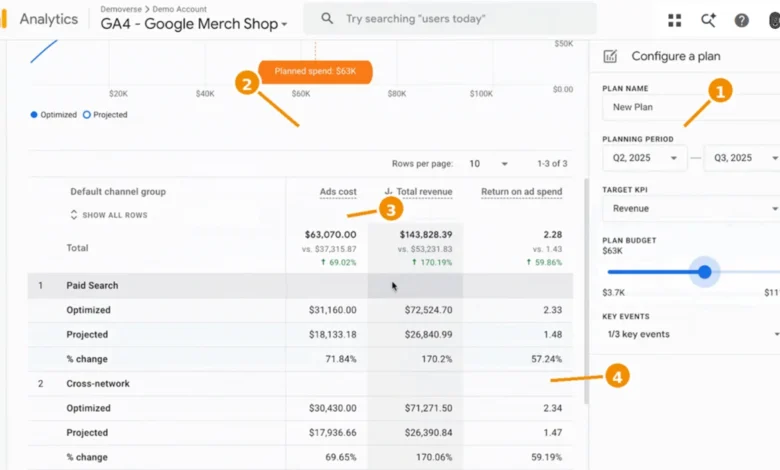
Bridging the gap between statistical insights and financial execution has historically been a challenge for marketing departments. The introduction of cross-channel budgeting tools within the advertising section of Google Analytics addresses this challenge by incorporating predictive analytics trained on historical performance, seasonality, and external variables.
The feature comprises two core planning utilities: project plans, which evaluate spending pace against projected outcomes, and scenario plans, which allow analysts to model the financial implications of reallocating capital between channels, such as shifting funds from paid social to paid search. By analyzing diminishing return curves and projected return on ad spend, digital teams can present executive leadership with data-backed optimization strategies rather than speculative budget requests.
Achieving accurate cross-channel planning requires comprehensive cost data integration. Organizations must successfully import campaign expenditure data from major advertising platforms, including Meta and TikTok, to ensure the predictive models reflect a holistic financial picture. While forecasting models inherently involve a degree of uncertainty, their ability to test budgetary hypotheses before capital deployment represents a vital advancement in enterprise fiscal governance.
Conversational Analysis and Large Language Model Integration
In an effort to democratize data access and reduce reliance on manual report generation, Google Analytics has introduced conversational analysis features, highlighted by the Ask Advisor tool. Accessible via a simplified interface icon, this feature allows users to pose complex analytical questions in natural language, enabling the system to synthesize multi-variable data sets—such as product performance shifts, pricing changes, and promotional impacts—within seconds.
This conversational capability addresses a persistent challenge in enterprise environments: encouraging senior leadership to interact directly with analytics platforms. By allowing executives to query data using plain language, analysts can reclaim time previously spent generating routine ad-hoc reports, redirecting their efforts toward complex strategic initiatives.
For organizations seeking to extend their analytical capabilities beyond the confines of the web interface, Google Analytics has introduced first-party server protocols that connect platform data directly to external large language models. This integration enables marketing and analytics teams to cross-reference web performance data with offline sales databases, comprehensive media plans, and promotional calendars, creating a unified analytical ecosystem.
Broader Implications for the Analytics Profession
The cumulative effect of these updates signifies a maturation of digital analytics. By automating routine reporting through conversational interfaces, standardizing the measurement of emerging AI channels, and introducing predictive financial modeling, Google Analytics equips professionals to participate more authoritatively in corporate strategy.
As organizations adapt to these advanced capabilities, the role of the digital analyst continues to evolve from a technical operator into a strategic partner. Those who successfully activate these features and interpret their nuances will be positioned to guide executive decision-making, optimize capital allocation, and secure a more influential role within the modern enterprise.