TikTok USDS Reports Surge in Q2 Enforcement Data Detailing Millions of Fake Accounts and Coordinated Influence Disruption

TikTok USDS, the specialized U.S.-based management and operational group overseeing the social media platform’s American subsidiary, has released its comprehensive data regarding rule enforcement, content moderation, and platform security for the second quarter. Covering the period from April 1 through June 30, this publication marks the second official Platform Security and Community Guidelines Report issued by the domestic entity since it formally assumed control over TikTok’s operations in the United States this past January.
The transition of TikTok’s American operations to a localized joint venture followed intricate negotiations and legal mandates designed to comply with U.S. federal oversight. By releasing quarterly metrics, the U.S. management team aims to provide transparency regarding its moderation efficacy, infrastructure stability, and adherence to rigorous security standards. Evaluating the newly released second-quarter data alongside the inaugural report published in July establishes a critical baseline for comparison, illuminating both the evolving scope of platform threats and the corresponding maturation of TikTok’s automated and human detection mechanisms.
Spike in Fake Account and Spam Interceptions
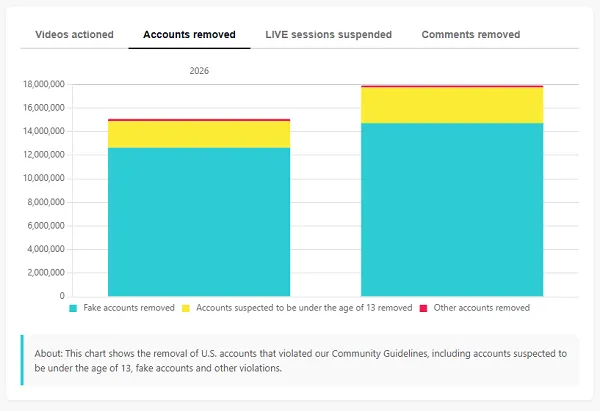
Among the most striking disclosures in the Q2 report is the dramatic escalation in the removal and prevention of fraudulent profiles. TikTok USDS reported that the platform successfully removed 14.6 million fake accounts during the three-month window. Furthermore, automated barriers and security protocols intercepted and prevented the creation of an additional 64.8 million spam accounts before they could actively interact within the ecosystem.
The proliferation of fraudulent metrics extended well beyond primary account generation. The platform purged 781.4 million fake followers and blocked 403.2 million unauthorized or fraudulent follow requests during the same period. These figures represent a substantial, order-of-magnitude increase compared to the metrics outlined in the first-quarter report.
Industry analysts tracking trust and safety trends suggest two primary interpretations for this surge. First, it indicates that TikTok remains an increasingly high-value target for malicious actors, bad-faith marketers, automated bot networks, and financial scammers seeking to artificially inflate engagement metrics. Second, and perhaps more importantly, the dramatic rise in removals reflects a marked improvement in TikTok’s detection capabilities. Enhanced algorithmic identification, coupled with more aggressive proactive sweeps by the newly structured U.S. trust and safety teams, have yielded higher catch rates. Regardless of whether the influx stems from increased hostile activity or superior detection technology, the net result is a significantly sanitized digital environment for legitimate American users.
Video Removals, Livestream Restrictions, and Policy Violations
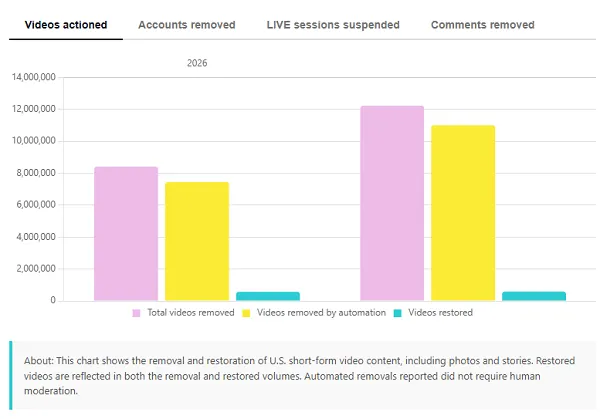
The upward trajectory in enforcement actions was not restricted to fake profiles; it extended directly to content moderation across standard video uploads and live-streaming sessions. Parallel to the account statistics, the volume of videos removed for violating TikTok’s Community Guidelines experienced a notable upward shift during the second quarter.
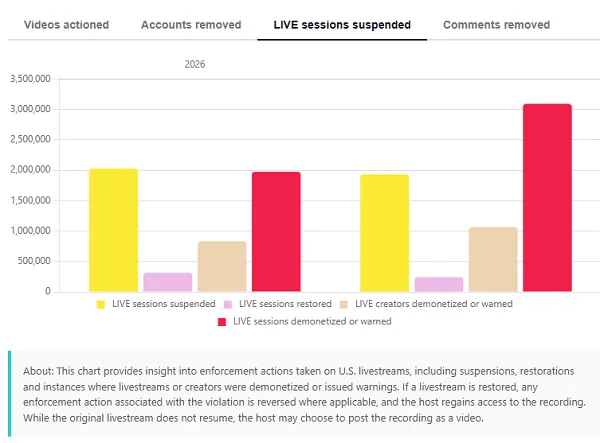
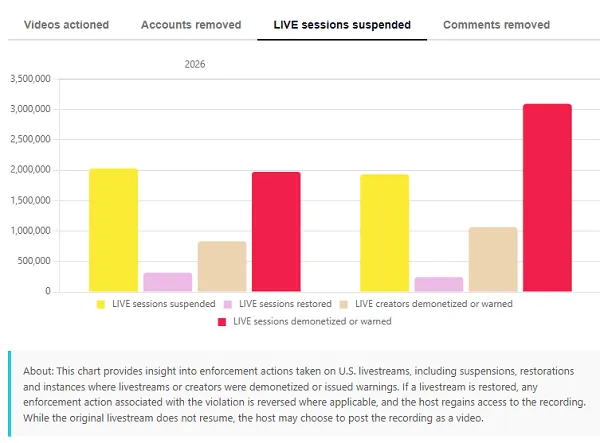
Livestreaming, a rapidly growing monetization and engagement vector on the platform, also faced stringent policing. A rising number of live broadcasts were subjected to punitive measures, categorized primarily as being either "demonetized" or receiving formal "warnings" for infractions committed in real time. These interventions highlight the unique challenges platform operators face in moderating live video feeds, where automated detection must operate instantaneously to halt policy-violating behavior before it reaches wide audiences.
A granular analysis of the content categories driving these removals reveals that the vast majority of infractions stemmed from violations of TikTok’s policies governing regulated goods and services. This expansive policy framework encompasses content depicting or promoting illicit drugs, controlled substances, alcohol, gambling, counterfeit merchandise, and high-risk financial services.
Crucially, this specific enforcement umbrella also targets commercial services that sell artificial engagement—including illegitimate vendors offering fake likes, views, comments, and followers. Because this category covers both dangerous physical goods and digital manipulation markets, it forms one of the broadest and most resource-intensive pillars of TikTok’s moderation strategy.
Following regulated goods and services, the second most frequent catalyst for content removal involved breaches of policies regarding body exposure and sexualized behaviors. The persistence of these violations at scale aligns closely with trends documented in the first-quarter report, demonstrating that human behavioral patterns on the app remain relatively consistent despite heightened moderation efforts.
Disruption of Covert Influence Operations
Beyond standard content moderation and spam containment, TikTok USDS disclosed intensive investigative efforts targeting coordinated, covert influence operations. These sophisticated networks typically attempt to deceive authentic users, obfuscate their true origins, and manipulate public opinion surrounding sociopolitical narratives.
During the second quarter, TikTok’s specialized security investigations disrupted 30 distinct covert influence networks. These operations specifically sought to manipulate engagement patterns and inject partisan or misleading narratives into the American discourse. The disruption campaigns resulted in the decisive removal of more than 76,000 associated accounts and the simultaneous purging of 4.8 million related posts distributed across the platform.
The successful neutralization of these influence networks carries immense strategic significance. The timing coincides with a critical juncture in the American political calendar, as the nation prepares for high-stakes midterm and upcoming electoral cycles where foreign and domestic actors alike are anticipated to aggressively ramp up voter influence campaigns.
Proactive Measures Ahead of U.S. Elections
Recognizing the imminent threats posed by election-related misinformation, deepfakes, and coordinated inauthentic behavior, TikTok has rapidly accelerated its defensive preparations. Earlier this month, the platform outlined a comprehensive suite of initiatives explicitly designed to safeguard the integrity of political discourse on the app.
Central to these preparations is the establishment of a dedicated U.S. Election Mission Control Center. This centralized hub is engineered to function as a high-readiness operational unit tasked with identifying emerging risks in real time, coordinating cross-functional investigations, and rapidly mitigating potential threats as they develop across the digital landscape. By centralizing these intelligence-gathering and response functions under the purview of the U.S.-based team, TikTok aims to demonstrate operational autonomy and responsiveness to domestic regulatory concerns.
Broader Context and Regulatory Scrutiny
The release of these detailed transparency and enforcement reports cannot be separated from the unique geopolitical and corporate history of TikTok’s U.S. presence. The formation of the U.S. management group and the execution of the joint-venture framework were established to satisfy strict national security requirements mandated by the federal government and vetted extensively by the White House.
Given the intense political and public scrutiny surrounding the platform’s ownership structure and data governance protocols, the performance of TikTok USDS is monitored closely by lawmakers, civil rights organizations, and cybersecurity experts. Every metric released in these quarterly reports serves as a vital benchmark for evaluating whether localized management can effectively police a platform utilized by tens of millions of Americans.
As digital threats grow increasingly sophisticated—spanning automated botnets, generative AI-driven content, and state-sponsored influence operations—the burden on platform operators escalates proportionally. The Q2 data released by TikTok USDS illustrates an aggressive posture toward platform hygiene, yet it simultaneously underscores the ceaseless nature of digital moderation. As the platform navigates the approaching electoral season under the watchful eye of U.S. regulators, its newly fortified infrastructure and dedicated oversight mechanisms will face their most definitive test to date.