The Rise of Agentic AI and Programmable Infrastructure: Why APIs Are Replacing Dashboards in Modern Web Development


The rapid evolution of artificial intelligence has shifted the paradigm of web development from human-driven user interface interactions to autonomous agentic workflows. When tasked with provisioning, managing, or scaling a WordPress website, an AI agent’s success is no longer determined by its ability to navigate visual menus, but rather by the underlying programmatic infrastructure available to it. Traditional dashboards, designed fundamentally for human visual consumption, present significant hurdles for autonomous systems. Consequently, modern hosting providers are increasingly evaluated not just on their graphical interfaces, but on the robustness, reliability, and machine-readability of their Application Programming Interfaces (APIs).
The Transition from Visual Dashboards to Programmatic Interfaces
Historically, the architecture of the internet has favored visual mediums. Dashboards rely on user interfaces (UIs) that allow human developers to visually assess layout elements, navigate menus, and click through administrative workflows. However, AI agents lack the capacity to natively interpret visual layouts in a meaningful way. Without structured data, an agent attempting to perform tasks through a standard web dashboard must resort to browser automation tools, such as Playwright or Puppeteer.
These automation frameworks read the Document Object Model (DOM) and parse HTML to locate buttons, forms, and links via scripted instructions. While functional under optimal conditions, browser automation is notoriously brittle. Minor updates to a dashboard’s visual layout, CSS selectors, or DOM structure can immediately break the automation script, leading to failed deployments and operational bottlenecks.
In contrast, interacting with a well-documented API bypasses the fragility of visual interfaces entirely. A standardized request—such as an HTTP POST or GET request—executes identically regardless of how a backend dashboard or frontend presentation layer changes. According to Postman’s 2025 State of the API report, nearly 90 percent of developers integrate generative AI into their daily work processes. Yet, the report highlights a critical industry gap: only a quarter of developers actively design APIs with agentic use cases in mind. This mismatch underscores the growing urgency for hosting providers and software architects to prioritize machine-readable API design.

Security, Reliability, and the Challenges of Agentic Integration
Integrating AI agents into development workflows introduces unique operational and security challenges that differ substantially from traditional human-developer interactions. When a human developer encounters unclear documentation or an undocumented schema change, they possess the cognitive flexibility to research the issue, test hypotheses, or manually circumvent the error.
An AI agent, conversely, operates strictly on the data it parses through the API, often taking inputs and documentation at face value. Undocumented changes or inconsistent endpoints can lead to unpredictable application behavior, silent failures, or corrupted site environments.
Security concerns further compound the complexity of agentic automation. Industry research emphasizes that the rapid adoption of autonomous workflows must be paired with stringent access controls. According to Salt Labs’ 2025 State of API Security report, approximately 95 percent of all API attacks originate from authenticated sources, illustrating that platform reliability is inextricably linked to robust authorization protocols. Similarly, the Open Worldwide Application Security Project (OWASP) highlighted "excessive agency" as a paramount security concern within its GenAI LLM Top 10 framework, warning that granting AI agents unchecked or overly broad permissions poses significant systemic risks.
Comprehensive Programmatic Control Through Hosting APIs
To support scalable agentic workflows, infrastructure providers must expose nearly every facet of their platform programmatically. Platforms like the Kinsta API exemplify this shift by providing developers and AI agents with direct access to core architectural elements, including WordPress site creation, environment management, database access, backup generation, domain configuration, and caching controls.
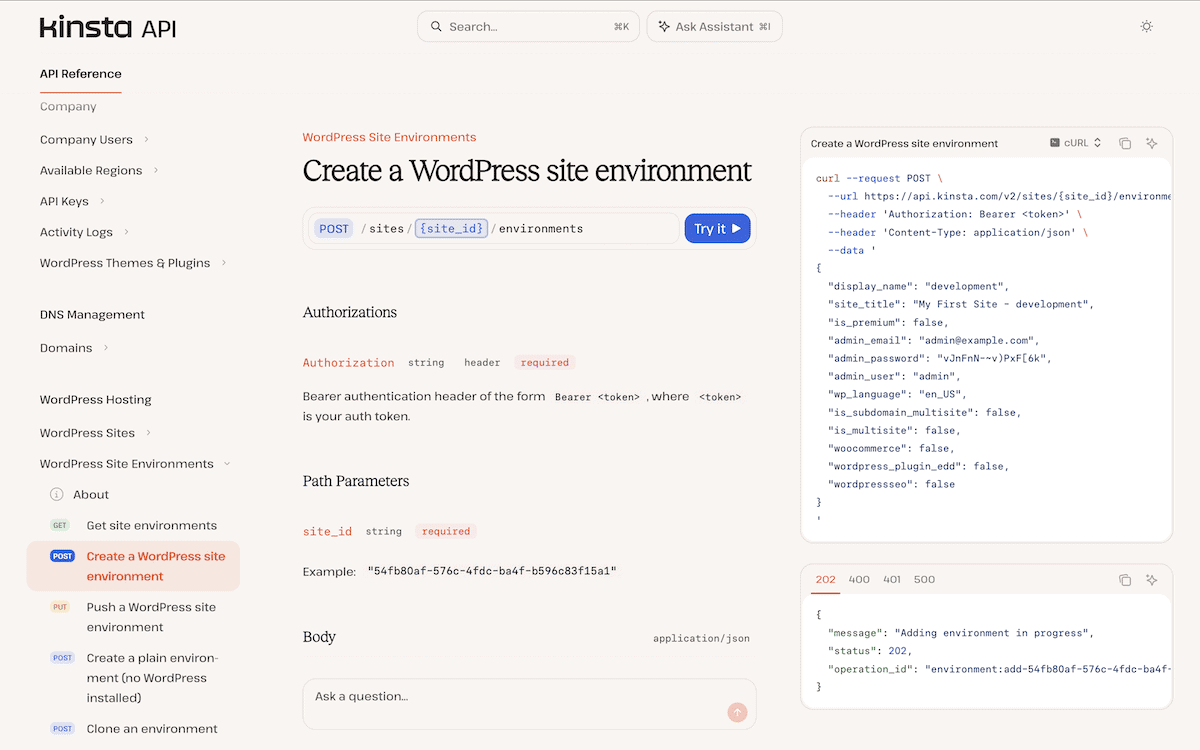
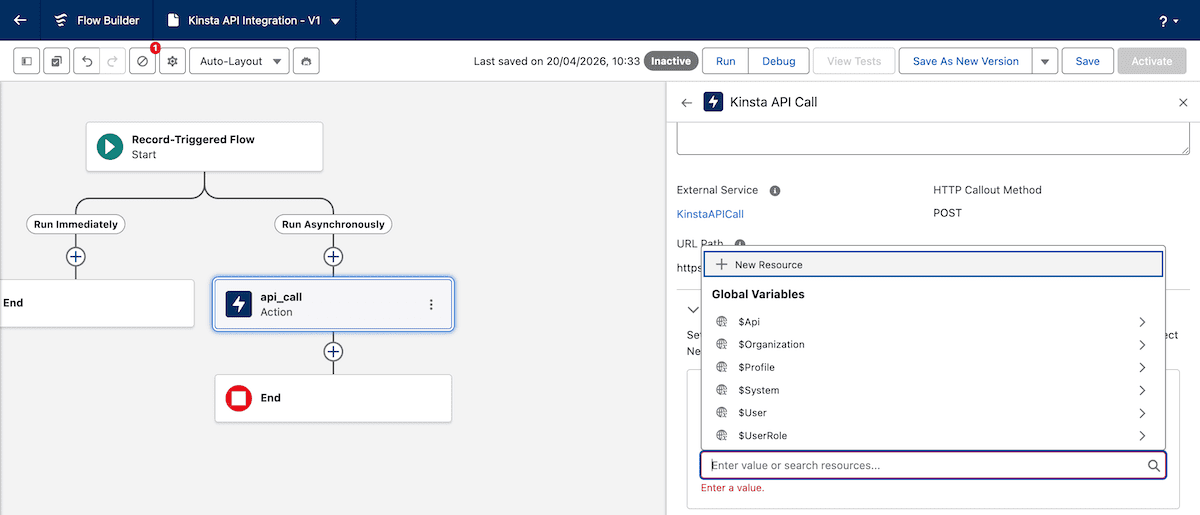
By integrating these endpoints into broader automation pipelines, organizations can eliminate traditional onboarding and deployment bottlenecks. For example, web development agencies frequently link CRM platforms like HubSpot or Salesforce with hosting APIs. When a new client contract is signed or an opportunity status updates in the CRM, an automated workflow can instantly provision a new WordPress environment, execute baseline configurations, and run initial deployment checks without manual intervention.
Advanced monitoring and maintenance represent another major advantage of API-driven infrastructures. Rather than requiring human administrators to continuously monitor performance metrics inside a visual dashboard, automated scripts can periodically query endpoints such as response code analytics. If an anomalous spike in HTTP 500 error codes is detected over a specified timeframe, an automated agent can immediately log an internal ticket, alert an engineering channel via Slack webhooks, or initiate diagnostic routines long before end-users notice a service degradation.
The Integration of the Model Context Protocol (MCP)
As the ecosystem matures, the Model Context Protocol (MCP) has emerged as an open standard for connecting AI models to external data sources and tools. Major industry players have rapidly adopted this standard; WordPress.com, for instance, offers a native MCP server that allows AI agents to interact with accounts without requiring intermediary plugins.
Furthermore, community-driven development has expanded these capabilities to specialized hosting environments. Open-source implementations, such as community-built Kinsta MCP servers, encapsulate dozens of distinct tools covering authentication, PHP allocation, plugin and theme lifecycle management, and security configurations like IP blocklists.
Ultimately, the effectiveness of an MCP server depends entirely on the underlying quality, clarity, and depth of the target platform’s API documentation. As artificial intelligence continues to reshape software engineering, platforms that provide comprehensive, programmable infrastructure will offer distinct competitive advantages to development teams and agencies.
Implications for the Future of Web Development
While dashboards will remain essential for human oversight, strategic planning, and client communications, repetitive operational tasks are decisively moving toward API-driven automation. The future belongs to organizations that treat the API as the primary product interface, reserving graphical dashboards for presentation and high-level management.
For developers and enterprises evaluating infrastructure partners, assessing API maturity is no longer a secondary consideration. Ensuring that a hosting platform provides complete programmatic control, secure authentication controls, and machine-readable documentation—such as dedicated llms.txt files—will determine whether development teams can successfully scale their operations alongside the rapid advancements of agentic artificial intelligence.
Related posts: