Major U.S. Financial Institutions Face Online Banking Disruptions Linked to JPMorgan Chase Software Bug

The reliability of digital infrastructure underpinning the United States financial sector faced renewed scrutiny on Monday afternoon as major banking institutions experienced widespread online service disruptions and transaction delays. The technical difficulties, which began shortly after noon Eastern Time, primarily affected JPMorgan Chase, while sending cascading ripples of transaction slowdowns across other prominent financial platforms including Bank of America, Wells Fargo, Capital One, and U.S. Bank.
According to official statements released by JPMorganChase and data monitored by outage-tracking platforms, the core issue originated from a localized software malfunction within on-premise hardware systems. Although the sudden surge in error reports prompted widespread public concern regarding the security of online banking assets, industry spokespeople and corporate representatives swiftly clarified that the event was neither a systemic financial failure nor the result of a malicious cyberattack.
The incident highlights the growing operational vulnerabilities inherent in hyper-connected digital banking ecosystems, where a software glitch at a single foundational institution can project secondary delays across the entire national payment and transfer network.
Chronology of the Outage and Initial Detection
The digital disruption materialized abruptly during the early afternoon hours of Monday, November 16. Around 12:00 p.m. ET, monitoring platforms such as DownDetector—which aggregates user-submitted error reports and service complaints—began registering a sharp, anomalous uptick in connectivity issues associated with major consumer banks.
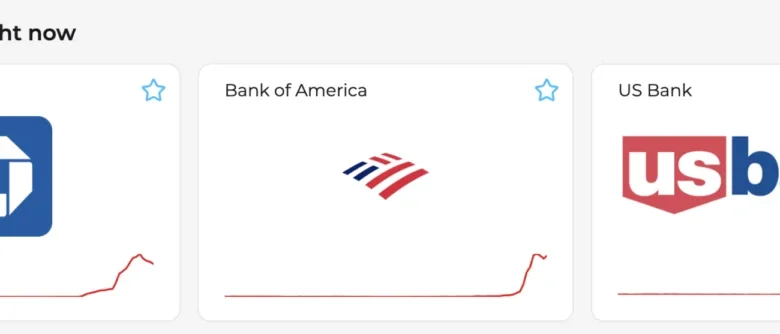
By 2:00 p.m. ET, the volume of complaints aimed at Chase Bank had escalated dramatically, recording a peak of more than 4,800 individual user error reports over a compressed 24-hour window. Concurrently, auxiliary spikes in reported disruptions appeared for accounts held with Bank of America, Wells Fargo, U.S. Bank, and Capital One.
As digital banking dashboards froze, mobile applications failed to load balances, and customers reported difficulties processing routine digital transactions, public anxiety mounted. The timing of the incident compounded public unease, arriving on the heels of a turbulent week for digital infrastructure that had already seen high-profile technological outages, including significant two-day disruptions to Microsoft’s Outlook services and a nationwide Federal Aviation Administration (FAA) ground stop prompted by telecommunications data glitches.
By late afternoon, however, corporate communications teams began providing granular clarity regarding the nature and scope of the technical failure.
Official Corporate Responses and Technical Clarifications
In an official statement published to social media platform X, JPMorganChase confirmed that its engineering teams were actively responding to a localized technical emergency.
"JPMorganChase is experiencing a temporary issue related to a software bug in on-premise hardware systems," the bank stated. Corporate representatives emphasized a critical point of reassurance for millions of retail account holders: customers retained full access to their accounts and underlying funds throughout the duration of the outage. The bank further projected that full service restoration would be achieved before the conclusion of the business day.
Addressing the broader panic surrounding multi-bank error reports, a JPMorganChase spokesperson clarified the distinction between a localized technical fault and a systemic sector failure. In a statement provided to media outlets, the spokesperson asserted, "This is not a systemic issue — other banks may have been impacted by slowness in transactions only to the extent that they were a party to a transaction with us."
This clarification proved vital in contextualizing the concurrent spikes observed on DownDetector for rival institutions. Cybersecurity and IT experts note that outage-tracking services frequently display elevated error metrics for completely healthy platforms when a major interconnected node encounters difficulties. For instance, if a customer attempts to transfer funds from an external bank account to a Chase account, and the transaction stalls due to Chase’s internal hardware bug, the user may log an error report against their own bank rather than the receiving institution.

The Ripple Effect on Third-Party Payment Networks
The interconnected nature of modern financial technology came under intense scrutiny regarding peer-to-peer payment networks, particularly Zelle. Because Zelle acts as an integrated transfer mechanism utilized by numerous participating banks and credit unions, transaction processing relies heavily on the operational health of the participating financial institutions rather than a standalone Zelle ledger.
U.S. Bank officials confirmed this dynamic in communications with the press. While DownDetector registered elevated error reports from U.S. Bank customers during the height of the Monday afternoon incident, a bank spokesperson explicitly clarified that U.S. Bank’s proprietary systems had not suffered a direct technical failure. Instead, the slowdowns were strictly environmental; clients attempting to send or receive Zelle payments involving external financial institutions—specifically those experiencing internal hardware bugs—encountered unavoidable transaction delays.
Zelle corroborated this assessment in a subsequent statement to reporters, reaffirming that its core infrastructure was operating normally throughout the event.
"Zelle is not down. Zelle is operating as it should," a Zelle spokesperson stated. "Consumers use Zelle through participating banks and credit unions, which manage their accounts and hold their funds. Consumers do not have a separate Zelle account, and Zelle does not hold consumer funds. An issue at the financial institutions may be impacting broader services, including Zelle payments, for some of their customers."
Nature of the Disruption: Access Versus Transaction Processing
A critical distinction emerged as journalists and financial analysts evaluated the operational impact of Monday’s incident: the event was characterized entirely by interface sluggishness, delayed transfer processing, and temporary in-person transaction hurdles, rather than a catastrophic loss of data or asset forfeiture.
At no point during the multi-hour disruption were consumer deposits compromised, nor did reports emerge indicating that account holders were permanently locked out of their capital. Retail and commercial customers retained visibility over their ledger balances, albeit through delayed or intermittently refreshing application interfaces. The primary friction points were concentrated in real-time clearing house communications, automated clearing house (ACH) transfer confirmations, and peer-to-peer digital settlements that required handshake protocols with JPMorganChase’s affected hardware architecture.
Broader Implications for Financial Technology Infrastructure
Monday’s outage serves as a stark reminder of the fragile dependencies underpinning the contemporary digital economy. As legacy financial institutions increasingly migrate toward hybrid architectures—combining cloud-based microservices with legacy on-premise hardware systems—the complexity of maintenance and software deployment escalates exponentially.
While cloud computing has introduced unprecedented scalability, large financial institutions continue to rely heavily on robust, on-premise physical hardware to anchor high-security databases and core ledger operations. A single undetected software bug introduced during a routine patch or system update on these foundational hardware tiers can produce cascading operational failures that mimic the symptoms of a distributed denial-of-service (DDoS) attack or an aggressive cyber intrusion.
Furthermore, the incident underscores the psychological sensitivity of the modern banking consumer. In an era where physical bank branches are utilized with diminishing frequency and daily financial life is mediated almost entirely through glass smartphone screens, even minor, temporary latency in application response times can trigger acute public anxiety. The swift proliferation of crowd-sourced error reporting platforms like DownDetector, while invaluable for real-time fault identification, often amplifies public panic by conflating localized software bugs with widespread systemic collapses.
Industry analysts anticipate that Monday’s event will prompt renewed internal reviews across major U.S. financial institutions regarding software testing protocols, deployment staging, and redundant hardware fail-safes. As financial infrastructure grows increasingly dense and interdependent, the imperative for airtight software quality assurance becomes not merely a matter of customer convenience, but a vital pillar of national economic stability.
JPMorganChase’s rapid containment of the software bug and its transparent, real-time communications via digital channels successfully mitigated long-term reputational damage and prevented a run on digital assets. Nevertheless, the episode remains a cautionary tale for a sector racing to digitize faster than its underlying infrastructure can reliably support.