Snap Inc. Q3 2026 Earnings Report Shows Stalled User Growth, Revenue Gains, and Mounting Challenges


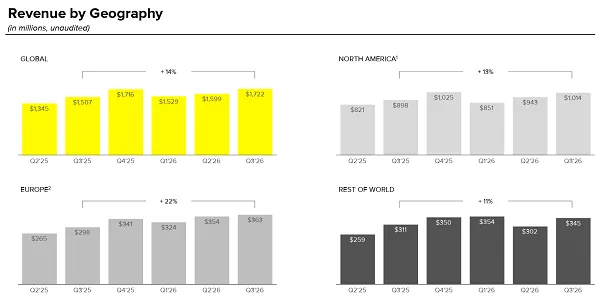
Snap Inc. released its financial results for the third quarter of 2026 on Wednesday, highlighting a complex financial and operational landscape characterized by stagnant user acquisition in core Western markets, robust year-over-year revenue expansion, and an aggressive push into artificial intelligence and augmented reality hardware. While the parent company of Snapchat managed to grow its top-line revenue by 14% compared to the same period last year, reaching $1.72 billion, fundamental questions regarding user saturation and regulatory headwinds continue to shadow the platform’s long-term trajectory.
Main Facts and Financial Performance
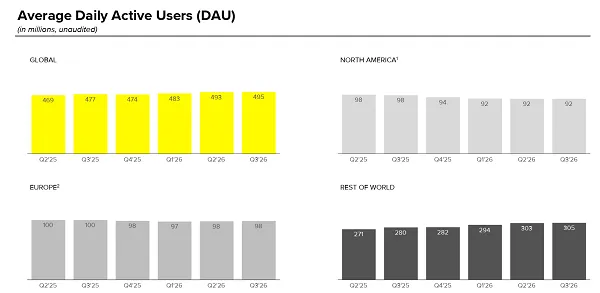
The Q3 2026 financial report underscores a persistent trend in the social media sector: mature platforms are finding it increasingly difficult to attract net-new users in Western industrialized nations. Snapchat reported a global total of 495 million daily active users (DAUs) for the third quarter, representing a modest increase of just 2 million users from the 493 million reported in the second quarter.
Despite the sluggish user growth, financial metrics pointed to healthy monetization efficiency. Total revenue rose to $1.72 billion, fueled by gains across key international territories. Regionally, North American revenue increased by 13% year over year to reach $1.01 billion. Europe exhibited the strongest regional growth rate, climbing 22% to $363 million, while the Rest of World segment grew 11% to $345 million.
Beneath these top-line figures, however, lies a stark structural disparity. Snapchat’s user growth during the quarter came exclusively from the Rest of World segment, as user counts in both North America and Europe remained entirely flat. This geographic imbalance creates a strategic paradox for the company. Snapchat generates the vast majority of its income in North America, where its average revenue per user (ARPU) reached $11.07 in Q3, up from $10.26 in Q2. By contrast, ARPU in the Rest of World segment languished at a mere $1.13. Consequently, the platform is expanding its user base almost entirely in regions that yield significantly lower advertising returns.

Chronology and Recent Regulatory Pressures
The hurdles facing Snap Inc. are not solely economic; regulatory frameworks targeting youth engagement have begun to materialize across multiple international jurisdictions. The timeline of youth-focused digital restrictions has accelerated significantly over the past two years, introducing operational compliance costs for social media operators.
In December 2025, Australia implemented formal social media usage restrictions prohibiting children under the age of 16 from accessing major social networks. In the wake of this legislation, Snap Inc. reported that it had locked or disabled more than 415,000 user accounts in Australia. These actions were taken based on direct age declarations or algorithmic detections by the platform’s age-verification technology. Given that Snap disclosed an Australian user base exceeding 8 million in August 2023, the enforcement of the ban appears to have immediately excised approximately 5% of the platform’s total footprint in that specific country.
The Australian mandate serves as a precursor to similar legislative proposals currently being debated or drafted in various other Western markets. Pew Research data published in late 2025 indicated that approximately 55% of U.S. teenagers aged 13 to 17 actively use Snapchat, cementing its position as the fourth most popular platform among American youth behind YouTube, TikTok, and Instagram. The prospect of expanded domestic and international teen social media bans presents a direct threat to Snapchat’s foundational demographic, potentially accelerating user attrition and diminishing its value as a vital communication conduit for younger generations.
Supporting Data and Ecosystem Metrics
To counter user stagnation, management has focused on deepening engagement among existing users and diversifying revenue streams beyond traditional display advertising. In his prepared remarks accompanying the earnings release, Snap CEO Evan Spiegel emphasized positive internal engagement metrics for the third quarter.
Average daily messages sent within the application increased by 8% year over year, while the volume of individuals engaging in two-way communication rose 6% compared to the same period in 2025. Furthermore, the short-form video discovery engine, Spotlight, demonstrated considerable momentum. Daily active viewers on Spotlight surged by 40% year over year, while the total volume of content posted to the feature increased by 130%.
Subscription offerings and premium services also provided a notable financial cushion. Snap reported that its "Other Revenue" category jumped 84% year over year, spearheaded by commercial adoption of Snapchat+, Memories Storage, and Lens+. Across these three subscription and premium options, Snap officially surpassed 30 million active subscribers during the third quarter.
Official Responses and Strategic Initiatives
Snap executives have leaned heavily into technological innovation—specifically artificial intelligence and augmented reality—to justify ongoing capital expenditures and reassure investors. CEO Evan Spiegel highlighted that artificial intelligence has evolved into a pivotal operational advantage, streamlining internal team workflows and optimizing the efficacy of the company’s automated advertising platform.
In tandem with technological upgrades, Snap has broadened its commercial outreach. The company has rolled out improved creator partnership structures and initiated strategic B2B advertising pitches aimed at diversifying its client portfolio away from direct-to-consumer brands.
Hardware development remains a high-stakes, long-term bet for the enterprise. In September, Snap formally launched its latest iteration of augmented reality hardware, colloquially referred to as AR Specs. Priced at $2,200, the advanced spectacles became available for pre-order in the United States, France, and the United Kingdom. Designed to foster advanced digital connection through immersive wearable visual overlays, the product represents a visionary pivot for a company historically reliant on software-driven mobile interfaces.
Despite the heavy strategic emphasis on AR Specs, initial financial disclosures suggest that hardware sales have not yet contributed meaningfully to the company’s bottom line. In their formal statements, neither Spiegel nor CFO Doug Hott disclosed specific pre-order volumes or revenue contributions associated with the glasses. Analysts infer from this omission that hardware revenues remain negligible relative to core advertising and subscription streams, leaving the immediate commercial viability of the $2,200 device an open question.
Broader Impact and Industry Implications
The Q3 2026 earnings report encapsulates the precarious transition facing mid-tier social media giants as they navigate a mature digital advertising market. Snap Inc. has demonstrated commendable fiscal discipline and operational resilience by successfully expanding its revenue per user in key territories despite flat user acquisition. The impressive 14% year-over-year revenue climb to $1.72 billion proves that the platform retains strong utility for advertisers willing to allocate budgets toward targeted visual campaigns.
However, the structural vulnerabilities cannot be easily dismissed. The heavy reliance on North American monetization to subsidize non-paying or lower-yielding international users creates a narrow margin for error. Should legislative bodies in the United States or Europe enact sweeping age-verification mandates or youth access restrictions akin to Australia’s model, Snap’s core demographic could face systemic disruption.
Moreover, the company’s ambitious hardware strategy requires substantial capital investment with highly uncertain returns. Without transparent metrics regarding consumer adoption of AR Specs, investors are forced to weigh proven software subscription growth—now exceeding 30 million users—against speculative hardware plays in an unproven consumer market.
Ultimately, Snap Inc. enters the final quarters of 2026 as a company successfully extracting greater value from its existing digital footprint, yet confronted by systemic headwinds that will test its capacity for reinvention in an increasingly regulated global digital ecosystem.