Beyond the Endless Scroll: Reimagining Content Aggregation Through Hybrid WordPress and Edge Computing Architectures

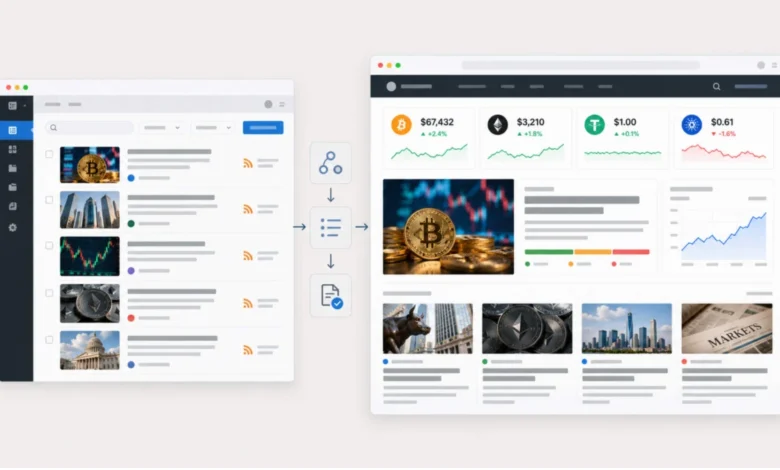
The modern digital landscape is saturated with news aggregators that rely on outdated, linear feed-based architectures. By leveraging a hybrid approach that combines the robust content management capabilities of WordPress with the high-performance execution of edge computing, developers can transform static link-farms into intelligent, curated briefing platforms. This architectural shift, exemplified by the redevelopment of the crypto-focused portal CryptoHeadlines, addresses the growing problem of "thin content" that frequently fails to rank in search engine results or provide genuine value to time-strapped readers.
The Limitations of Traditional RSS Aggregation
For over a decade, the standard model for a WordPress news aggregator has remained static: a theme, a feed importer plugin, and a chronological list of headlines. While this model is accessible, it suffers from severe structural flaws. Search engines, particularly Google, increasingly prioritize "helpful content" that demonstrates expertise, experience, authoritativeness, and trustworthiness (E-E-A-T). A site that merely regurgitates headlines without adding synthesis or context is often flagged as thin content, leading to poor visibility and low user engagement.
The primary failure point of traditional aggregators is their reliance on chronological sorting. When an industry-wide event occurs—such as a major regulatory shift or a sudden market correction—multiple outlets will produce dozens of headlines. A standard RSS feed treats each article as a discrete, equal entity, burying the actual narrative in a long, repetitive scroll. This approach forces the reader to act as the editor, manually cross-referencing multiple sources to understand the "what" and the "why" behind a story.
A New Paradigm: WordPress as the Data Backend
The solution is not to abandon WordPress, but to relegate it to its area of greatest strength: backend data management. WordPress excels at the tedious, complex tasks of fetching, parsing, deduplicating, and storing content. By utilizing plugins such as WP RSS Aggregator Pro, developers can maintain a clean, organized database of sources without writing custom scraping logic.
This administrative layer serves as the "source of truth." It allows non-technical team members to manage feed sources, update URLs, and resolve import errors via a user-friendly interface. By offloading the "boring" heavy lifting—such as handling malformed XML or managing source-specific edge cases—to the mature WordPress ecosystem, developers can focus their technical efforts on the user experience layer.

The Edge Architecture: Intelligence at the Perimeter
The transition from a standard blog to a curated news briefing is achieved by introducing an "edge app"—in this case, Cloudflare Workers. In this architecture, the WordPress site acts as a headless content store, while the edge worker acts as the intelligent interface that serves the end user.
This approach offers several technical advantages:
- Performance: By serving the site from the edge, content is delivered with minimal latency to users globally.
- Dynamic Curation: Instead of serving a static post loop, the worker retrieves the latest raw data from the WordPress database and performs real-time operations, including clustering headlines, ranking stories by relevance, and generating concise summaries.
- Resource Efficiency: Heavy tasks, such as AI-driven sentiment analysis and summarization, are executed on a schedule, ensuring the homepage remains lightning-fast for the reader.
Chronology and Logic: Building the Briefing
The process of transforming raw feeds into a professional briefing follows a strict, automated pipeline. First, the WordPress backend polls various RSS sources. Once the data is ingested, the edge worker initiates the "clustering" phase. Using Natural Language Processing (NLP) models, the system identifies headlines that refer to the same event.
Ranking is determined by a dual-signal methodology: frequency and recency. A story that is being covered by ten different outlets is automatically prioritized over a story covered by only one, even if the latter was published more recently. This ensures that the most impactful news remains at the top of the page. Once ranked, the stories are categorized into thematic buckets—such as markets, regulatory updates, or specific asset classes—using large language models (LLMs) like Llama 3.3.
Integrating AI with Strict Guardrails
The integration of Artificial Intelligence in news aggregation presents significant risks, primarily regarding accuracy and hallucination. To mitigate these risks, developers must implement a multi-layered validation strategy. In the case of the CryptoHeadlines model, the AI does not have free rein; it operates under a "guardrail" system.
When the system generates a market summary, it is subjected to a secondary verification process. If the output fails to adhere to specific constraints—such as including unverifiable claims or lacking citations—the system triggers an automated rewrite. If the model fails a second time, the system defaults to the previous, verified commentary rather than displaying potentially inaccurate information. This "fail-safe" ensures that the platform maintains credibility, a necessity in volatile sectors like financial technology and cryptocurrency.

Data-Driven Design and User Experience
The user experience is centered around a single, fundamental question: "How is the market doing, and why?" By moving away from the "infinite scroll" of headlines, the site provides a snapshot that can be digested in roughly five minutes.
Key design elements include:
- The Homepage Headline: A dynamically generated, data-driven summary that states, for example, "Crypto is down 0.7% in the last 24 hours," providing immediate context upon arrival.
- Sentiment Indicators: The "News Mood" bar measures the balance of bullish, bearish, and neutral coverage. By weighting this bar based on the volume of coverage from multiple sources, the platform provides a nuanced look at industry sentiment that is distinct from raw price movement.
- Localized Temporal Awareness: The site calculates time based on the user’s location, ensuring that "today" is accurately represented for readers in different time zones.
Broader Implications for Digital Publishing
The success of this hybrid model suggests a shifting landscape for independent publishers. For years, the industry debated whether to move to "headless" architectures, often finding that the complexity of managing a custom frontend outweighed the benefits. However, by combining the maturity of WordPress with the simplicity and power of modern serverless edge functions, publishers can achieve the best of both worlds.
This approach is highly replicable across numerous niches. Whether tracking local government news, specialized research, or industry-specific deals, the recipe remains consistent:
- Use WordPress for reliable, scalable feed ingestion.
- Utilize an edge worker to handle data transformation, ranking, and AI-driven analysis.
- Design for a specific user question rather than a general category.
Conclusion: The Future of News Aggregation
As the digital noise floor continues to rise, the value of curation will only increase. Readers are becoming less interested in the volume of information and more interested in the synthesis of it. The hybrid architecture described here offers a pathway for independent news outlets to compete with larger media entities by providing higher-quality, more readable, and better-structured content.
By focusing on the "briefing" rather than the "feed," developers can create sustainable, valuable platforms that provide genuine utility. The goal is to move past the era of the endless scroll and into an era of intelligent, automated, and highly relevant news delivery. As AI continues to evolve, the ability to enforce strict guardrails while leveraging the speed of edge computing will define the next generation of successful digital news products. Future iterations of these platforms will likely incorporate even deeper integrations of real-time financial APIs and personalized user data, further blurring the line between a traditional news site and a real-time financial terminal.