The Model Context Protocol Revolution: How Decentralized Integration is Transforming Creator Workflows


The Model Context Protocol (MCP), an open standard introduced to bridge the gap between Large Language Models (LLMs) and external data sources, has rapidly evolved from a niche developer interest into a foundational architecture for content creators and knowledge workers. By allowing AI assistants like Claude, ChatGPT, and others to communicate directly with third-party software, the MCP framework effectively eliminates the friction of "context switching"—the cognitive and temporal cost associated with toggling between multiple applications. For the modern creator, this represents a shift from a fragmented, tab-heavy environment to a unified "hub-and-spoke" ecosystem where an AI agent acts as a central operating system for productivity.
The emergence of the MCP coincides with a broader industry trend toward AI-driven automation that does not require traditional coding knowledge. As of mid-2026, the adoption of official MCP servers by major platforms—including Buffer, Notion, Canva, and Descript—signals that enterprise software companies are prioritizing interoperability as a primary feature. This transition mirrors the evolution of the software-as-a-service (SaaS) industry over the last decade, shifting from isolated "walled gardens" toward an open, interconnected web of utility.
A Chronology of Integration: The Move Toward Unified Workspaces
The history of creator workflows has long been characterized by fragmentation. In the early 2020s, creators relied on disconnected tools: Notes apps for brainstorming, cloud storage for research, design software for production, and scheduling tools for distribution. The inefficiency of this model became increasingly apparent as the volume of content required for audience retention grew exponentially.
In early 2025, the Model Context Protocol was introduced by Anthropic as an open-source standard designed to solve the "last mile" problem of LLM utility. By mid-2025, early adopters began experimenting with custom-built MCP servers, but the barrier to entry remained high, requiring users to possess technical knowledge of command-line interfaces. By the first quarter of 2026, the landscape shifted as major platforms began releasing "official" MCP integrations. These versions utilized OAuth, a secure authorization standard that allows users to connect their accounts without exposing sensitive credentials, effectively democratizing the technology. By May 2026, when Descript launched its MCP integration, the standard had achieved enough critical mass to be considered a viable, professional-grade workflow for high-output creators.
The Ecosystem Architecture: A Hub-and-Spoke Model
The effectiveness of an MCP-based workflow lies in the distinction between "Capture" and "Create" tasks. In this model, the AI assistant—typically a high-performance LLM like Claude—functions as the central hub.
- The Capture Layer: This involves the ingestion of raw data. Tools like Buffer (for social ideas), Notion (for deep research storage), and Granola (for call transcripts) act as feeders. By using natural language commands, a user can direct the AI to "save this thought to my Buffer ideas board" or "extract key insights from my latest Zoom transcript."
- The Create Layer: This involves the transformation of captured data into tangible assets. This stage utilizes integrations such as Canva, for visual asset creation, and Descript, for video editing. The AI acts as the project manager, initiating the workflow in the corresponding software, thereby allowing the user to bypass manual menu navigation.
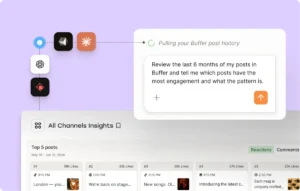
- The Analytical Loop: Finally, the integration of performance data, such as Buffer’s analytics suite, allows the creator to complete the feedback loop. By querying the AI regarding the performance of past content, the creator gains data-driven insights that inform the next cycle of the Capture and Create phases.
Quantitative Benefits and Productivity Metrics
While anecdotal evidence from creators highlights significant time savings, the objective benefit of MCP integration is best measured in the reduction of "context switching." Research from the American Psychological Association (APA) has previously noted that shifting between tasks can cost as much as 40% of an individual’s productive time. In a professional creator workflow, where a single post may require navigation between a research database, a design suite, and a scheduling platform, the potential for lost productivity is substantial.

Current data suggests that the implementation of an MCP-enabled stack can reduce the time spent on manual administrative tasks by 30 to 50 percent. For instance, the ability to pull engagement analytics directly from a scheduling platform like Buffer through an AI interface allows for immediate performance assessments, replacing the need for manual CSV exports or dashboard-hopping. Furthermore, the use of specialized research tools like Elicit—which connects to academic databases—allows creators to verify claims against peer-reviewed literature in seconds, a process that historically took hours of manual searching.
Security and Ethical Considerations
The rapid adoption of MCPs has necessitated a renewed focus on data privacy. The industry standard has converged on two primary security protocols: the use of official servers and the implementation of OAuth.
Security analysts emphasize that users should avoid unofficial, community-developed servers that lack transparent data handling policies. Official integrations, such as those provided by Notion or Google Workspace, ensure that data remains encrypted during transit and that the user retains control over access permissions. OAuth is critical in this context because it allows the user to revoke an AI’s access to their data at any time through the primary application’s security settings, preventing the permanent leakage of private information into an LLM’s training or context window.
Broader Implications for the Creator Economy
The rise of the MCP signals a paradigm shift in the creator economy: the move from "creator as operator" to "creator as architect." In the previous era, the value of a creator was tied to their ability to master the interface of various complex tools. In the MCP-enabled era, the value shifts toward the ability to orchestrate these tools using natural language and strategic oversight.
Industry experts note that this transformation has several long-term implications:
- Lowering the Barrier to Entry: Complex workflows that previously required a production team can now be managed by a single individual, provided they understand how to structure their digital environment.
- Increased Content Velocity: With the friction of moving ideas between apps removed, creators can iterate on concepts much faster, leading to higher-quality output and more frequent engagement with audiences.
- Data-Driven Content Strategy: The ability to query an AI about cross-platform performance, research backing, and historical notes ensures that content is no longer produced in a vacuum but is instead informed by a holistic view of the creator’s digital history.
Conclusion: Future Outlook
As the Model Context Protocol matures, the next frontier will likely involve deeper integration into high-fidelity creative tasks. Future updates are expected to enable more granular control over design transitions in Canva, advanced audio engineering within Descript, and automated synchronization between disparate research databases.
For the average creator, the advice remains consistent: start small. By integrating one primary "Capture" tool—such as a note-taking app or a scheduling platform—users can begin to experience the efficiency gains of a unified system. As the ecosystem expands, the role of the creator will continue to evolve, with the AI assistant serving not as a replacement for human creativity, but as the essential infrastructure upon which that creativity is built. The transition to an MCP-first workflow is not merely a technical upgrade; it is a fundamental reconfiguration of the creative process designed for an era of information abundance.