The Lifecycle of Model Decay
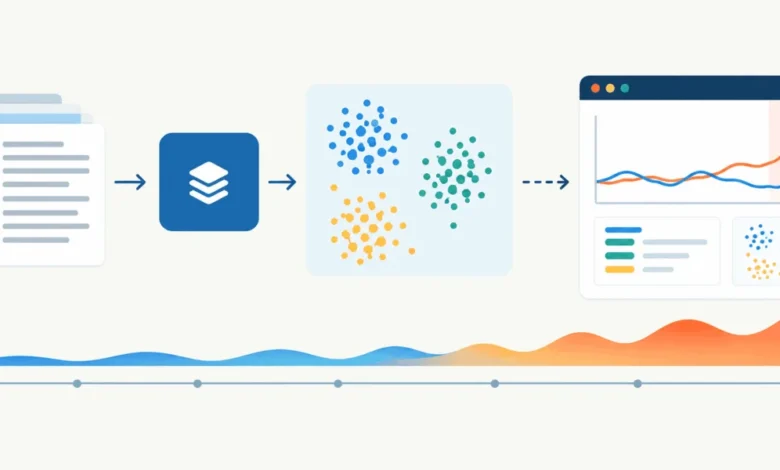
In the lifecycle of a production machine learning system, the period immediately following deployment is often characterized by stability. However, as real-world interactions accumulate, the input data—often comprised of user queries, support tickets, or transactional metadata—begins to deviate from the baseline training distribution. This is not necessarily a failure of the model but a reflection of the "data-centric" reality of AI. New topics emerge, industry jargon shifts, and user intent patterns change, effectively moving the data points in the vector space away from the clusters the model was optimized to interpret.
The challenge lies in the nature of these embeddings. Because they are high-dimensional—typically 384, 768, or even 1,536 dimensions—traditional statistical drift detectors used for tabular data, such as the Kolmogorov-Smirnov test, are often ineffective or computationally prohibitive. Detecting this drift requires specialized approaches that respect the geometry of the embedding space while remaining sensitive enough to trigger alerts before the model’s performance drops below acceptable thresholds.
Chronology of Data Drift Detection
The evolution of drift detection has transitioned from simple statistical monitoring to sophisticated model-based approaches. In the early stages of machine learning maturity, developers relied on basic distribution checks of individual features. As we shifted toward deep learning and LLMs, this proved insufficient because individual dimensions of an embedding rarely hold independent semantic meaning; rather, the "meaning" is distributed across the entire vector.
- Phase 1: Statistical Thresholding (Pre-2020): Focused on monitoring mean and variance of specific input variables.
- Phase 2: Dimensionality Reduction (2020–2022): Using techniques like Principal Component Analysis (PCA) or t-SNE to project embeddings into 2D or 3D space to visually identify clusters, which, while intuitive, is difficult to automate in production pipelines.
- Phase 3: Domain Classifier and Centroid Analysis (2023–Present): The current industry standard, which utilizes auxiliary models or distance metrics to quantify the displacement of new data relative to a gold-standard baseline.
Implementing Proactive Drift Detection
To effectively manage this, engineers are increasingly turning to the "Domain Classifier" method. In this approach, a lightweight, fast-to-train model—such as a Random Forest or a Logistic Regression—is tasked with a binary classification problem: distinguish between "Reference" data (the original training/validation set) and "Production" data (live traffic).
If the classifier can easily distinguish between the two datasets, it is a clear indicator that the distribution of production data has drifted. If the classifier yields a high Receiver Operating Characteristic Area Under the Curve (ROC-AUC) score, it serves as an early warning system. An AUC of 0.5 implies the model cannot distinguish between the two datasets, suggesting the system is stable. Conversely, an AUC approaching 1.0 indicates a significant, measurable shift in the nature of the data being processed.
The Centroid Distance Approach
A more computationally efficient, albeit less nuanced, technique is the calculation of the "center of mass" or centroid. By averaging the vectors in the baseline set and the production set, one can calculate the cosine distance between these two points. A large distance indicates that the mean "semantic position" of user queries has moved.
While this method is faster than training a classifier, it carries inherent risks. Specifically, it can mask "multi-modal" drift. For example, if users start asking questions about two completely different topics, the centroid might remain relatively stable while the actual distribution of data has widened significantly. Despite this, for many real-time monitoring dashboards, the centroid method provides a low-latency "canary" alert that can trigger more deep-dive investigations.
Technical Synthesis: Scikit-LLM and Modern Pipelines
Integrating these techniques into a Python-based pipeline is facilitated by libraries like Scikit-LLM, which abstracts the complexities of interfacing with LLM APIs for embedding generation. By combining Scikit-LLM with standard scikit-learn components, developers can create a closed-loop monitoring system.
In a production scenario, the workflow generally follows this pattern:
- Baseline Storage: Securely store embeddings from the initial deployment phase in a vector database.
- Batching: Aggregate recent production queries into batches.
- Embedding Generation: Use an embedding model (e.g.,
all-MiniLM-L6-v2) to convert new, raw text into vectors. - Comparison: Run the domain classifier or calculate the cosine distance between the current batch and the baseline.
- Action: If the drift metric exceeds a pre-defined threshold, the system triggers an alert to the data science team, signaling that it may be time to update the system prompts, add new documents to the RAG (Retrieval-Augmented Generation) pipeline, or fine-tune the model.
Implications for Business Reliability
The failure to detect embedding drift has profound implications for enterprises. For a customer service bot, drift might manifest as an inability to answer questions regarding a new product launch, leading to higher deflection rates and frustrated users. In financial services, it could result in the misclassification of documents or fraudulent activity, as the model no longer recognizes the patterns it was trained to identify.
Furthermore, as organizations scale, the "human in the loop" approach to monitoring becomes unsustainable. Automated drift detection is not merely a technical convenience; it is a prerequisite for maintaining trust. When a model’s environment changes, the model must be treated as a dynamic entity that requires regular calibration.
Official Industry Stance and Best Practices
Industry leaders in AI infrastructure suggest that drift detection should be treated as part of the "Observability" pillar of MLOps. Experts argue that companies should not wait for accuracy to drop to implement these checks. Instead, they recommend:
- Versioning: Always keep a versioned copy of the baseline embeddings used at the time of model deployment.
- Sensitivity Tuning: Thresholds for alerts should be determined empirically. A threshold that is too sensitive will lead to "alert fatigue," while one that is too loose will allow performance degradation to go unnoticed.
- Contextual Evaluation: Embeddings should be monitored in context. If a drift is detected, the first step should be to inspect the text samples driving that drift. Often, this reveals that the drift is caused by a benign event, such as a holiday period or a temporary spike in specific, non-critical queries.
Conclusion
As large language models continue to integrate into the backbone of corporate infrastructure, the ability to monitor the integrity of the data they consume is becoming as important as the model architecture itself. Embedding drift is an inevitable consequence of real-world deployment, but it is not unmanageable. Through the use of domain classifiers, centroid analysis, and robust MLOps pipelines, developers can transition from reactive troubleshooting to proactive model governance, ensuring that their systems remain accurate, relevant, and reliable in an ever-changing digital landscape. By adopting these standard practices, teams can effectively bridge the gap between initial development and long-term production success.
Related posts: