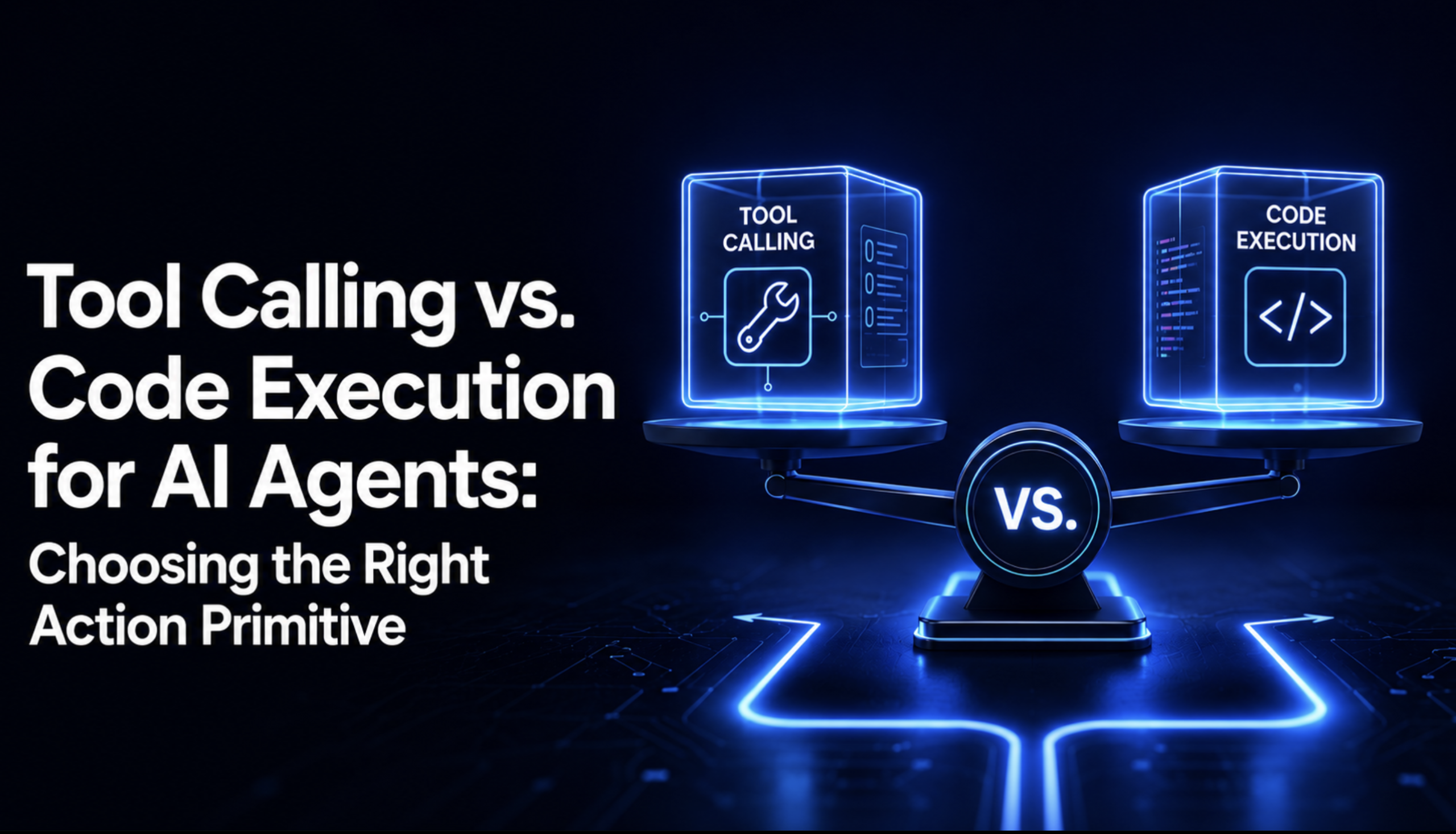
Tool Calling vs. Code Execution for AI Agents: Choosing the Right Action Primitive

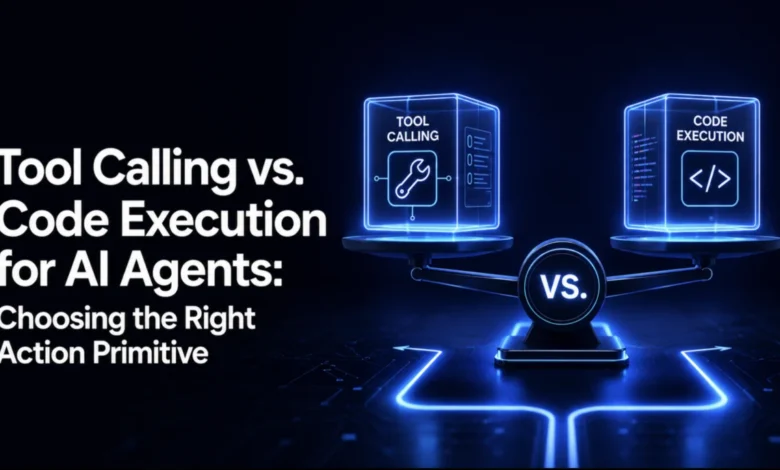
In the rapidly evolving landscape of artificial intelligence, the transition from simple chatbots to autonomous agents is defined by how these systems interact with the real world. An action primitive serves as the fundamental mechanism through which a large language model (LLM) exerts influence over external systems—whether that involves querying a database, initiating an API request, or manipulating local files. As developers move beyond rudimentary prototypes, the choice between "tool calling" and "code execution" has emerged as a critical architectural decision that dictates the efficiency, cost, and reliability of AI agents.
To understand the stakes, consider a high-volume enterprise scenario: an agent tasked with auditing the travel expenses of twenty employees across a single fiscal quarter. A traditional tool-calling approach would require the model to initiate twenty individual requests for expense records. Each call returns a voluminous payload of line items—flights, hotel stays, and meals—which are then forced into the model’s context window for analysis. This process can generate upwards of 2,000 line items and 50KB of raw data that the model does not necessarily need to "read" as text; it merely needs to perform a mathematical aggregation. This inefficiency is the "hidden tax" of improper architectural design, leading to bloated token usage, increased latency, and a higher probability of arithmetic errors.
The Evolution of Action Primitives
The field of agentic workflows has undergone a distinct chronological shift since 2024. Early implementations relied almost exclusively on standard tool calling, a method where the model is prompted to output a structured JSON payload. A host application intercepts this signal, executes the requested function, and feeds the result back into the model’s conversation history. This method is praised for its transparency and ease of debugging, as every interaction is logged as a distinct, traceable event.
However, as agentic tasks grew more complex, researchers identified a "bottleneck of reasoning." In November 2025, the release of advanced programmatic tool-calling features marked a departure from the one-step-at-a-time paradigm. By allowing models to write and execute scripts within sandboxed environments, developers could offload the heavy lifting—loops, conditional logic, and data processing—to a deterministic runtime. This shift mirrors the findings of the 2024 "CodeAct" research paper, which demonstrated that agents capable of generating and executing code outperformed standard JSON-based agents by as much as 20% on complex multi-step benchmarks.
Mechanics of Tool Calling
Standard tool calling operates as a synchronous loop. When a model encounters a query requiring external data, it pauses its natural language generation and emits a special sequence of tokens. These tokens act as a bridge, signaling to the host application that a specific tool, such as a weather API or a CRM lookup, must be invoked.
The primary strength of this method is "human-in-the-loop" auditability. Because every intermediate result is returned to the model as a text-based input, developers can inspect the exact state of the conversation at any point. This is ideal for tasks requiring human verification or complex, qualitative decision-making where the model needs to "reason" over the data it retrieves. However, this visibility is also its weakness; if the result of an API call is massive, the model must expend significant computational resources and token credits just to parse the raw data, which can lead to "context window drift," where the model loses track of the initial objective due to the sheer volume of supporting information.
The Rise of Programmatic Code Execution
Code execution represents a fundamental shift in responsibility. By utilizing a sandboxed environment—frequently implemented via patterns like Anthropic’s Model Context Protocol (MCP)—the agent is no longer limited to requesting single, static actions. Instead, it is granted the ability to write a full Python or TypeScript script.
When an agent is equipped with the "allowed_callers" capability, it can generate code that executes multiple tasks, performs data filtering, and computes aggregates before returning a single, concise result to the user. The crucial distinction is that the vast majority of intermediate data never touches the model’s active memory. In the context of the fifteen-city weather analysis mentioned previously, the model simply writes a loop to fetch the data, calculates the average in the sandbox, and provides the final answer. This reduces the cognitive load on the LLM and minimizes the token count, effectively keeping the "working memory" of the agent clean and focused.
Quantitative Analysis and Performance Metrics
The shift toward code-based orchestration is supported by substantial empirical data. According to internal benchmarks released by Anthropic, transitioning from standard tool use to programmatic execution resulted in a 37% reduction in token consumption during complex research tasks. More importantly, the accuracy of these agents rose from 46.5% to 51.2% on the GAIA benchmark, a standardized test designed to measure the capability of AI agents to solve real-world problems.
These figures indicate that the benefit is not merely financial. By moving logic into code, developers eliminate the "arithmetic tax" models pay when forced to perform calculations in natural language. Models, by their nature, are probabilistic predictors of text; they are fundamentally ill-equipped for rigorous multi-step arithmetic. Code execution delegates these tasks to a deterministic interpreter, which is mathematically precise and immune to the "hallucinations" that can occur when a model tries to sum long lists of integers in its head.
Infrastructure and Operational Implications
Despite the clear performance gains, code execution introduces new infrastructure requirements. Implementing a secure, sandboxed environment is a non-trivial engineering challenge. Unlike standard tool calling, which can be implemented with a simple Python function wrapper, code execution requires a robust sandbox—such as a Docker container or a WebAssembly (Wasm) runtime—to prevent the generated code from accessing unauthorized system resources.
For teams lacking existing sandboxing infrastructure, the overhead of implementing these safety measures may outweigh the benefits for simpler projects. Furthermore, debugging becomes significantly more complex. When an agent fails, the developer must determine whether the failure occurred in the model’s reasoning, the generated code, or the environment in which the code was executed.
Strategic Decision Framework for Development Teams
To navigate this choice, organizations should evaluate their specific use cases against a clear set of criteria:
- Complexity and Volume: For single-shot lookups or simple queries, tool calling remains the industry standard due to its simplicity and low latency. For high-volume data aggregation or "fan-out" tasks, code execution is the clear winner.
- Data Sensitivity: If the task involves sensitive personal identifiable information (PII), keeping that data within a controlled, ephemeral sandbox rather than pushing it into the model’s prompt history is a significant security advantage.
- Reasoning vs. Computation: If the goal is for the model to analyze nuances within a document, use tool calling. If the goal is to perform calculations or organize data, use code execution.
- Auditability: If the business requirements mandate a strict log of every single action for compliance, the transparent nature of tool calling is preferable.
The Hybrid Future
The prevailing trend in production-grade AI is the adoption of a hybrid architecture. The most sophisticated agents do not treat tool calling and code execution as mutually exclusive options but as modular components in a larger toolkit. Modern agentic frameworks now allow for the dynamic selection of the appropriate primitive based on the specific sub-task at hand.
As the industry matures, we are likely to see the emergence of "meta-agents" that possess the intelligence to self-select their own primitive. An agent might start a query with a standard tool call to search a database, realize the results are too large to process, and then automatically spawn a sandboxed code-execution session to aggregate the findings.
Ultimately, the choice of an action primitive is an engineering decision, not a philosophical one. It represents the maturation of AI agents from "chatbots that can call APIs" to "intelligent systems that can orchestrate complex workflows." By understanding the mechanical differences between tool calling and code execution, developers can build more resilient, cost-effective, and capable systems that turn the raw potential of large language models into tangible, reliable business outcomes. The future of the agentic web will not be defined by which model is more intelligent, but by which agent can interact with the digital world with the greatest efficiency and the fewest errors.